

Every year, reminders go out before the IRAS filing deadline in mid-April, and every year some people still miss it. If you have a missed tax filing deadline on your hands, the good news is that the fix is usually straightforward, provided you act quickly.
This guide is for individual taxpayers, not companies. It explains what happens after the deadline passes, what an estimated assessment and a composition fine are, and how to file late or ask for more time. It is general information, not tax advice. Deadlines, penalties and processes can change, so always check the current details on the IRAS website or with IRAS directly.
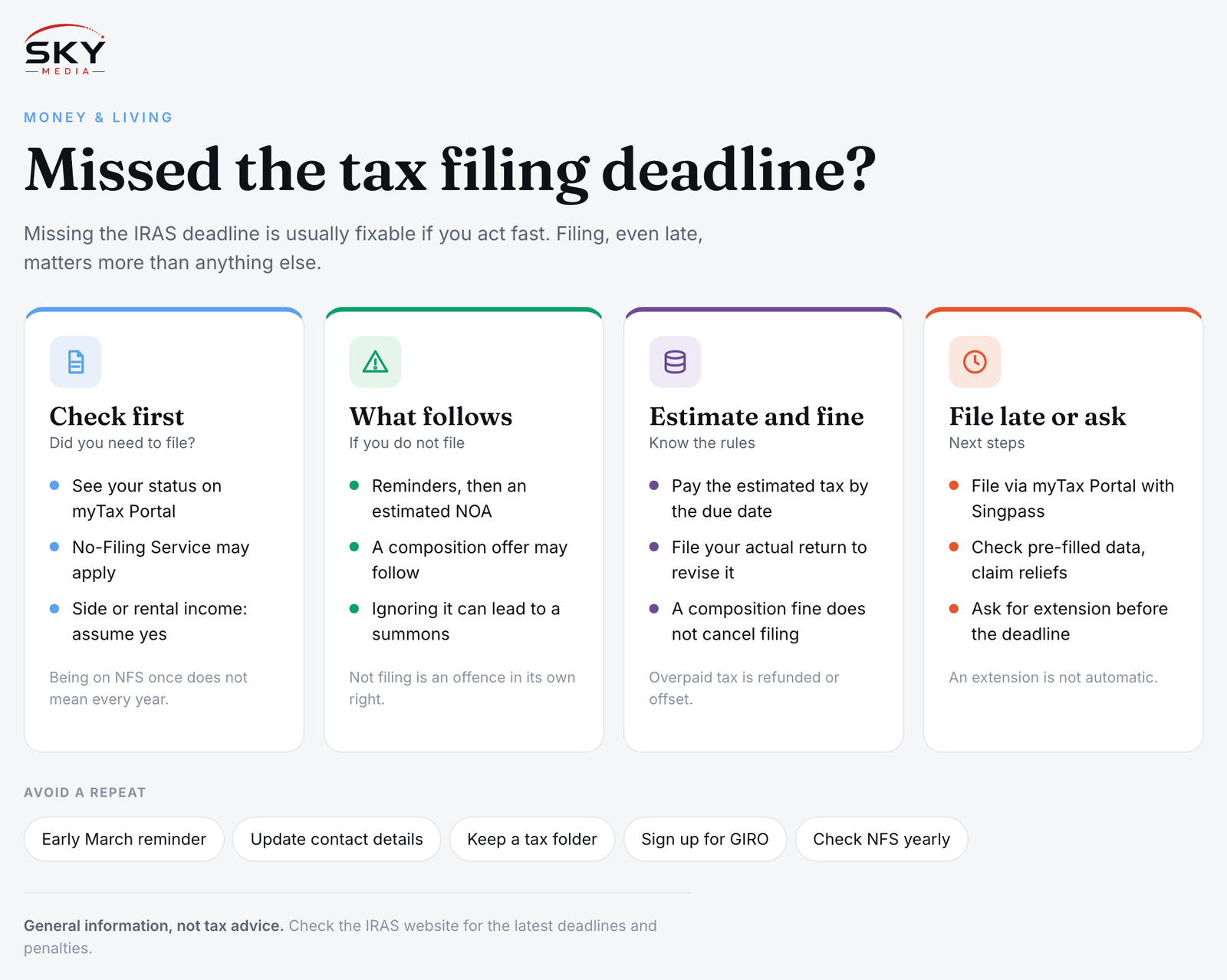
First, Confirm You Actually Needed to File
Many employees are on the No-Filing Service (NFS), where IRAS prepares the assessment using information already sent in by employers. If you were selected for NFS and have nothing extra to declare, there may be nothing for you to file. Our guide to the IRAS No-Filing Service explains how to check.
To confirm your status:
- Log in to myTax Portal (the IRAS online portal, accessed with Singpass) and look at your notices and filing status for the current Year of Assessment (YA).
- Check for letters or SMS notifications from IRAS telling you to file.
- If you have self-employed, rental or other income your employer does not report, assume you need to file.
If you were required to file and did not, read on.
What Happens After You Miss the Deadline
The general sequence for individuals tends to look like this, though steps and timing depend on your case:
- Reminders. IRAS may send a reminder letter or notification asking you to file by a new date.
- Estimated assessment. If you still do not file, IRAS can raise an estimated Notice of Assessment (NOA) based on the information it has, such as past income or employer records. This estimate may be higher than what you actually owe.
- Composition offer. IRAS may offer to compound the offence of not filing. A composition amount is a fine you pay to settle the matter without going to court.
- Summons. If you ignore the above, IRAS can take legal action, which may result in a court summons and fines set by the court.
Failing to file is treated as an offence in its own right, separate from any tax you owe. That is why filing, even late, matters more than anything else.
Understanding an Estimated Assessment
Because IRAS does not have your full return, the estimate may not include reliefs you are entitled to, and it may assume more income than you earned.
Key points to know:
- You still have to pay the estimated tax by the due date shown, even if you think the figure is wrong. Late payment can lead to separate late payment penalties.
- To replace the estimate, file your actual return. IRAS generally treats a return filed after an estimated assessment as your basis for revising it, but there is a time window to do this. Check the period stated on your NOA and on the IRAS website.
- If your actual tax is lower, IRAS will revise the assessment and refund or offset any overpayment.
Understanding a Composition Fine
A composition fine is an offer from IRAS to settle the late filing offence. Paying it closes that particular offence, but it does not remove your obligation to file. You must still submit your return.
The composition amount depends on factors such as how late you are and your filing history. IRAS publishes the general approach on its website. Do not ignore a composition offer: if it is not paid and the return is not filed, the matter can go to court, where penalties can be heavier.
If you had a genuine reason, such as serious illness, you can write to IRAS to explain and ask for the composition to be reviewed.
How to File Late, Step by Step
Filing late uses the same channel as filing on time. For most people, that is myTax Portal.
- Log in to myTax Portal with Singpass.
- Open the individual income tax return for the relevant YA. If it is no longer available as a standard e-filing option, look for instructions in your IRAS letter or contact IRAS.
- Check the pre-filled data. Employment income from employers on the Auto-Inclusion Scheme (AIS) is usually already there. Add anything missing, such as rental income, freelance income or foreign income that is taxable.
- Claim your reliefs. Many reliefs carry over automatically, but check that qualifying ones are included.
- Submit and save the acknowledgement page.
- Pay any composition fine separately if you received an offer.
- Watch for your revised NOA and pay any balance by the due date.
If you changed jobs during the year, the AIS data may come from more than one employer. Our article on filing income tax after changing jobs mid-year covers what to check.
Asking for More Time Before the Deadline Passes
If the deadline is approaching and you know you cannot make it, ask for an extension before the due date rather than after. IRAS considers requests from individuals on a case-by-case basis, and a request is more likely to be considered if you have a good reason, such as:
- Waiting for documents from an overseas employer or bank
- Being hospitalised or caring for a seriously ill family member
- Being overseas for an extended period without reliable access
You can usually make a request through myTax Portal or by contacting IRAS through its official channels. Include your tax reference number, the YA, the reason and the date by which you can file. An extension is not automatic, so do not assume one has been granted until IRAS confirms it.
Filing Late vs Ignoring It: How Outcomes Compare
| Situation | What usually happens | What you should do |
|---|---|---|
| File a few days late, before IRAS acts | Return is processed; IRAS may still take note of lateness | File immediately and keep proof of submission |
| Receive an estimated NOA | You must pay the estimate by the due date | Pay on time, then file your actual return within the stated window |
| Receive a composition offer | Fine settles the offence only, return still due | Pay the composition and file the return |
| Ignore all notices | Possible summons and court-imposed penalties | Contact IRAS at once and file without further delay |
| Ask for extension before deadline | IRAS decides case by case | Apply early, with reasons, and wait for confirmation |
Common Reasons People Miss the Deadline
- Outdated contact details. Update your mailing address and mobile number with IRAS so notices reach you.
- Assuming NFS applies. Being on NFS one year does not guarantee it the next. Check every year.
- Newcomers unfamiliar with the system. If this is your first year in Singapore, our guide to income tax filing for newcomers walks through the basics.
- Side income. Freelance, platform or rental income often means you must file, even if your main job is on AIS.
Preventing a Repeat Next Year
- Set a calendar reminder in early March to log in to myTax Portal and check your status.
- Keep a simple folder, physical or digital, for documents such as rental agreements, donation receipts and freelance invoices.
- Sign up for GIRO with IRAS so tax payments go out automatically once your NOA is issued.
- Review the common income tax filing mistakes before you submit, so you do not need to correct things later.
The Bottom Line
A missed deadline is not the end of the world, but it does not go away on its own. File as soon as you can, pay any estimated tax and composition fine on time, and speak to IRAS early if you have a genuine reason for the delay. For the latest deadlines, penalty amounts and procedures, go straight to the IRAS website, which is the only authoritative source.
Official sources: IRAS
Further reading: How to Revise Your Income Tax Return After Filing · A Small Business Compliance Calendar: Key Filing Deadlines in Singapore · Paying Your Income Tax by GIRO Instalments in Singapore