
Watching a rocket you built streak into the sky and drift back under a parachute is a genuine thrill, and it explains why model rocketry has captured curious minds for generations. Model rocketry in Singapore is a hands-on hobby that blends craft, physics, and a dash of adventure, but it is one where safety and the rules come first, always, before the fun. Done responsibly, with the right kit and the right approach, it is a rewarding way to learn how flight really works.
Safety Comes Before Everything
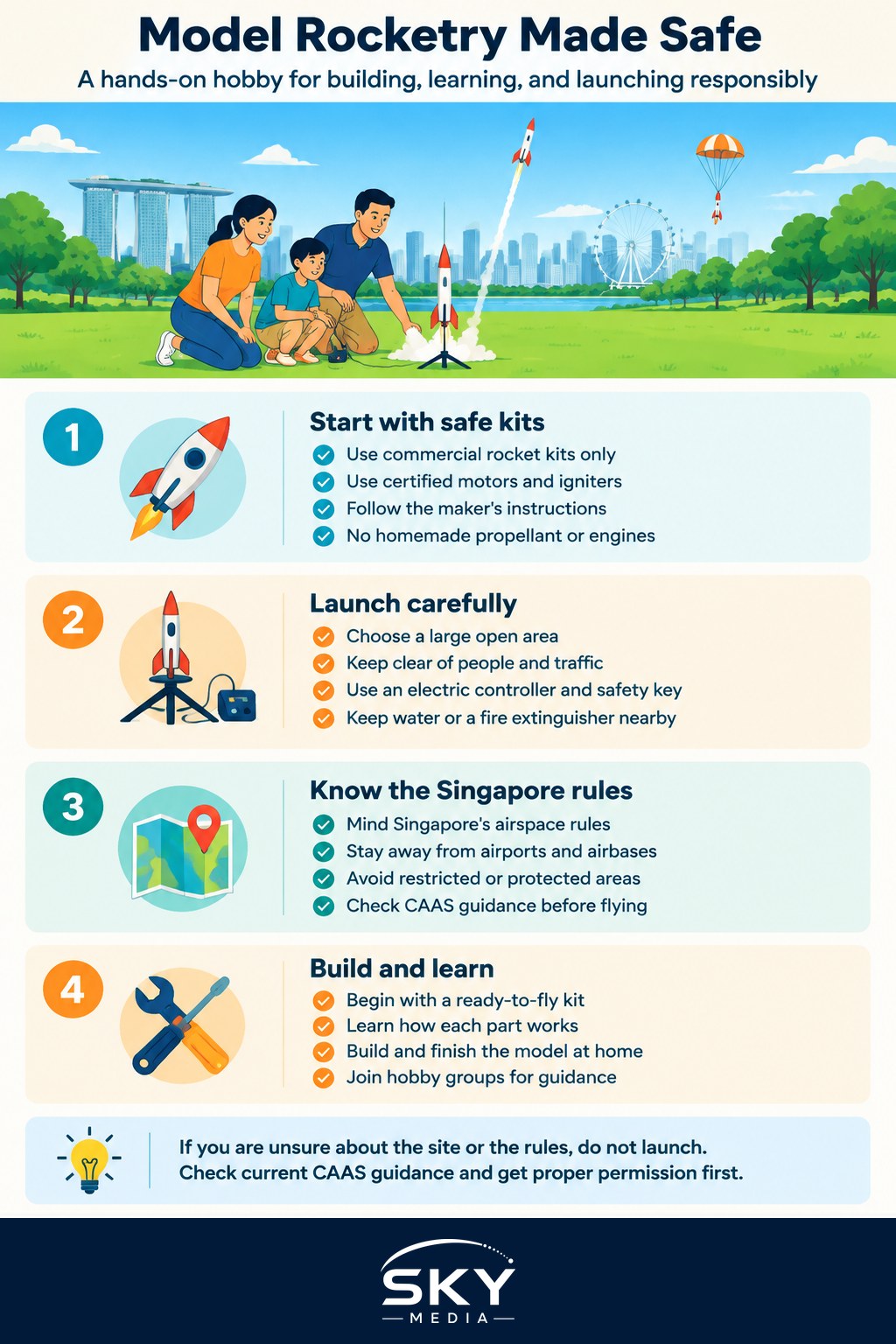
Let us be completely clear at the outset, because this is not a hobby to improvise. Model rocketry involves small motors that burn hot and launch fast, so the golden rule is to use commercial, purpose-made kits and motors and to follow an established model rocketry safety code rather than making your own propellant or engines. Homemade motors and improvised chemicals are dangerous and have no place in a beginner’s hobby.
A few principles keep model rocketry safe, and experienced flyers treat them as non-negotiable.
- Use only commercially manufactured rocket kits and certified motors, and follow the manufacturer’s instructions exactly.
- Launch only in a safe, large, open area, well clear of buildings, dry grass, trees, people, and traffic, and only with permission to use that space.
- Fire electrically from a safe distance using a launch controller with a removable safety key, never with a fuse held by hand.
- Have a fire extinguisher or water on hand, wait before approaching a rocket that did not launch, and never point a rocket at anyone.
- Children must always be supervised by a responsible adult for building and, especially, launching.
Treat these as the price of entry. If you cannot meet them, it is not the day to launch.
Understanding Singapore’s Airspace and Legal Rules
This part matters as much as the safety code, because Singapore is small, dense, and tightly regulated in the air. Anything that flies here can fall under the Civil Aviation Authority of Singapore’s rules, and you must never assume an open field is automatically fair game.
Before you even think about launching, understand that you should mind Singapore’s airspace regulations and never launch anywhere near an airport, airbase, or any restricted or protected area. Rockets climbing into airspace used by aircraft are a serious hazard, so proximity to aviation is an absolute no. Requirements can also apply to activities that send objects into the air, and the sensible, responsible path is to check the current CAAS guidance and any permissions needed before flying, rather than guessing. Because suitable, permitted open space is genuinely limited on our island, many local enthusiasts focus on building, learning, and connecting with organised groups who understand where and how flying can be done legally. When in doubt, do not launch, and seek proper guidance first.
Getting Started the Right Way
The building side of model rocketry is safe, absorbing, and a lovely craft in its own right, and it is the perfect place for a beginner to start. A basic beginner set usually includes a rocket kit, a launch pad, and a controller, and these are designed to work together safely.
- A beginner rocket kit, ideally a ready-to-fly or easy-assembly model with a low-power motor.
- The matching launch pad and electrical controller with a safety key.
- Certified motors, igniters, and recovery wadding as specified by the kit.
- Basic craft tools, glue, and paint for assembly and finishing.
Spend your early time building carefully, learning how the nose cone, body tube, fins, and recovery parachute work together. This is satisfying model-making that you can enjoy fully at home. If you love that constructive side, you will find kindred pleasure in a beginners guide to model building and the tinkering mindset of electronics and arduino projects, which pairs well with understanding launch electronics.
Learning, Community, and Improving
Because launching responsibly in Singapore takes planning and space, connecting with others is the single best move a beginner can make. Established hobby communities and interest groups can point you to how enthusiasts here approach the rules, safe practices, and any organised, supervised opportunities. Learning from people who already fly correctly is far safer than working it out alone.
Keep reading, keep building, and treat every launch as a checklist to complete rather than a shortcut to rush. The physics is genuinely rewarding to understand, and the same patient, precise mindset carries over into other technical hobbies. Those who enjoy the engineering flavour often also like 3d printing as a hobby for making parts and stands.
A Grounded Wrap-Up
Model rocketry is a hobby that rewards respect, and the enthusiasts who enjoy it for decades are the ones who never cut corners on safety or the law. Use commercial kits and motors, follow the safety code, mind CAAS airspace rules and stay far from airports, launch only in safe, permitted open areas, and keep children supervised. Get those foundations right, and the moment your rocket lifts off and floats gently back to you will feel every bit as magical as you hoped.
Frequently Asked Questions
Where can I legally launch a model rocket in Singapore? There is no simple answer, because suitable, permitted open space is genuinely limited here. Never assume an open field is fair game, and stay far from airports, airbases and restricted areas. Check the current CAAS guidance and any permissions needed first, and when in doubt, do not launch.
Is it enough to just build model rockets without launching them? Yes, and that is where many local enthusiasts focus. Building is safe, absorbing craft work, and you learn how the nose cone, body tube, fins and parachute work together. You can enjoy the hobby at home and join organised groups for supervised flying opportunities.
Can I make my own rocket motors or fuel to save money? No. Homemade motors and improvised chemicals are dangerous and have no place in a beginner’s hobby. Use only commercially manufactured kits and certified motors, and follow the manufacturer’s instructions exactly. Following an established model rocketry safety code is the safest way to learn.
What should I buy in a first model rocket set? Look for a beginner rocket kit, ideally ready-to-fly or easy-assembly with a low-power motor, plus a matching launch pad and an electrical controller with a safety key. You will also need certified motors, igniters and recovery wadding as the kit specifies, along with basic craft tools, glue and paint.
Is model rocketry suitable for children? It can be, provided a responsible adult supervises both building and launching. Younger children can enjoy the assembly side, while launching needs a safe, large, open area and a launch controller used from a safe distance. Never point a rocket at anyone, and wait before approaching one that did not launch.