
An international move is a big project on its own. Doing it with a baby on the way adds deadlines that do not move: airline cut-offs, insurance waiting periods and the need for continuous antenatal care. If you are moving to Singapore pregnant, the good news is that the city has excellent maternity care. The challenge is getting the timing, paperwork and cover lined up before you land.
This guide covers the period between deciding to move and your first appointments in Singapore. It is general information, not medical or immigration advice. Always follow your own doctor’s guidance and confirm pass requirements with the Ministry of Manpower (MOM) and the Immigration and Checkpoints Authority (ICA).
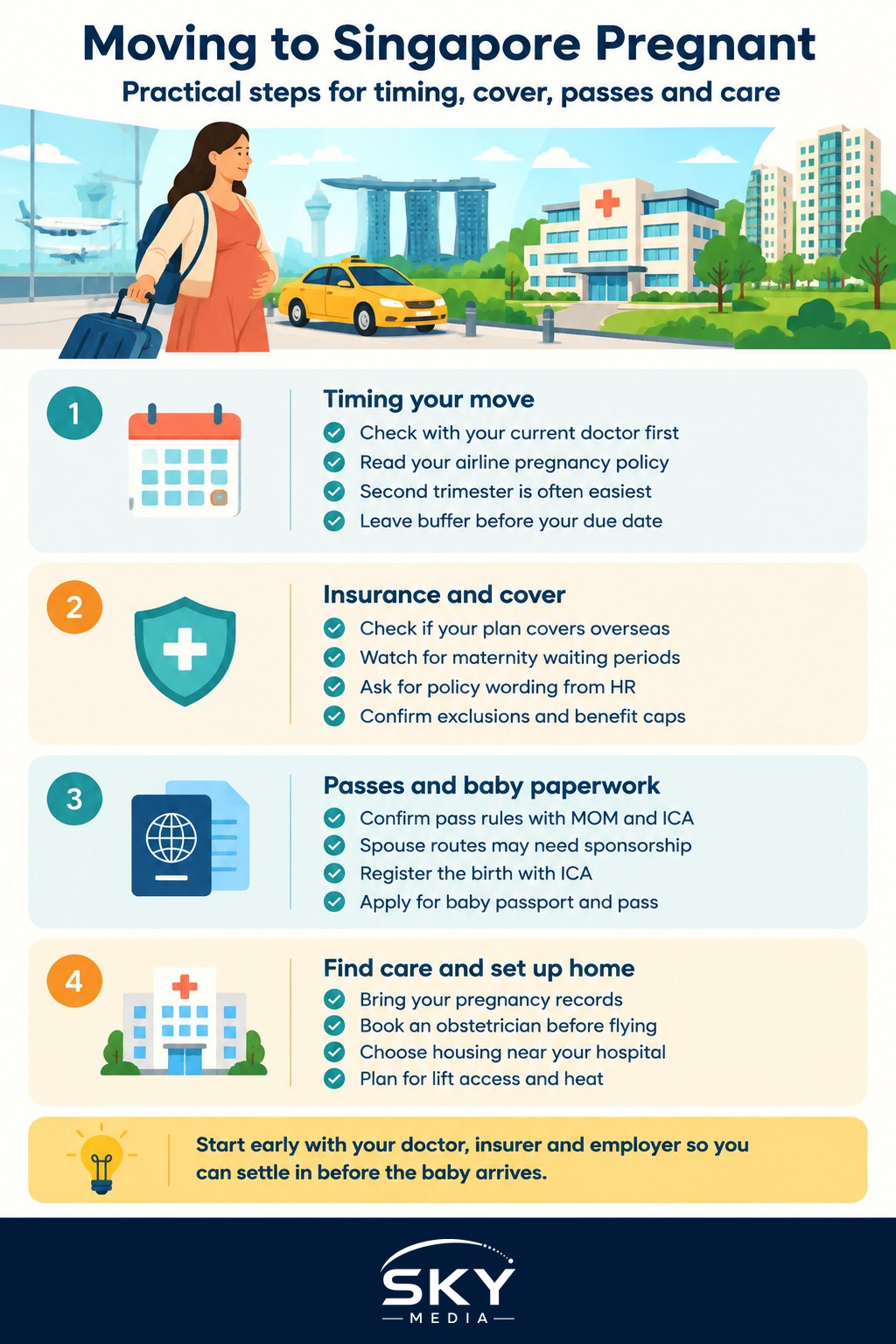
Getting the Timing Right
When you fly matters more than almost anything else on your checklist.
- Talk to your current doctor first. Ask whether there is any reason you should not fly, what stage they consider safest for you, and for a written summary of your pregnancy so far.
- Check your airline’s pregnancy policy. Most carriers set a cut-off week after which they will not carry you, and many ask for a doctor’s letter after a certain point. Policies differ, so read the exact rules for your airline and route, including any connecting flights.
- Consider the middle trimester. Many doctors regard the second trimester as the most comfortable time to travel, but this is a medical decision for you and your doctor.
- Leave buffer before your due date. Arriving too close to delivery leaves little time to build a relationship with a new obstetrician or to register at a hospital.
Our guide to travelling while pregnant has more on comfort and safety on the flight itself.
Health Insurance and Maternity Waiting Periods
This is the area where newcomers most often get caught out.
Many health insurance plans that include maternity benefits apply a waiting period, meaning the policy must have been in force for a set number of months before pregnancy-related costs are covered. A pregnancy that already exists when you buy a policy is often treated as a pre-existing condition and excluded. Buying a new individual plan after you have found out you are pregnant may therefore not cover this birth.
Questions to work through:
- Does your current insurer cover you overseas? Some international plans continue when you relocate, which may be your best route if your waiting period has already passed.
- What does your new employer’s group plan offer? Ask HR for the policy wording, not a summary. Check whether maternity is included, whether a waiting period applies to new joiners, and whether spouses are covered.
- What is excluded? Look at complications, premature delivery, newborn care and neonatal intensive care, which can be the most expensive parts.
- Is there a cap? Maternity benefits often have a fixed limit that may be well below actual hospital bills.
As a foreigner, you will generally not have access to the subsidies and schemes that Singapore citizens use for hospital bills, so you may pay full private or non-subsidised rates. Ask hospitals for estimated package costs in writing and keep a savings buffer for anything insurance does not cover.
Your Pass and Your Spouse’s Pass
Your immigration situation shapes your access to care and your baby’s status.
- If you are the main pass holder, your work pass comes through your employer and MOM. Ask your employer early about leave arrangements and how they apply to your situation. Our guide on working through your pregnancy covers the practical side of managing work.
- If you are joining a spouse, you will usually need a Dependant’s Pass or another pass sponsored through the main pass holder. Apply in good time, as you will need your pass in hand to set up local services smoothly.
- Maternity leave entitlements depend on your employment terms and the rules that apply to your contract. Check MOM’s website and your contract rather than assuming home-country rules carry over.
What happens after the baby is born
A baby born in Singapore to two foreign parents does not automatically become a Singapore citizen. In broad terms you will need to:
- Register the birth with ICA within the required time after delivery. Hospitals usually guide you on this.
- Apply for your baby’s passport through your home country’s embassy or consulate in Singapore. Check processing times early, as they vary widely.
- Apply for the baby’s pass, usually a Dependant’s Pass through MOM if the main pass holder is eligible, or another long-term pass through ICA. There is a deadline for regularising your baby’s stay, so confirm the current rules with MOM and ICA well before your due date.
Plan for this paperwork during late pregnancy, when you have more energy, rather than in the first weeks with a newborn.
Finding an Obstetrician and a Hospital
Singapore has both public hospitals and private hospitals that deliver babies, and many obstetricians practise in private clinics attached to or near a hospital where they deliver.
Steps to find the right fit:
- Bring your records. Ultrasound reports, blood test results, vaccination history and your doctor’s summary, ideally in English or with a translation.
- Ask for recommendations. Colleagues, parent groups and your insurer’s panel list are good starting points.
- Check where the doctor delivers. Your choice of obstetrician usually decides your hospital, and your insurer may only cover certain hospitals or panel doctors.
- Book your first appointment before you fly. Many clinics accept bookings by email or phone from overseas, which avoids a gap in antenatal care.
- Ask practical questions. Who covers if your doctor is away? What is the approach to birth plans, pain relief and caesarean sections? Is there a package price, and what does it include?
| Stage of pregnancy at move | Main priorities | Watch out for |
|---|---|---|
| First trimester | Confirm insurance cover, plan pass applications, find an obstetrician | Waiting periods, early scans you may need to arrange quickly |
| Second trimester | Fly within your doctor’s guidance, settle housing, register with a hospital | Airline letter requirements, booking antenatal tests on time |
| Third trimester | Only travel if your doctor and airline agree, finalise hospital and paperwork | Airline cut-off weeks, limited time to change doctors |
| After birth | Register birth, get baby’s passport and pass | Pass deadlines, embassy processing times |
Setting Up Your New Home Around the Pregnancy
A few choices make the last months much easier:
- Housing near your hospital. Short travel time to your obstetrician and delivery hospital matters more than usual. Consider a short-term rental first if you are unsure of neighbourhoods.
- Lift access and layout. Stairs, long walks from the car park and older buildings without lifts become harder late in pregnancy and with a pram.
- Air-conditioning and heat. Singapore’s heat and humidity can be tiring. Stay hydrated and plan outdoor errands for cooler parts of the day.
- Getting around. Ride-hailing and taxis are easy to book, which helps for appointments. If you plan to drive, read our tips on driving safely while pregnant.
- Support network. Look for antenatal classes, parent groups and community associations for people from your home country. These can provide advice on everything from confinement practices to baby gear.
A Simple Pre-Move Checklist
- Doctor’s letter confirming fitness to fly and expected due date
- Full set of pregnancy records, with translations if needed
- Written confirmation of insurance cover, including maternity and newborn benefits
- Pass applications submitted or approved for you and your spouse
- First obstetrician appointment booked in Singapore
- Housing within easy reach of your chosen hospital
- Notes on embassy requirements for your baby’s passport
- Emergency contacts and the address of the nearest hospital emergency department
Moving while pregnant takes careful planning, but many families do it successfully. Start with your doctor and your insurer, lock in your passes and your obstetrician early, and give yourself time to settle in before the baby arrives.
Frequently Asked Questions
Can I bring my regular prescription medicines into Singapore? Some medicines are restricted or controlled, even if they are legal elsewhere. Check HSA’s guidance before you fly, and carry a doctor’s letter and the medicine in its original packaging. Do not post controlled medicines to yourself without checking the rules.
How soon after arriving should I see an obstetrician? As soon as practical. Booking the first appointment before you fly avoids a gap in antenatal care, and you can bring your records and scan reports to that visit. Your doctor will advise the schedule for the rest of the pregnancy.
Is tap water and local food safe during pregnancy in Singapore? Tap water in Singapore is generally drinkable, and food hygiene standards are high, but normal pregnancy food-safety advice still applies, such as avoiding raw or undercooked items. Ask your obstetrician for the dietary guidance that fits your situation.
Should I move now or go home to give birth? It depends on your health, insurance, support network and work situation. Discuss with your doctor, check what your insurance covers in each country, and weigh the airline cut-off rules. There is no single right answer for every family.
What postnatal help is available for newcomers without family nearby? Options include confinement services, postnatal nurses and parent groups, as well as community associations for people from your home country. Ask your obstetrician or hospital what support they offer, and plan this before your due date.