

The fish stall is often the busiest, wettest and most confusing corner of a Singapore wet market. Fish are laid on ice, prices are chalked or printed on small boards, and the fishmonger fires off quick questions while scaling the last customer’s order. If you are new to Singapore, knowing how to order fish at a wet market makes the whole experience easier and gets you exactly the cut you need for dinner.
This guide goes deeper than general wet market tips. It covers choosing fish by dish, judging freshness, asking for cleaning and cutting, and understanding what the seller is likely to ask you. For the basics of market layout, timing and etiquette, start with our guide on how to navigate wet markets in Singapore.
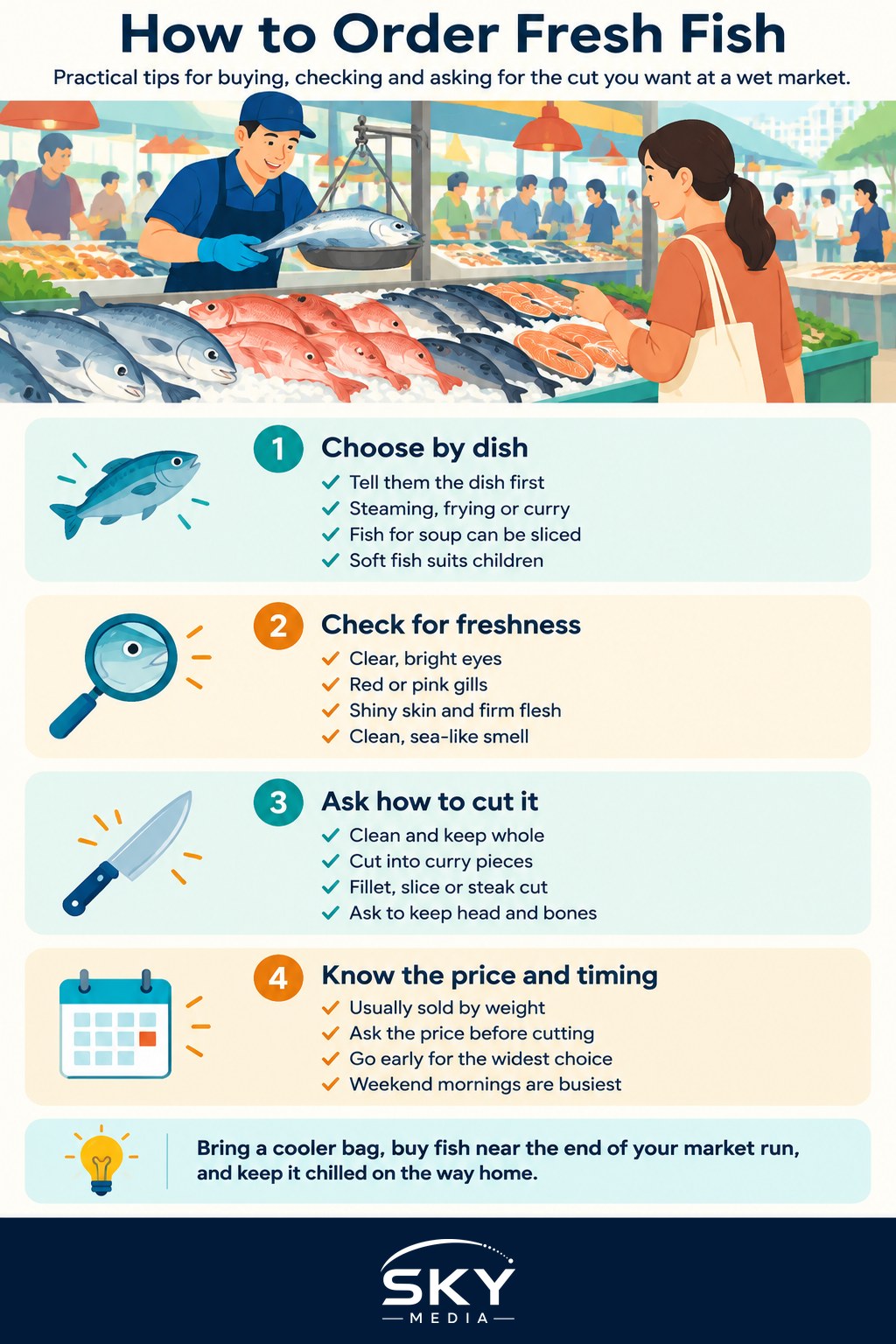
Start With the Dish, Not the Fish
Fishmongers are used to customers who say what they want to cook. Telling them “I want to steam fish for two people” is often more useful than naming a species. They will usually point you to suitable fish and suggest a size.
Common pairings you will hear at Singapore stalls:
- Steaming, Teochew or Cantonese style: white pomfret, red snapper, sea bass (often called siakap in Malay), grouper.
- Pan-frying or deep-frying whole: smaller fish such as selar (yellowtail scad), kembong (Indian mackerel), and small snappers.
- Fish curry or asam pedas: firm, meaty fish such as batang (Spanish mackerel), red snapper pieces or a large fish head.
- Fish slices for soup or porridge: batang, threadfin (ikan kurau) or grouper, sliced thinly.
- Children or picky eaters: threadfin and pomfret are popular because the flesh is soft and bones are easier to manage.
If you want to learn the names and textures of local fish before your trip, our guide to fish and shellfish types is a helpful reference.
Checking Freshness Before You Point
Even at a busy stall, take a few seconds to look closely. Fresh fish usually shows these signs:
- Clear, bright, slightly bulging eyes. Cloudy or sunken eyes suggest the fish is older.
- Red or pink gills. Ask the fishmonger to lift the gill cover if you are unsure. Brown or grey gills are a warning sign.
- Shiny, moist skin with scales firmly attached.
- Firm flesh that springs back when pressed. Many sellers will press it for you if you ask.
- A clean, sea-like smell, not a strong, sour or ammonia smell.
For pre-cut steaks and slices, look for moist, translucent flesh without dry edges or discolouration. If something looks off, it is perfectly acceptable to choose a different fish.
How Fish Is Priced and Weighed
Most wet market fish is sold by weight. The price board usually shows a rate per 100g or per kilogram, and the fishmonger weighs the fish whole before cleaning. That means you pay for the head, bones and guts even if you ask them to be removed. Some stalls sell certain fish per piece instead, especially small fish or pre-cut portions.
Practical tips:
- Ask for the price before cutting if no board is displayed. Prices vary with season, supply and size.
- Give a rough size or budget, for example “one fish, enough for three people” or “around this size”.
- Carry cash and a payment app. Many stalls accept digital payment such as PayNow, but some still prefer cash.
Fish prices shift often, so do not rely on prices you saw months ago.
Cleaning and Cutting: What to Ask For
This is where a fishmonger’s skill saves you a lot of mess at home. Cleaning is usually included when you buy a fish, though it is polite to say clearly what you want. The table below lists the requests you will use most.
| What to ask | What the fishmonger does | Best for |
|---|---|---|
| “Clean, keep whole” | Scales, guts and removes gills, leaves head and tail on | Steamed fish, whole fried fish |
| “Cut into pieces” or “cut for curry” | Chops into chunky bone-in pieces | Curry, asam pedas, braising |
| “Steak cut” or “cut into slices across” | Cuts thick cross-section slices through the bone | Pan-fried batang, grilled fish |
| “Fillet, no bones” | Removes the fillets from the bone, sometimes skin on | Baking, pan-searing, children’s meals |
| “Slice thin for soup” | Fillets then slices thinly | Fish soup, porridge, hotpot |
| “Keep the head and bones” | Packs head and frame separately | Fish stock, fish head curry |
A few extra requests worth knowing:
- “Score the fish” means making diagonal cuts on each side so it cooks evenly and absorbs sauce when steaming.
- “Butterfly” opens a small fish flat for grilling or frying.
- “Remove the skin” is useful for fillets if your family prefers no skin.
Questions the Seller May Ask You
Fishmongers often speak a mix of English, Mandarin, Hokkien, Teochew and Malay. Questions are short and quick, so it helps to know what to expect:
- “Steam or fry?” They are deciding how to clean and cut. For steaming they may keep it whole and score it.
- “Want head or not?” If you do not want it, say so. Many people keep it for soup.
- “Cut or whole?” Answer with the cutting style from the table above.
- “Take the bones?” For fillets, the bones and frame can be packed for stock.
- “How many people?” They are helping you choose a size.
- “Anything else?” Many stalls also sell prawns, squid, clams and crabs, and may offer to clean those too.
If you do not understand, simply point, smile and repeat your key words: “steam”, “fry”, “curry”, “fillet”. Most sellers are patient with newcomers, especially outside the busiest weekend morning rush.
Timing Your Visit
- Early morning usually offers the widest choice, since stalls are freshly stocked.
- Weekend mornings are busiest, and the queue for cleaning can be long.
- Late morning may have less variety, though some stalls offer better deals to clear stock. Do not count on this.
- Before festive periods such as Chinese New Year, demand for fish such as pomfret rises, and prices and queues often increase. Order earlier if you need a particular fish.
Bringing Your Fish Home
Singapore’s heat is unkind to fresh seafood. To keep your purchase in good condition:
- Bring an insulated bag or ask for ice if you have a long trip home.
- Make fish one of your last purchases at the market.
- Refrigerate as soon as you get home, and cook within a day or two, or freeze it.
- Rinse briefly and pat dry before cooking.
Once you have ordered a few times, you will find a favourite stall and a fishmonger who remembers what you like. That relationship is one of the real pleasures of shopping at a Singapore wet market. If you would rather start by tasting, our list of the best fish soup in Singapore shows how local cooks use many of these fish.
Further reading: Buying Live and Freshwater Fish, Chinese Style, in Singapore