
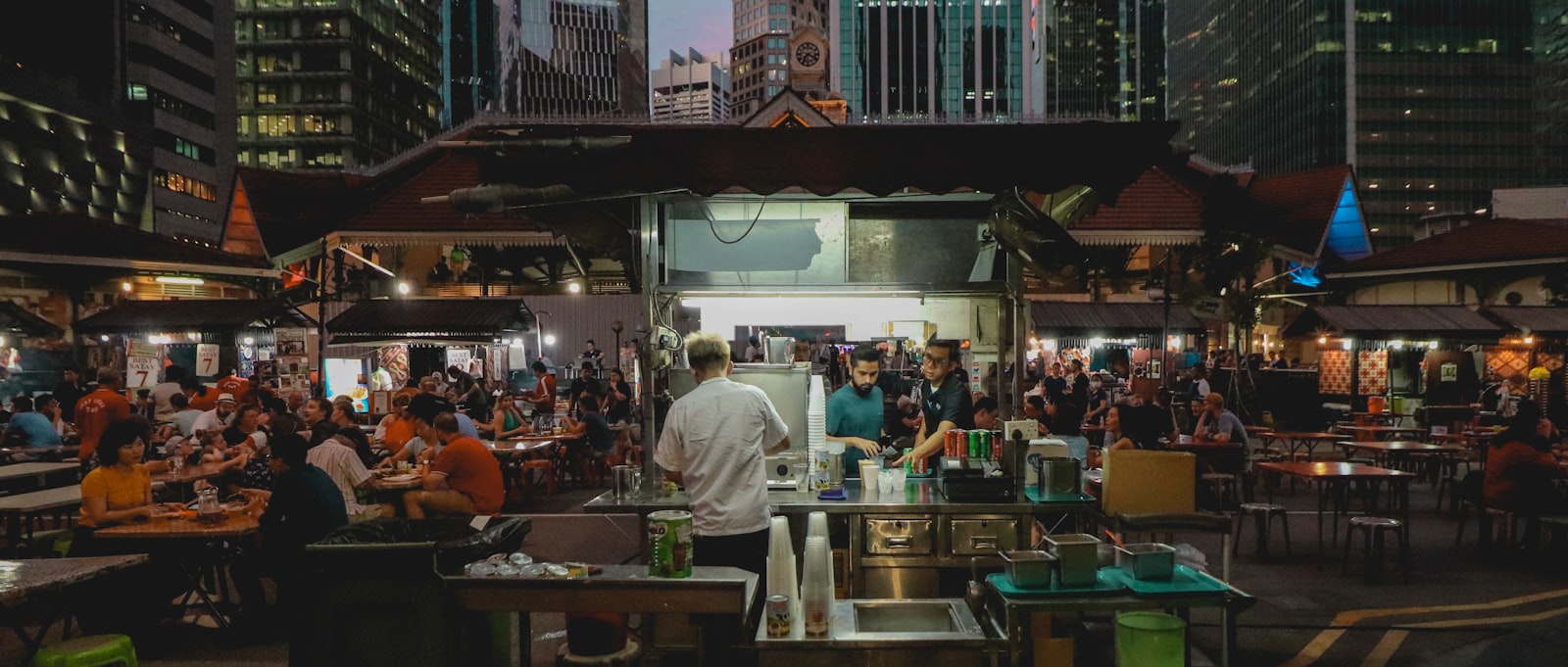
Hawker centre photography is one of the most rewarding subjects Singapore offers: steam rising off a wok, worn Formica tables, aunties ladling out laksa, all under warm tungsten light. It is also one of the trickiest, mixing low light, fast movement and real people going about their livelihoods. This guide covers the settings, the etiquette and the shots that capture the flavour of our markets without getting in anyone’s way.
Gear and settings to start with
Travel light. A big rig makes you conspicuous and slow. A single fast prime, a 35mm or 50mm equivalent, is ideal; a capable phone is genuinely fine too.
Hawker centres and wet markets are dim, so lean towards fast glass and steady technique. Sensible starting points:
- Aperture: f/1.8 to f/2.8 to gather light and lift subjects off busy backgrounds.
- Shutter speed: 1/125s minimum for still subjects, 1/250s or faster to freeze a wok toss or a chopping cleaver.
- ISO: do not be afraid of it. 1600 to 6400 is normal indoors; a slightly grainy sharp frame beats a clean blurry one.
- White balance: auto is usually fine in RAW, but expect warm tungsten and cool daylight to mix near entrances.
Shoot RAW to tame the strong orange cast of hawker centre lighting later.
Etiquette first: shoot with respect
Before any technique, understand that a hawker centre is a workplace and a home ground for the people in it. Respect comes first.
For wide atmosphere shots and food, you generally do not need to interrupt anyone. But for a close portrait of a stallholder, ask permission. A smile, a gesture towards your camera and a simple “can I take your photo?” is enough. Many uncles and aunties are happy to oblige and even pose, especially if you buy something first. If someone declines, thank them and move on without fuss.
Be unobtrusive. Do not block the queue, lean over food, or point a lens in someone’s face mid-service. Buy a drink, sit for a while, and let the place carry on around you. The best frames come when people forget you are there. Our guide on photographing Singapore festivals respectfully shares the same principle: presence without intrusion.
Capturing the food
The food is the star, so treat it well. Natural light from a nearby entrance or window is softer and truer than overhead tungsten, so a table near the edge of the centre often photographs best.
Shoot from a slight angle, around 45 degrees, for most dishes to show both the surface and the height; go top-down for flat spreads like a full table of zi char. Get in close and fill the frame with texture: the char on satay, the glossy gravy of a curry, the crackle of roast pork. For deeper technique, see how to take good food photos in Singapore.
Keep the styling honest. A hawker plate looks best as it is served, steam and all. Work fast, because steam fades and hot food dulls within a minute.
Capturing the atmosphere
Atmosphere is what separates a hawker photo from a menu photo. Look for the layers that tell the story:
- Steam and wok hei rising against a dark background, backlit by a stall light.
- Hands at work: chopping, ladling, wrapping, counting change.
- The worn textures of the place, tiled tables, plastic stools, hanging red lanterns, faded signboards.
- Wide establishing frames from a mezzanine or corner that show the sprawl and bustle.
Shoot a mix of scales, wide for context, medium for interaction, tight for detail, and you will build a set that feels like a visit rather than a single snapshot. The composition fundamentals in street photography composition tips transfer directly to the market floor.
Settings by shot: a quick reference
| Shot | Aperture | Shutter | ISO | Note |
|---|---|---|---|---|
| Bowl of noodles at the table | f/2.8 | 1/160s | 1600 | Angle 45 degrees, near the light |
| Wok toss with flame | f/2.8 | 1/500s | 6400 | Freeze the action, dark backdrop |
| Stallholder portrait | f/2 | 1/200s | 3200 | Ask first, focus on the eyes |
| Wide atmosphere from a corner | f/4 | 1/125s | 3200 | Steady, show the layers |
| Steam and detail crop | f/1.8 | 1/250s | 3200 | Backlight the steam |
Working the low light
Hawker centres are darker than they feel, so technique matters. Brace your elbows against your body or rest the camera on a table edge for slower shutter speeds. Shoot in short bursts to improve your odds of a sharp frame. Watch for the pockets of good light, a shaft of daylight by the entrance, the pool of light under a stall lamp, and position your subject within them.
Avoid on-camera flash. It flattens the scene, kills the ambient mood and draws unwanted attention. If you truly need more light, a small bounce off a ceiling is gentler, but usually a higher ISO is the better trade.
Common mistakes to avoid
- Blocking the flow. Never stand in the queue or the walkway to get a shot. Wait for a gap.
- Shooting stallholders without asking. Close portraits need consent. It is basic courtesy and gets you a warmer picture.
- Using flash. It ruins the atmosphere and annoys everyone.
- Being too slow with hot food. Steam and shine vanish quickly. Set up, then plate.
- Only shooting wide. Details and hands tell the human story. Get close, respectfully.
- Chasing clean images. Grain is part of the honest, dim mood of a hawker centre. Do not over-smooth it.
Bringing it together
Travel light, respect the people whose livelihood you are photographing, and embrace the messy warm light instead of fighting it. Ask before you shoot a face, buy a plate, sit a while, and let the market reveal itself. Do that and hawker centre photography stops being a technical struggle and becomes what it should be: a record of the sights, tastes and characters that make our food culture worth documenting.
Explore more: How to Take Good Food Photos in Singapore · Street Photography Composition Tips · Photographing Singapore Festivals Respectfully