

Children outgrow uniforms fast, and many textbooks and workbooks are used for a single year before they sit on a shelf. That makes preloved school uniforms and textbooks one of the easiest green swaps a family can make. You save money, keep usable items out of the bin, and often help another family at the same time.
The catch is that school items are specific. A uniform has to be the right school, level and design, and a textbook has to be the edition your child’s school actually uses. This guide covers where preloved items come from in Singapore, how to check them, and how to pass your own on when the year ends.
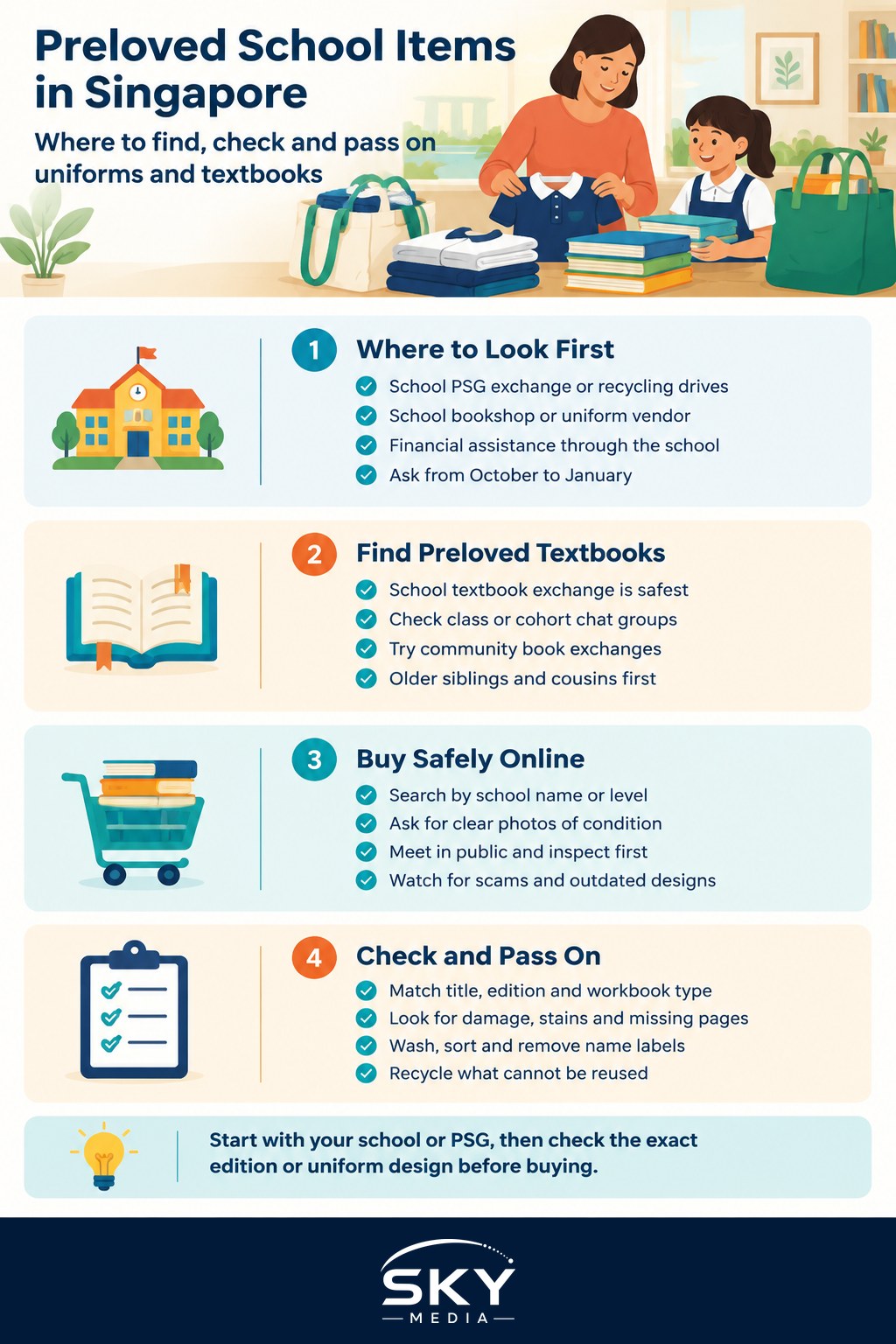
Why School Items Are Worth Buying Preloved
Uniforms are made to be tough. Shorts, skirts and pinafores are often still in good shape when a child has simply grown out of them, especially for lower primary pupils who shoot up in a single year. Textbooks are similar: many are barely used, particularly books for subjects that rely more on worksheets than on the book itself.
Buying preloved also helps when:
- A child changes school mid-year, or a family has just moved to Singapore and needs a full set quickly.
- You need extra sets for CCA days or for wet weather.
- You want spare PE attire or an extra school polo without buying new.
If you are new to the system, our guide on Singapore school uniforms for China parents explains what a typical set includes and how schools sell them.
School Uniform Exchanges and Recycling Drives
The best place to start is the school itself.
- Parent Support Group (PSG) drives. Many primary and secondary schools have a PSG, a volunteer group of parents that helps with school activities. PSGs often run uniform exchange or recycling drives, typically at the end of the school year or around the start of a new term. Parents donate outgrown uniforms, which are sorted by size and made available to other families, sometimes for free and sometimes for a small token sum that goes back to the school fund.
- The school bookshop or uniform vendor. Some schools work with their vendor to take back or resell used uniforms. Ask the general office whether this happens at your school.
- Financial assistance channels. Families who need help with uniforms and books can ask the school about support. Schools administer financial assistance schemes, including support linked to the Ministry of Education (MOE). Speak to the school’s general office or your child’s form teacher; check current schemes on the MOE website.
- Graduating cohorts. Primary 6 and Secondary 4 or 5 students finishing school are a big source of uniforms each year. Some schools collect these specifically.
Watch the school’s parent app, newsletters and notices from around October to January, which is when these drives tend to be announced. If you miss one, ask the PSG coordinator whether leftover items are kept for later requests.
Textbook Reuse Drives and Book Exchanges
Textbooks are trickier than uniforms because editions change and many books are designed to be written in.
- School book exchanges. Some schools or PSGs collect textbooks from the level above and pass them on to the next cohort. These are the safest source because the school confirms which titles and editions are still on the booklist.
- Class and cohort chat groups. Parents often offer last year’s books in class chat groups as the school year ends. Ask in your child’s level group before buying new.
- Community book exchanges. Some community centres, residents’ networks and charities hold book collection or exchange drives. Charitable organisations sometimes accept assessment books and readers for children from lower-income families. Check what they accept first, as many cannot take written-in workbooks.
- Older siblings and cousins. Still the most reliable source of all, as long as the school has not changed the booklist.
Before you buy or accept a book, compare it with the official booklist your school issues. Check the exact title, the edition or year printed on the copyright page, and whether it is a textbook (reusable) or an activity book or workbook (usually meant to be filled in). A different edition can mean different page numbers and exercises, which makes homework confusing.
Resale Groups and Online Marketplaces
Online marketplaces and Facebook or Telegram groups for specific schools or estates are another option. Search using the school name plus “uniform” or the level plus “textbooks”.
Some tips for buying from strangers:
- Ask for clear photos of the logo, size tag and any stains or wear.
- Meet in a public place, and inspect the items before paying.
- Be wary of anyone asking for payment before you have seen the goods.
- For uniforms, confirm the design is current. Schools occasionally update uniform designs or crests.
If you are selling instead, our tips on how to sell your preloved items online apply here too: honest descriptions, good light and fair pricing move items fastest.
Comparing Your Options
| Source | What to expect | Watch out for |
|---|---|---|
| School or PSG exchange | Correct school design, sizes sorted, often free or a token fee | Limited sizes, only on certain dates |
| School textbook exchange | Titles and editions matched to the booklist | Workbooks usually excluded |
| Class chat groups | Quick, local, often free from other parents | Check edition and condition yourself |
| Online marketplaces and resale groups | Wide range, including hard-to-find sizes | Scams, outdated designs, wrong editions |
| Charity and community drives | Good for readers and assessment books | May not carry school-specific uniforms |
Checking Condition Before You Buy
Uniforms
- Look at the collar, cuffs and armpits for yellowing that will not wash out.
- Check zips, buttons, hooks and elastic waistbands.
- Hold white shirts to the light to spot thinning fabric.
- Check embroidered logos are intact. Some schools sell logo patches or badges separately.
- Wash everything before use, ideally on a hot cycle if the label allows.
Textbooks
- Flip through every page for missing or torn pages.
- Check how much writing there is. Light pencil can be erased; pen answers in a textbook can distract a child doing the exercises fresh.
- Make sure any access codes for online resources are still valid, or that your child does not need them.
Passing Your Own Items On
When the school year ends, sort through uniforms and books while you still remember what is what.
- Wash and fold uniforms, sorted by size, with any name labels removed or covered. Our guide to labelling school uniforms has tips on labels that peel off cleanly.
- Group textbooks by level and subject, and note the edition.
- Offer them first to the school or PSG, then your class groups, then community drives or charities.
- Recycle what cannot be reused. Heavily written-in workbooks can go in the blue recycling bin as paper. Badly worn uniforms can go to textile collection points, or be cut into cleaning rags.
A little effort each year keeps uniforms and books in circulation for several children, and teaches kids that good things deserve a second life.
Explore more: How to Resell Your Preloved Fashion in Singapore
Frequently Asked Questions
Is it hygienic to buy preloved school shoes or PE socks? Shoes and socks are the items most people prefer to buy new, because fit and wear patterns matter for growing feet. If you take preloved shoes, inspect the soles and insoles and clean or replace the insoles. Socks and underwear are best bought new.
Do schools accept secondhand uniforms, or must everything be new? Most schools are fine with a clean, correct uniform whether it is new or preloved, as long as it matches the current design and is in good condition. Ask the general office if your school has specific requirements, such as badges sold separately.
How do I remove stubborn stains from a preloved school uniform? Soak the stained area in cool water, then treat it with a stain remover or a mild detergent before washing. Avoid hot water on protein stains, and check the care label first. Heavily yellowed collars may not fully come out, so inspect before you pay.
Where can I donate old uniforms if I cannot reach the PSG? Yes, start with the general office, which can point you to the right person or drive. Some community groups and charities also accept clean uniforms. Check what they accept first, since many can only take uniforms from specific schools.
Are preloved calculators, school bags and other supplies worth buying too? They can be, if they are in working order and meet your school’s requirements. For calculators, check that the model is on the approved list for your child’s level and exam. Bags and water bottles should be clean and sturdy, so inspect zips and seams.
Further reading: Where to Donate Old Towels, Bedsheets and Blankets in Singapore · Where to Donate Books in Singapore