

If you are in Primary 6 or in your final year of secondary school, Term 2 is the quiet turning point of your exam year. The national exams still feel far away, but this is the term when you have the most time to fix weaknesses calmly, before prelims and the final papers crowd everything else out. A good term 2 study plan is not about studying more hours. It is about using your weighted assessments to find out exactly what you do not know yet, and fixing it before the June holidays.
A note on exam names: from the 2027 cohort onwards, the GCE O-Level and N-Level exams are replaced by the Singapore-Cambridge Secondary Education Certificate (SEC). If you are a current secondary student, your national exam is likely the SEC. Many people still say “O-Levels”, so this guide uses both names. Check MOE and SEAB (the Singapore Examinations and Assessment Board) for the exact format, subjects and dates for your cohort. Our guide to the SEC exam explains the change in more detail.
Why Term 2 Is the Best Time to Fix Weaknesses
Each term in an exam year has a different job:
- Term 1: settling in, covering new content, getting a first sense of your standing.
- Term 2: more content, weighted assessments and often mid-year exams or reviews. This is your diagnostic term.
- Term 3: prelims and intensive practice. There is little time left to learn topics from scratch.
- Term 4: the national exams themselves.
By Term 3, you want to be practising and polishing, not discovering that you never really understood fractions, chemical bonding or essay structure. Term 2 gives you the space to rebuild those foundations. Our Term 3 study plan for prelims picks up where this guide ends.
Turn Your Weighted Assessments Into a Map
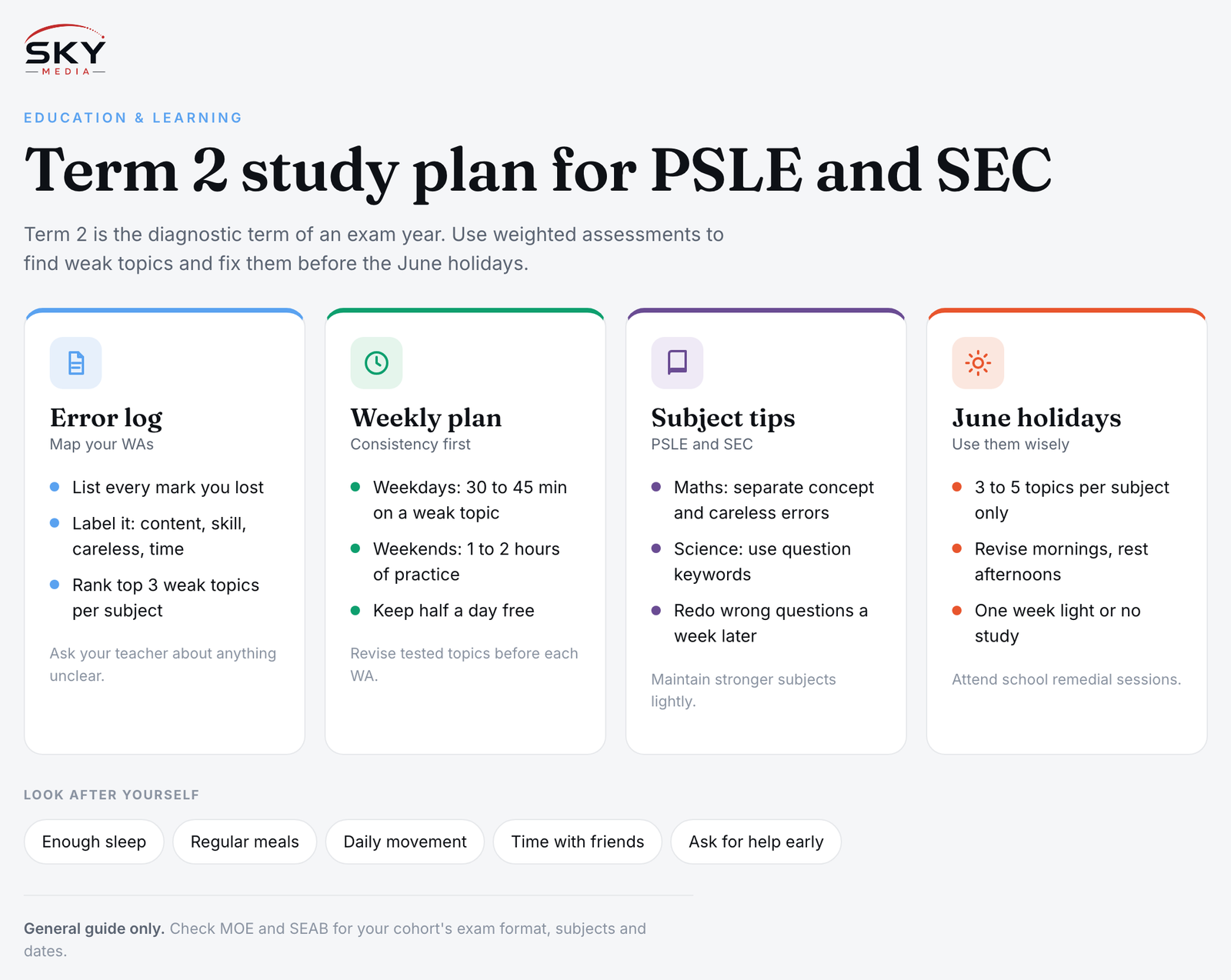
Weighted assessments (WAs) and class tests are not just marks. They are information. After each one, spend twenty minutes analysing your paper instead of filing it away.
- List every mark you lost. Go question by question.
- Label the reason. Was it a content gap (“I did not know this”), a skill gap (“I knew it but could not apply it”), carelessness, or running out of time?
- Group by topic. You will usually find that a few topics account for most lost marks.
- Rank your top three weak topics per subject. These become your Term 2 priorities.
- Ask your teacher about anything you still do not understand after checking the answers.
Keep all this in one notebook or document, your “error log”. It becomes the most valuable revision resource you own, because it is built from your own mistakes.
Building Your Weekly Term 2 Study Plan
You still have school, homework and CCA, so your plan must fit around real life. Aim for consistency over intensity.
- Weekdays: after homework, do one focused 30 to 45 minute session on a weak topic. Rotate subjects across the week.
- Weekends: one longer block (one to two hours) for practice papers or topical exercises, plus a review of your error log.
- Rest: keep at least half a day each weekend free. Tired students make careless mistakes.
- Before each WA: shift to revising the tested topics for a few days, then return to your weak-topic rotation afterwards.
| Week of Term 2 | Main focus | What you produce |
|---|---|---|
| Weeks 1 to 2 | Review Term 1 results and the March holidays work | Error log and top three weak topics per subject |
| Weeks 3 to 5 | Rebuild weak topics through notes and basic questions | Summary notes or mind maps for each weak topic |
| Weeks 6 to 8 | Apply topics with exam-style questions, prepare for WAs or mid-year papers | Corrected practice work, updated error log |
| Weeks 9 to 10 | Analyse WA or mid-year results, plan the June holidays | A short June holiday revision list |
Subject-by-Subject Tips for PSLE Students
PSLE students in Primary 6 usually take English, Mother Tongue, Mathematics and Science, at the standard or foundation level.
- Mathematics: sort your mistakes into concept errors and careless errors. For problem sums, practise drawing models or listing information before calculating. Check the current paper format with your teacher so you know when calculators are allowed.
- Science: many marks are lost on answering technique. Practise using keywords from the question and linking cause to effect in full sentences.
- English: read widely and keep a list of useful phrases. For compositions, plan for five minutes before writing.
- Mother Tongue: regular short practice, such as reading aloud or listening to news in the language, builds confidence for oral and listening components.
Parents can help by keeping the routine steady and focusing praise on effort, not just marks.
Subject-by-Subject Tips for SEC and O-Level Students
Secondary students juggle more subjects, so prioritisation matters more.
- Pick your battles. Put extra time into subjects where steady effort can lift your grade, and maintain your stronger subjects with lighter practice.
- Maths and sciences: redo questions you got wrong without looking at the answer, a week later. If you get them right, the topic is fixed.
- Humanities: practise structured answers to source-based and essay questions, and compare your answers to marking guidance from your teachers.
- Languages: timed writing practice and regular oral practice make a visible difference over a term.
- Science practicals: if your subjects include practical assessment, use school lab sessions to build confidence in planning and recording. Our guide to preparing for the science practical covers the skills.
For broader exam strategy, see how to study for the O-Levels, most of which applies equally to the SEC.
Using the June Holidays Wisely
The June holidays come right after Term 2, and they are the last long break before prelims. Your Term 2 analysis tells you how to use them.
- Make a short list of no more than three to five topics per subject to revisit.
- Plan revision for mornings and keep afternoons for rest, family time or activities.
- Include at least one full week with light or no academic work. Rest is part of the plan.
- Attend any school holiday lessons or remedial sessions your teachers offer.
Looking After Yourself Through the Term
A study plan only works if you are well enough to follow it. Sleep enough, eat regular meals, move your body every day and keep in touch with friends. If you feel overwhelmed, anxious or unable to cope, talk to a parent, a teacher or your school counsellor. Asking for help early is a smart study strategy, not a weakness.
Term 2 is not the term for panic. It is the term for honest diagnosis and steady repair. Do that well, and you will walk into prelims knowing exactly where you stand.
Further reading: How to Use Prelim Results to Plan the Final Weeks Before the PSLE · Tackling PSLE Science Open-Ended Questions With Confidence