

The PSLE written papers are the part of the Primary School Leaving Examination most families picture when they think of “exam season”. By this point the studying is largely done. What is left is logistics: a pencil case packed properly, a calculator that is allowed, a phone left safely at home or in the bag, and a morning that runs smoothly enough that your child walks into the hall feeling settled.
This guide answers the practical question of PSLE exam day what to bring, plus the items that are not allowed and a simple routine for the mornings of the papers. It is written for parents, but it works well as a checklist to go through with your child the night before. For the emotional side of the day, see our separate guide on managing exam day nerves.
One important note before the lists: the official rules come from the Singapore Examinations and Assessment Board (SEAB), the agency that runs national exams, and your child’s school passes on the specific instructions. Rules can be updated from year to year, so always treat the school’s briefing and SEAB’s candidate instructions as the final word.
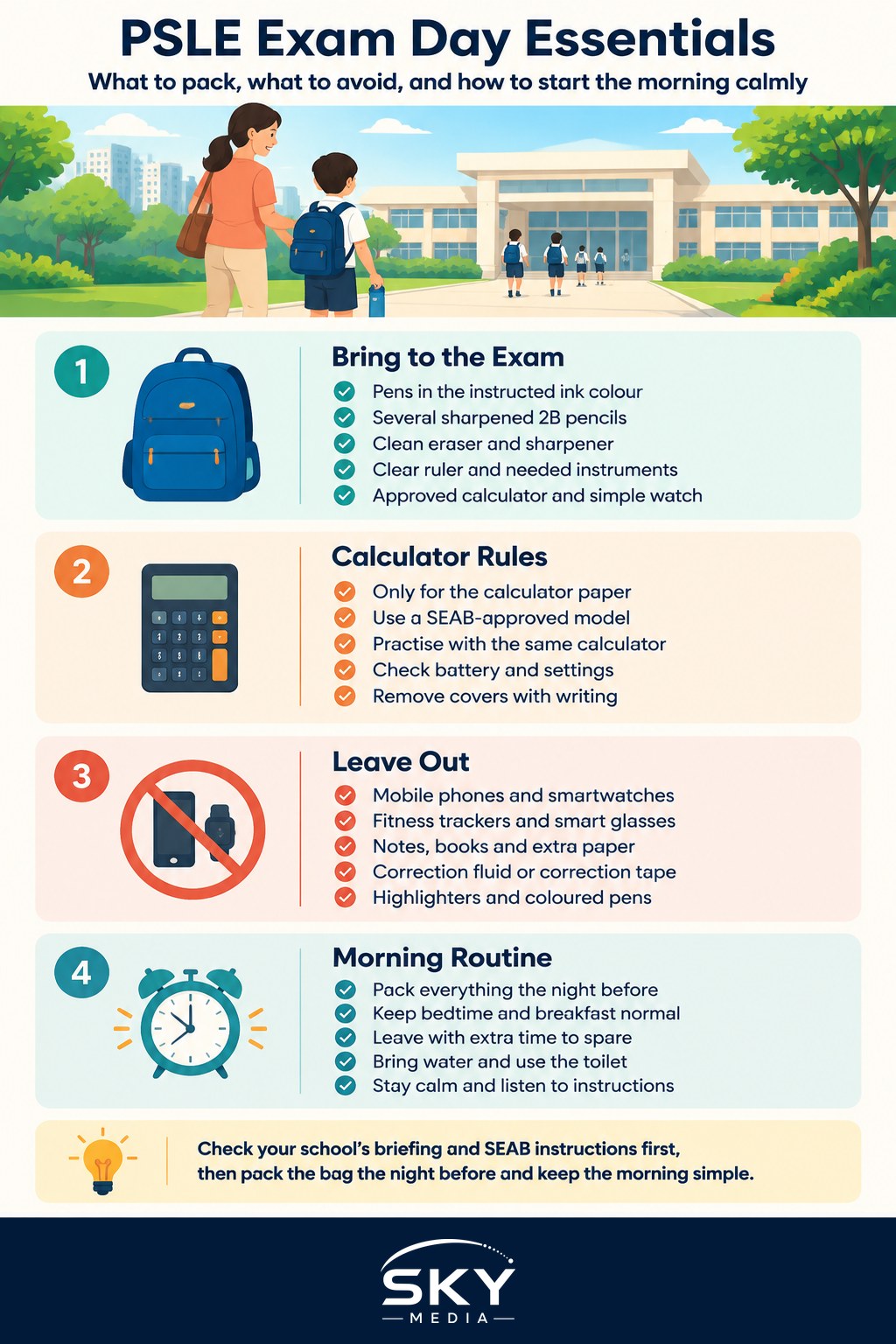
The Core Stationery Checklist
Most PSLE papers need only a small, well-chosen set of tools. Pack a clear or simple pencil case so items are easy to find and easy for invigilators to see. A sensible kit looks like this:
- Pens: two or three pens in the ink colour the instructions specify (typically blue or black). Bring spares, since a pen running dry halfway through a composition is a needless stress.
- 2B pencils: several sharpened 2B pencils for shading the Optical Answer Sheet (OAS), the machine-read sheet used for multiple-choice questions. A 2B lead gives a dark, readable mark. A small sharpener helps.
- Eraser: a clean, good-quality eraser that removes pencil marks fully, so the OAS reader does not pick up a half-erased answer.
- Ruler: a clear 15cm or 30cm ruler for Mathematics and Science diagrams and for underlining if your child likes to.
- Mathematical instruments: a protractor and set squares for Mathematics, if your child’s school has advised that they are needed.
- Approved calculator: for the Mathematics paper that permits calculators (more on this below).
- Watch: a simple analogue or basic digital watch without smart features, so your child can pace themselves.
Label everything with your child’s name or initials, since pencil cases look alike in a crowded hall.
Calculator Rules for PSLE Mathematics
Calculators are allowed only for part of the PSLE Mathematics paper, not all of it. Teachers will have practised this split, but confirm it at home too.
A few practical points:
- Use an approved model. SEAB publishes a list of approved calculator models. Check that your child’s calculator appears on the current list, and look for any approval label the school asks for.
- Use a familiar one. Exam morning is not the time for a brand-new calculator. Your child should sit the paper with the model they have practised on all year.
- Check the battery and settings. Many calculators are solar with a battery backup. Test it the night before and make sure it is not stuck in an unusual mode (such as a different angle unit or fraction display) that could confuse your child.
- Bring a backup if you can. A second approved calculator in the pencil case is a cheap insurance policy.
- No covers with notes. Remove any slip covers, stickers or labels with writing, other than a name label.
Items Not Allowed in the Exam Venue
The list of banned items matters as much as the packing list, because breaking a rule, even by accident, can lead to an investigation and penalties. Talk this through calmly with your child rather than as a warning.
Commonly prohibited items include:
- Mobile phones and smartwatches, or any device that can store, send or receive information. Even switched off, these generally must not be on your child’s person in the exam room. Follow the school’s arrangements for where bags and devices go.
- Fitness trackers and smart glasses, for the same reason.
- Notes, books and paper of any kind other than what the invigilator hands out. Check pockets, pencil case pouches and the calculator cover.
- Correction fluid or tape, which many paper instructions ask candidates not to use. Teach your child to cross out neatly with a single line instead.
- Highlighters and coloured pens on answer scripts, unless the instructions say otherwise.
The table below sums up what to do with the most common items.
| Item | Bring it? | What to know |
|---|---|---|
| Pens in the specified ink colour | Yes | Pack spares in case one runs dry |
| 2B pencils, eraser, sharpener | Yes | Needed for shading the OAS cleanly |
| Approved calculator | Yes, for the calculator paper | Must be on SEAB’s approved list |
| Basic watch with no smart features | Yes | Helps your child pace each paper |
| Mobile phone or smartwatch | No, not in the exam room | Follow school arrangements for storing devices |
| Correction fluid or tape | Usually no | Cross out with a single neat line |
If your child has exam access arrangements, such as extra time or a separate room, the school will brief you on what changes. Follow those instructions in place of the general guidance here.
A Calm Morning Routine for PSLE Papers
Children sit the PSLE at their own primary school in most cases, which helps, because the route and the building are familiar. Even so, small hiccups add up on a stressful morning. A simple routine helps:
- Pack the night before. Lay out the pencil case, calculator, water bottle, uniform and shoes. Go through the checklist together and let your child zip up the bag themselves.
- Keep bedtime normal. Late-night revision rarely helps by this stage. A regular bedtime does more for focus.
- Wake up with buffer time. Build in at least 15 to 20 extra minutes so nobody is rushing.
- Eat a familiar breakfast. Choose something your child normally eats and tolerates well, not a new or heavy meal. A light snack in the bag for breaks, if the school allows, can help.
- Bring a water bottle. Check the school’s instructions on whether it must be clear and label-free.
- Use the toilet before reporting.
- Arrive early, not too early. Aim to reach school with time to spare before the reporting time the school gives. Arriving very early can mean a long, anxious wait.
On the way, keep conversation light. A quick “you have done the work, just read each question carefully” is more useful than last-minute quizzing.
What Happens on the Day and After Each Paper
Your child’s school will tell you the reporting time, where to gather and how long each paper runs. Invigilators will read out instructions before each paper starts. Encourage your child to listen carefully, raise a hand if anything is unclear, and check that they have the right paper and have filled in their details correctly.
After each paper, resist the urge to do a full post-mortem. Children often misremember how they did, and dwelling on one paper can affect the next. Talk about lunch, rest and the next paper instead. Then repack the bag for the next exam, checking that the calculator and pencils are back in place.
If your child falls ill or something serious happens on the morning of a paper, contact the school immediately. There are established procedures for candidates who cannot sit a paper, and our guide on what happens if your child misses a national exam paper explains the general process.
If you want to understand how the papers feed into scoring and secondary school posting, start with The PSLE Explained. For the weeks before the exam, our Term 3 study plan for PSLE and O-Level prelims offers a steady way to finish revision.
Official sources: SEAB