

You have a new job offer that starts in three weeks, but your contract says one month’s notice. Or your employer wants you out the door today rather than at the end of your notice. Both situations come down to the same idea: salary in lieu of notice. In Singapore, this lets either side end the employment contract early by paying for the notice period instead of working it.
This guide focuses on how the buy-out works and how to calculate it. It is general information, not legal advice. For your exact situation, check your employment contract and MOM’s (the Ministry of Manpower’s) guidance, and seek advice from MOM, your union or TADM (the Tripartite Alliance for Dispute Management) if there is a dispute.
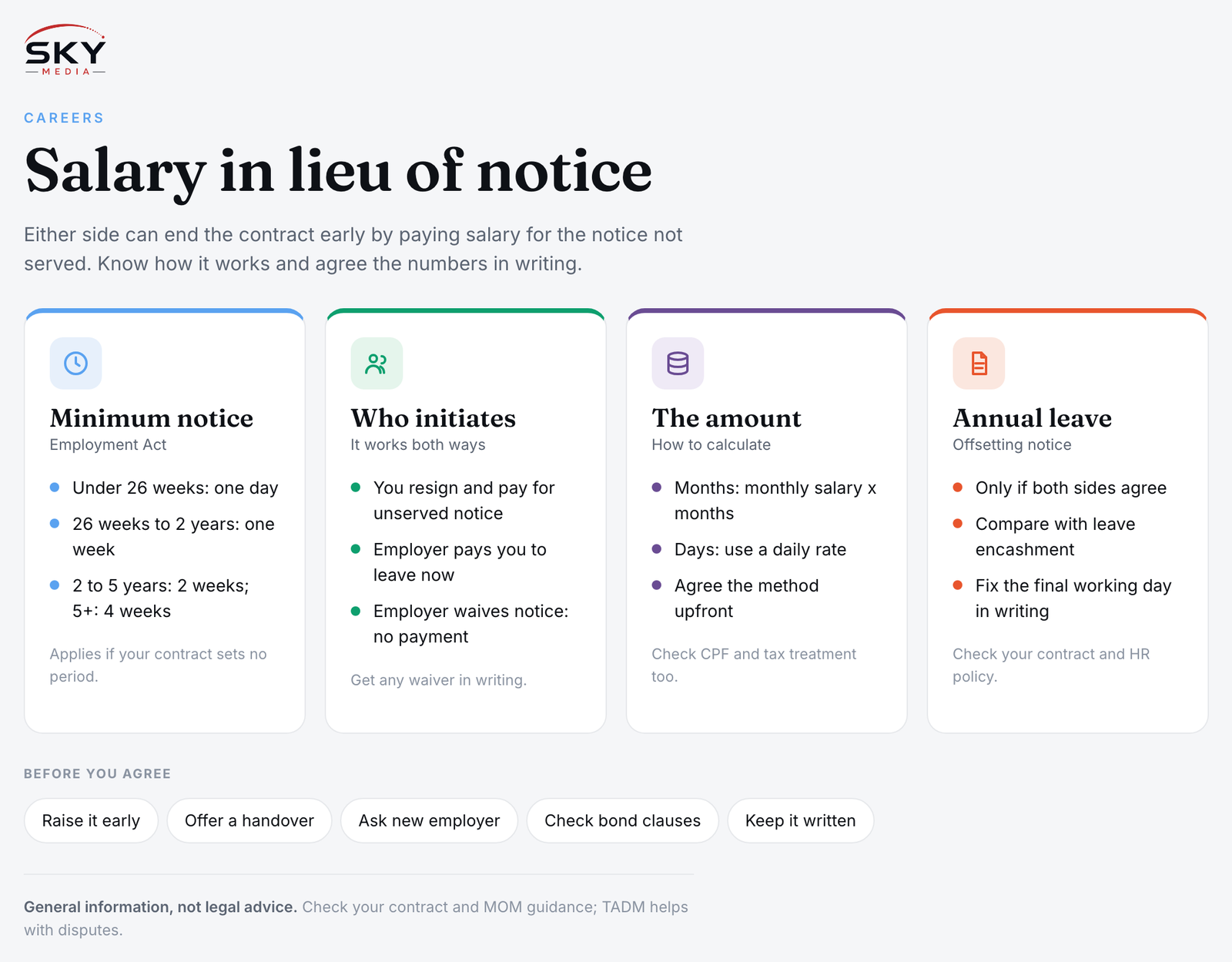
What Salary in Lieu of Notice Means
Most employment contracts specify a notice period. If yours does not, and you are covered by the Employment Act, the Act sets a minimum notice period based on how long you have worked:
- Less than 26 weeks: one day
- 26 weeks to less than two years: one week
- Two years to less than five years: two weeks
- Five years or more: four weeks
Under the Employment Act, either the employer or the employee can end the contract without serving notice by paying the other party salary for the notice period that is not served. That payment is the salary in lieu of notice, sometimes called pay in lieu or a notice buy-out.
Contracts for managers, executives and senior staff often set longer notice periods, such as one to three months, and may include their own terms on buy-outs. Always read your contract first.
Who Can Initiate a Buy-Out
This is where many people get confused. A buy-out works in both directions.
The employee buys out the notice. You resign and pay your employer for the notice you will not serve. In practice, this is usually deducted from your final salary rather than paid as a separate cheque. You may also buy out only part of the notice, for example working two weeks and buying out the remaining two.
The employer pays in lieu. Your employer ends your employment, or accepts your resignation, and asks you to leave immediately while paying salary for the notice period. This is common when someone moves to a competitor or holds sensitive information.
The employer waives notice. This is different from a buy-out. If your employer agrees to let you go early without either side paying, they are waiving the notice. Get this in writing, as it saves you money.
| Scenario | Who pays whom | What to get in writing |
|---|---|---|
| You resign and want to leave early | You pay the employer for unserved notice | Last day, amount, how it is deducted |
| Employer asks you to leave immediately | Employer pays you for the notice period | Payment amount and date, status of benefits |
| Employer agrees to release you early | No payment either way | Clear waiver of remaining notice |
| You offset notice with annual leave | No payment, leave days used instead | Number of leave days applied, final working day |
How to Calculate the Amount
The basic idea is simple: the payment equals the salary you would have earned during the unserved notice. The details depend on how your notice period is expressed.
If notice is in months. The usual approach is your monthly salary multiplied by the number of months not served. For one month’s notice and a monthly salary of $5,000, a full buy-out is typically $5,000.
If notice is in weeks or days, or you buy out part of it. You need a daily rate. Common methods include:
- Monthly salary divided by the number of working days in that month.
- Monthly salary multiplied by 12, divided by the number of working days in a year.
Your contract or company policy may specify the method. If not, MOM’s guidance on calculating a day’s pay for monthly-rated employees is the reference point. Different methods can produce slightly different amounts, so agree on the method upfront.
What counts as salary. Questions often come up about whether allowances, commissions or bonuses are included. This depends on your contract and how the Employment Act defines salary and gross rate of pay for your situation. Fixed allowances are more often included than variable payments, but check MOM’s guidance and your contract wording.
CPF and tax. Pay in lieu of notice may be treated differently from ordinary wages for CPF purposes, so check the CPF Board’s guidance on what is payable. It is generally taxable income, so report it as IRAS requires. These rules can change, so confirm with CPF Board and IRAS.
Using Annual Leave to Offset Notice
Many employees ask whether they can use their remaining annual leave to shorten the notice period. The common position is that this can be done if both you and your employer agree. Your employer cannot generally force you to use leave this way, and you cannot generally insist on it either, unless your contract says otherwise.
Points to consider:
- Check your contract and HR policy. Some contracts say whether leave can offset notice.
- Compare offsetting with encashment. Some employers pay out unused leave instead. Which is better depends on the amounts and your next job’s start date.
- Agree the final working day in writing so your last day of employment is clear for CPF, benefits and your new employer.
- Remember public holidays that fall during notice; our guide to public holiday pay and time off in lieu explains how those days are normally treated.
Practical Tips Before You Agree
- Raise it early. Ask your manager or HR as soon as you know your start date elsewhere. A cooperative conversation often leads to a waiver rather than a payment.
- Offer a handover plan. Employers are more willing to release you early if work is in good hands. Our guide to serving your notice period well has handover ideas.
- Ask your new employer. Some employers reimburse buy-out costs to secure a hire. It never hurts to ask during negotiation.
- Check bond or training clauses. Leaving early may trigger other repayment obligations, separate from notice.
- Watch for benefits. Insurance cover, bonuses and stock vesting may depend on your last day of employment, not your last day at work.
- Keep it written. Confirm the agreed amount, method and final date by email or letter.
If you need a refresher on how notice periods work in general, see understanding probation and notice periods and notice period and resigning well.
When There Is a Dispute
If you and your employer disagree about the amount or whether a buy-out applies, start by referring to the contract and putting your understanding in writing. If that fails, employees covered by the Employment Act can seek help from TADM, which handles mediation of employment disputes, before claims go to the Employment Claims Tribunals. Check MOM and TADM’s websites for current eligibility and filing steps.
A notice buy-out can be a clean way to move on quickly, as long as both sides understand the numbers and the agreement is clear.
Official sources: Ministry of Manpower (MOM)
Further reading: How to File a Salary Claim With TADM as an Employee