

A working holiday lets you live in another country for an extended stay and take up casual or short-term work to fund your travels. For young Singaporeans, it can be a gap year after graduation, a reset between jobs, or a way to test whether you would like to work overseas long term. Getting a working holiday visa as a Singaporean is usually straightforward compared with a full work visa, but places are limited, age limits are strict and each country sets its own conditions.
This is general information. Visa programmes, quotas and requirements change, sometimes every year, so always check the official immigration website of the country concerned before you apply or make plans.
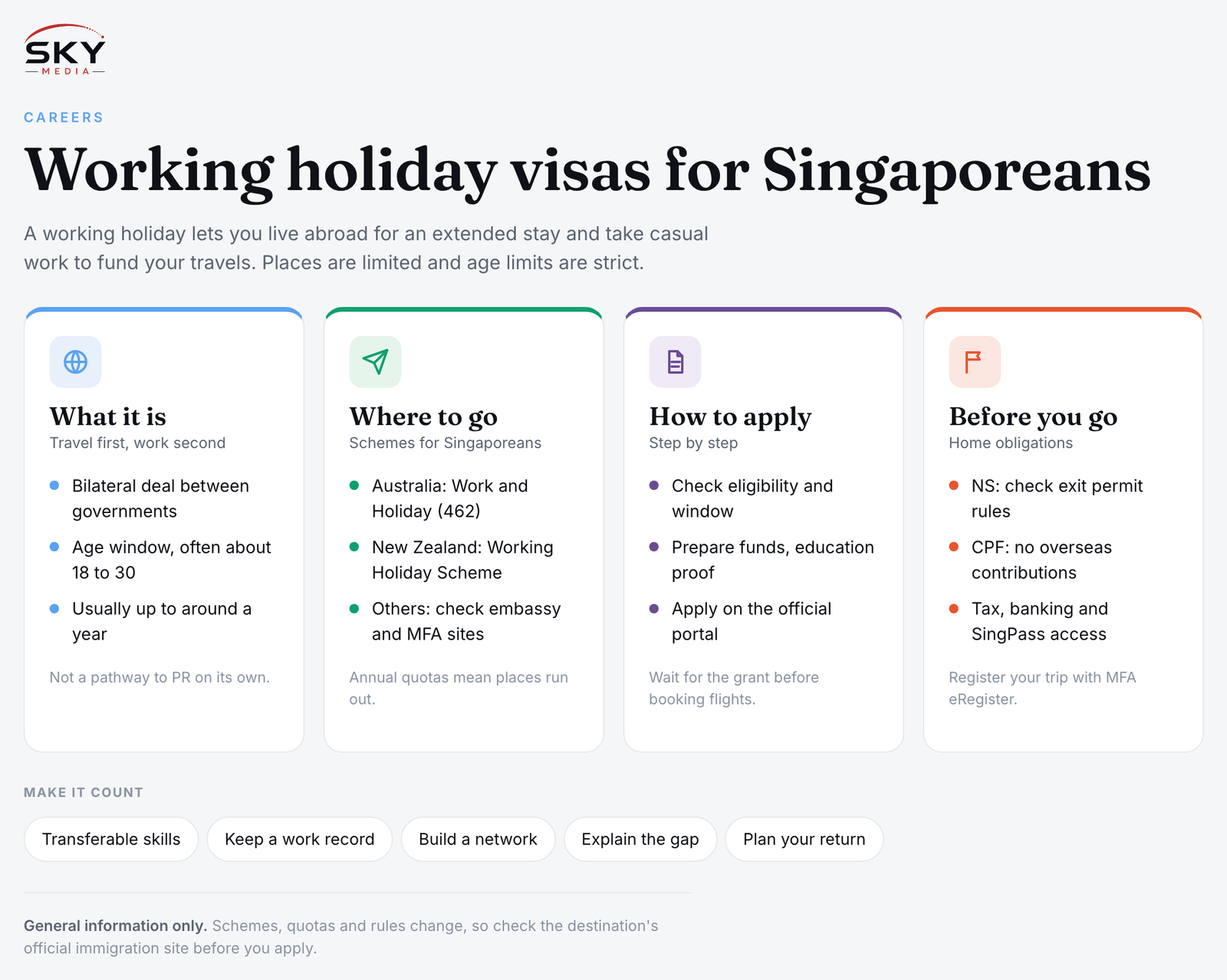
What a Working Holiday Visa Is (and Is Not)
Working holiday arrangements are usually bilateral agreements between two governments. They aim to encourage cultural exchange among young people, so travel is the main purpose and work is meant to support your stay.
Typical features include:
- An age window, commonly for applicants roughly between 18 and 30 at the time of application, though limits vary by country and agreement.
- A time limit, usually up to around a year, sometimes with options to extend under certain conditions.
- Work restrictions, such as a cap on how long you can work for one employer.
- Annual quotas, so places can run out.
- Proof of funds and a return ticket or the money to buy one.
- Health insurance for the whole stay, and sometimes health checks.
It is not a pathway to permanent residence on its own, and it does not usually let you bring dependants. If you want a long-term career abroad, treat it as a first step and a way to build experience and contacts.
Countries With Working Holiday Schemes for Singaporeans
Australia. Singapore citizens can apply for Australia’s Work and Holiday visa (subclass 462) under a bilateral arrangement. Applicants generally need to meet age, education and funds requirements set by the Australian Department of Home Affairs, and places are subject to an annual cap. Check the Home Affairs website for the current age limit, education requirement, length of stay and whether extensions are available.
New Zealand. New Zealand runs a Working Holiday Scheme for Singapore citizens with its own age, duration, funds and education conditions, and a limited number of places each year. Details are on the Immigration New Zealand website, which also lists when applications open.
Other countries. Singapore has youth mobility or working holiday style arrangements discussed or in place with other partners over the years, and some countries offer youth programmes open to many nationalities. Because these change, the most reliable approach is to check the website of the embassy or high commission of the country you are interested in, and the Ministry of Foreign Affairs (MFA) Singapore website, for current reciprocal schemes.
If a country does not offer a working holiday visa to Singaporeans, you may still be able to visit visa-free, but that normally does not allow you to work. Our guide to visa-free countries for Singaporeans explains entry for short visits, and applying for travel visas from Singapore covers other visa routes.
How to Apply: Step by Step
- Check eligibility on the official site. Confirm the age limit, education requirement, quota and application window for your nationality.
- Check your passport. Make sure it is valid for well beyond your planned stay. Renew through ICA if needed.
- Prepare documents. Common requirements include proof of education, bank statements showing sufficient funds, and sometimes a police certificate or medical checks.
- Apply online through the destination government’s official portal, and pay the visa fee shown there. Avoid agents who charge to “guarantee” a place.
- Wait for the grant before booking non-refundable flights. Note the date by which you must enter the country, as the visa may lapse if you do not arrive in time.
- Buy comprehensive health and travel insurance that covers working holidays and any activities you plan to do.
Before You Go: Singapore Obligations
Your commitments at home do not pause while you are away.
- National Service. NS-liable men and Operationally Ready NSmen may need an exit permit or to notify MINDEF for extended overseas stays. Check the current requirements on the NS Portal well before you apply, as missing an in-camp training date has serious consequences.
- CPF. You will not receive CPF contributions from overseas employers. Factor that into your long-term savings, and consider voluntary top-ups if it fits your plans. CPF Board’s website explains the options.
- Tax. Income earned overseas may be taxed by the host country. Check the host country’s tax office for rules on working holiday makers, and IRAS for your Singapore position.
- Phone, banking and bills. Keep a Singapore number or set up overseas access for SingPass two-factor authentication, and make sure your bank cards work abroad. Our guide to managing money across two countries has useful tips on transfers and accounts.
Comparing Your Options
| Option | Can you work? | Typical stay | Best for |
|---|---|---|---|
| Working holiday visa | Yes, with conditions | Up to around a year | Travel funded by casual work, gap years |
| Visa-free visit | Generally no | Short stays only | Holidays and exploring |
| Student visa | Limited hours, varies | Length of the course | Gaining a qualification abroad |
| Employer-sponsored work visa | Yes, for that employer | Linked to the job | Building a professional career overseas |
Turning a Working Holiday Into Career Growth
Many working holiday makers end up in hospitality, farm work, retail or tourism. These jobs can still be valuable if you approach them deliberately.
- Pick roles that build transferable skills. Customer service, team supervision, sales, logistics and bilingual communication all translate well back home.
- Look for work in your field. Some graduates find short contracts in design, IT support, admin, early childhood or healthcare support, depending on local licensing rules. Research your sector before you go.
- Keep a record. Note responsibilities, achievements and references from each job while they are fresh.
- Build a network. Join industry meetups, alumni groups and Singaporean communities abroad.
- Explain the gap clearly. On your CV and in interviews, frame the year around skills gained, independence and adaptability, not just travel photos.
- Plan your return. Start job searching a few months before you come back, and line up any short courses through SkillsFuture if you want to sharpen specific skills.
Practical Tips for First-Timers
Arrive with enough savings to cover several weeks without work, as jobs may take time to find. Research rental costs and scams aimed at newcomers, such as fake rooms requiring deposits upfront. Pack for the seasons, especially if you are heading to southern Australia or New Zealand in winter. Register your travel with MFA’s eRegister so the Singapore government can reach you in an emergency.
A working holiday visa is a time-limited opportunity, because once you pass the age cut-off it is gone. If you are curious, check the official sites early, note when applications open, and give yourself enough time to prepare.