

Bringing in a new investor, rewarding a co-founder or simply injecting more capital into your company usually means issuing new shares. In Singapore this process is called an allotment of shares, and it has a set sequence of approvals, documents and filings. Get the order right and it is straightforward. Get it wrong and you may end up with an invalid issue, an inaccurate register or a late filing.
This guide focuses on the mechanics of allotment of shares in Singapore for private companies limited by shares. It is general information, not legal advice. The Companies Act and your company’s constitution govern the details, and ACRA (the Accounting and Corporate Regulatory Authority) publishes current filing guidance on its website. For anything unusual, speak to your company secretary or a corporate lawyer.
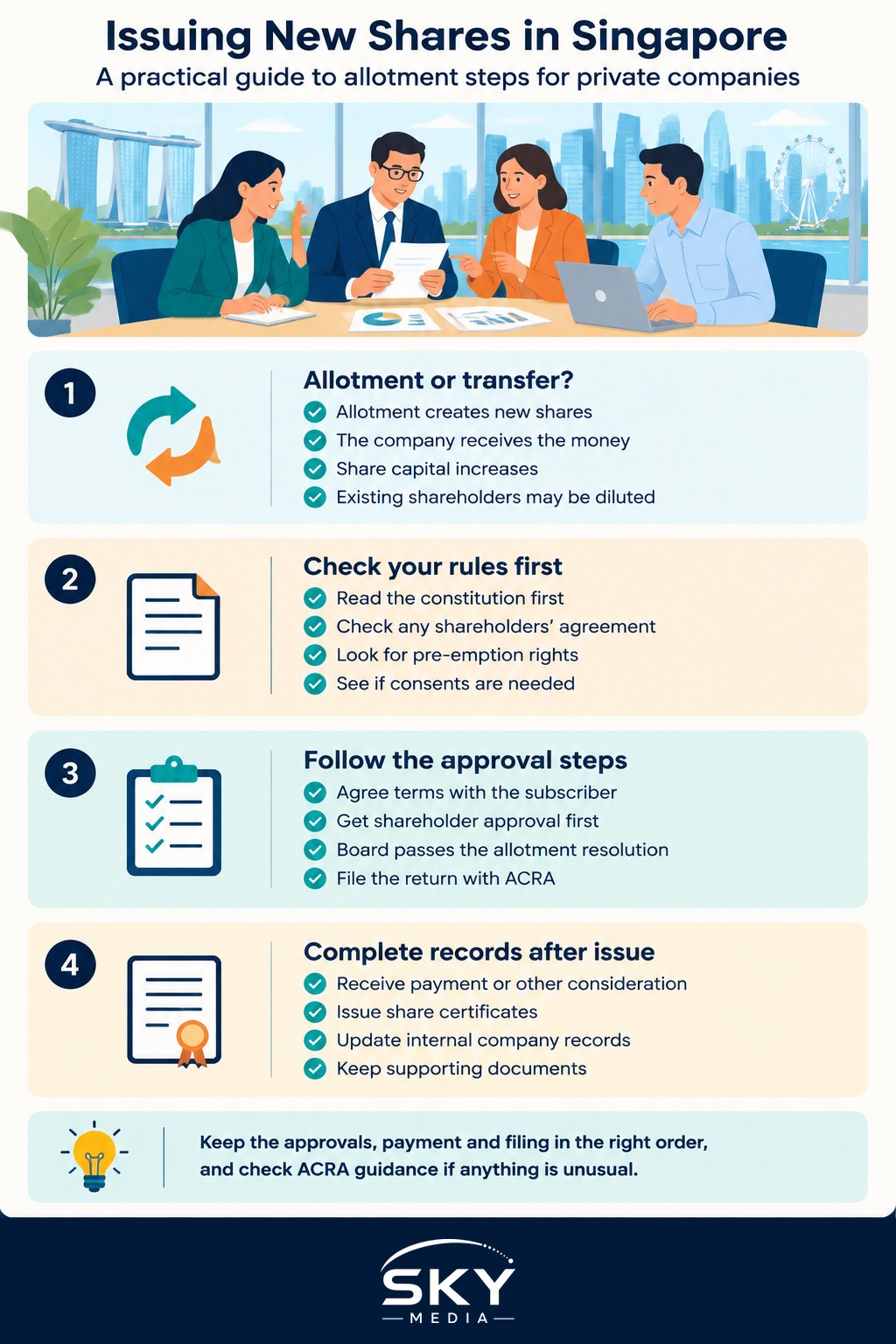
Allotment vs Transfer: Know Which One You Are Doing
Before starting, be clear about what is happening:
- Allotment means the company creates and issues new shares. The company receives the money (or other consideration), and its share capital increases. Existing shareholders are diluted unless they also subscribe.
- Transfer means an existing shareholder sells or gives existing shares to someone else. The company’s share capital does not change, and the money goes to the selling shareholder.
The two have different paperwork and different tax treatment. For example, stamp duty in Singapore generally applies to transfers of existing shares rather than to new allotments, as covered in our guide to stamp duty on shares. Check the current position with IRAS for your own transaction.
Check Your Constitution and Existing Agreements First
Your company’s constitution (what older companies called the memorandum and articles of association) and any shareholders’ agreement may add rules on top of the law. Look for:
- Pre-emption rights. Many constitutions require new shares to be offered first to existing shareholders in proportion to their holdings, unless they waive that right.
- Share classes. If you plan to issue preference shares or a new class with different rights, the constitution may need to allow or be amended for it.
- Consent or veto rights. Investors in earlier rounds often negotiated the right to approve any new issue.
- Limits on directors’ powers. Some constitutions restrict what the board can do without shareholders.
If any of these apply, you will need the relevant waivers, consents or amendments before the allotment goes ahead.
The Step-by-Step Allotment Process
Here is the typical sequence for a private company. Your company secretary can tailor it to your situation.
| Step | Who acts | What is produced |
|---|---|---|
| 1. Agree terms with the subscriber | Directors and subscriber | Term sheet or subscription agreement setting price, number and class of shares |
| 2. Obtain shareholder approval to issue shares | Shareholders | Ordinary resolution at a general meeting or a written resolution |
| 3. Handle pre-emption and consents | Existing shareholders | Signed waivers or consents, where the constitution requires them |
| 4. Approve the allotment | Board of directors | Directors’ resolution allotting the shares |
| 5. Receive payment or consideration | Subscriber and company | Funds in the company bank account, or the agreed non-cash consideration |
| 6. File the allotment with ACRA | Company secretary or authorised filer | Return of allotment lodged via BizFile+, updating the electronic register of members |
| 7. Issue share certificates and update records | Company | Share certificates and updated internal records |
Shareholder approval
Under the Companies Act, directors generally need prior approval from shareholders in a general meeting before issuing shares. This can be a specific approval for one issue, or a general mandate that lets directors issue shares within its terms until the next annual general meeting or the time by which it must be held. Private companies can often pass the resolution in writing rather than holding a meeting, subject to the Act and the constitution. If your company has dispensed with AGMs, read our guide to AGM rules for private companies, since this affects how long a general mandate lasts.
The directors’ resolution
Once shareholders have approved, the board passes a resolution actually allotting the shares. It typically records the subscriber’s name, the number and class of shares, the issue price, how payment is made and authority for an officer to file with ACRA and sign certificates.
Payment and consideration
Shares are usually issued for cash. Make sure the money has actually reached the company account, and keep the bank record. If shares are issued for non-cash consideration, such as intellectual property or services, there are additional documentation and filing requirements, including lodging the underlying contract or particulars with ACRA. Get professional help for these.
Filing with ACRA
Private companies in Singapore lodge a return of allotment with ACRA through BizFile+, ACRA’s online filing portal. For private companies, ACRA maintains the electronic register of members, so this filing is also what updates the official record of who owns the company. There is a statutory deadline after the allotment date, and late filing can attract penalties, so file promptly and check the current deadline and any fees on ACRA’s website.
Share certificates
The company should issue share certificates to the new shareholder within the time required by law, and keep copies with the board and shareholder resolutions in the company’s statutory records.
Common Mistakes to Avoid
- Issuing shares before shareholder approval. An allotment without the required authority can be challenged and may need court action to fix.
- Ignoring pre-emption rights. Skipping existing shareholders’ rights under the constitution can lead to disputes.
- Recording before receiving payment. Allot only once the consideration terms are met, so the register reflects reality.
- Filing late or with errors. Wrong share numbers or classes on BizFile+ create an inaccurate public record that must then be corrected.
- Forgetting other registers. If the new shareholder becomes a controller, update the company’s register of registrable controllers too.
- Overlooking investor documents. Funding rounds usually come with a shareholders’ agreement that should be signed alongside the subscription.
Practical Tips for Founders
- Keep a clean timeline. Date your resolutions in the right order: shareholder approval, then directors’ allotment, then filing.
- Use your corporate secretary. Every Singapore company must appoint one, and share allotments are core to their work.
- Model dilution in advance. Before agreeing terms, work out each shareholder’s percentage after the issue so there are no surprises.
- Communicate with existing shareholders. Even where waivers are not legally required, early discussion avoids friction.
- Keep documents together. Investors, auditors and future buyers will ask for the full trail of every share issue.
Handled carefully, an allotment of shares is a routine corporate event. The key is respecting the order of approvals, documenting each step and filing accurately with ACRA. When in doubt, confirm the current requirements on ACRA’s website or with a qualified professional before you proceed.
Frequently Asked Questions
Can a private company pass a share issue resolution in writing? Often yes. Private companies can usually pass the shareholder resolution in writing instead of holding a meeting, subject to the Companies Act and the constitution. Check your constitution first, and keep a signed, dated copy in the statutory records.
What happens if I issue shares without shareholder approval? The allotment can be challenged and may need court action to fix, which is costly and slow. Directors generally need prior shareholder approval, either specific to the issue or through a general mandate. Get the approval dated before the directors’ resolution.
Do I need to pay stamp duty on newly allotted shares? Stamp duty generally applies to transfers of existing shares rather than to new allotments. Your own transaction may have different features, so confirm the current position with IRAS before relying on that.
Can I issue shares in exchange for services or intellectual property? It is possible, but non-cash consideration brings extra documentation and filing requirements, including lodging the underlying contract or particulars with ACRA. Because valuation and drafting can be tricky, get a company secretary or corporate lawyer involved.
How do I work out how much a new investor dilutes me? Compare your shares against the total number after the issue. Model each shareholder’s percentage before agreeing terms so there are no surprises. Existing shareholders are diluted unless they also subscribe, which is why pre-emption rights matter.
Official sources: ACRA
Further reading: How a Singapore Private Company Can Buy Back Its Own Shares · Register of Members and Share Certificates for a Singapore Pte Ltd · Variable Capital Companies (VCC) in Singapore Explained