

When you incorporate a company in Singapore, most of your attention goes to the business name, directors, shareholders and bank account. One requirement that often slips past first-time founders is the register of registrable controllers, sometimes shortened to RORC. It is a record of the people and entities who ultimately own or control your company, and keeping it is a legal requirement for most companies under the Companies Act. This guide explains what the register is, who counts as a controller, what you must record and how to keep it up to date.
This is general information, not legal advice. Rules are set by ACRA (the Accounting and Corporate Regulatory Authority, which oversees company registration in Singapore) and can change, so check ACRA’s website or speak to your company secretary for current requirements.
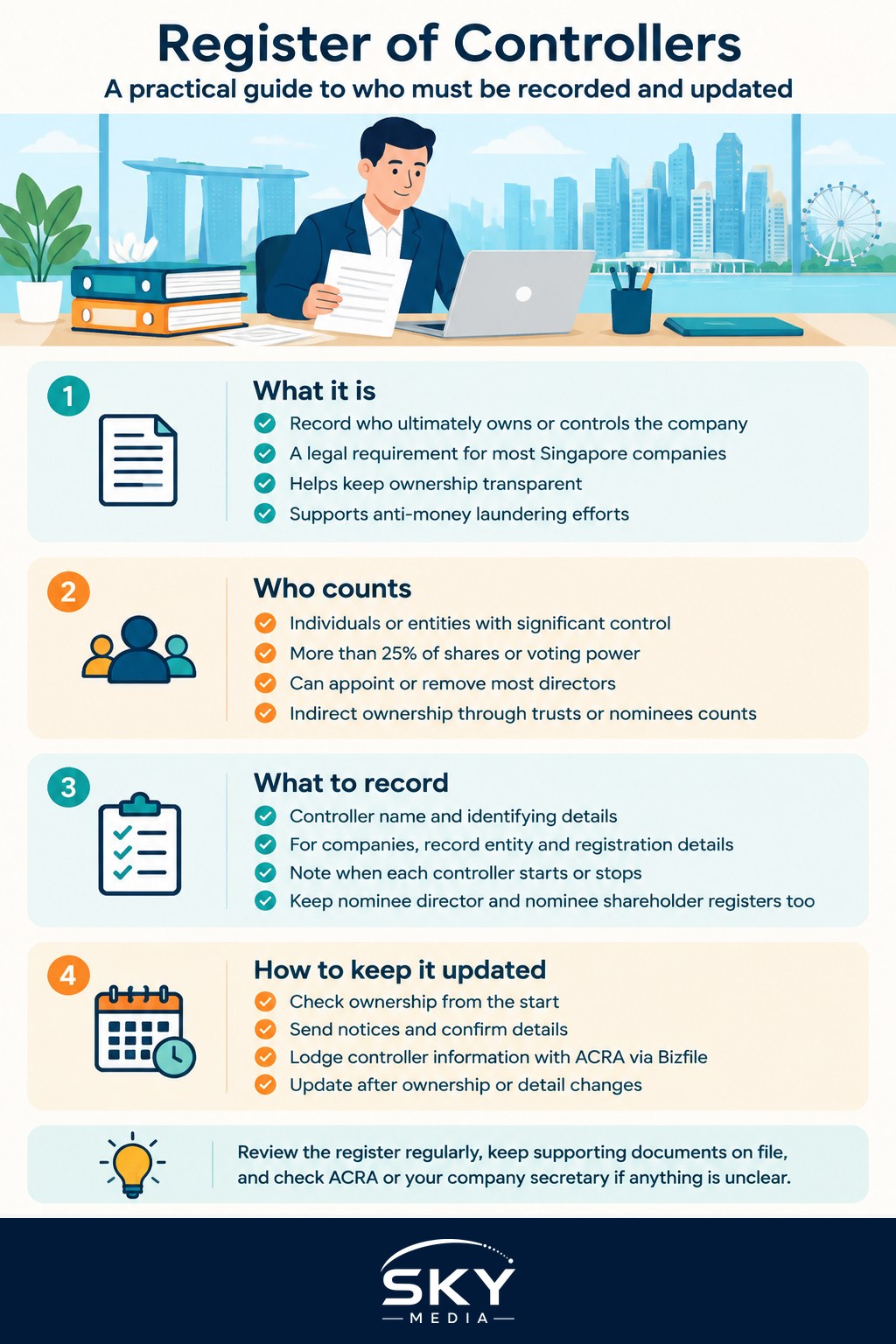
Why the Register Exists
The register is part of Singapore’s commitment to transparency about who really owns companies, sometimes called “beneficial ownership”. It helps authorities tackle money laundering, terrorism financing and tax evasion by making sure there is a clear record of the individuals behind a company, not just the names on the share register.
For a founder, the practical point is simple: your company must know who its controllers are, record them properly and make the information available to ACRA. Failing to do so can lead to penalties for the company and its officers.
Who Counts as a Registrable Controller
In broad terms, a controller is an individual or a legal entity that has a significant interest in, or significant control over, the company. Under ACRA’s guidance, this generally includes anyone who:
- Holds more than 25% of the shares, directly or indirectly
- Holds more than 25% of the voting power
- Can appoint or remove a majority of the directors
- Exercises significant influence or control over the company in other ways, such as through an agreement or arrangement
A controller can be an individual or a corporate entity. If another company owns more than 25% of your company, that company is a registrable controller, and you should also look through the chain to identify the individuals who ultimately control it.
A few points that often confuse founders:
- Directors are not automatically controllers. A director with no shares and no special control rights may not be a controller at all.
- Shareholders below the threshold usually are not. Unless they have control through other means.
- Indirect holdings count. Shares held through another company, a trust or a nominee can still make someone a controller.
Some types of companies are exempt, for example certain listed companies and government-owned entities. Check ACRA’s guidance to confirm whether any exemption applies to you.
What the Register Must Contain
The register records identifying details for each controller. The exact fields are set out in ACRA’s guidance, but generally include:
| Controller type | Typical details recorded | Where to confirm |
|---|---|---|
| Individual | Full name, aliases, residential address, nationality, identification number, date of birth | ACRA’s guidance on registrable controllers |
| Corporate entity | Name, unique entity number, registered office address, legal form, jurisdiction and register where it is incorporated | ACRA’s guidance on registrable controllers |
| Any controller | Date they became a controller and, where relevant, the date they ceased | Your company secretary or ACRA |
| Nominee directors (separate register) | Details of the person who nominated a nominee director | ACRA’s guidance on the register of nominee directors |
Note that companies must also keep a separate register of nominee directors, where relevant, and a register of nominee shareholders. These sit alongside the controllers register and are often handled together.
How to Identify Controllers and Keep the Register
Your company has an active duty to find out who its controllers are, not just wait to be told. The typical process looks like this:
- Map your ownership. List every shareholder and check whether any hold more than 25% directly or through other entities.
- Send notices. Companies are expected to send written notices to people they know or believe to be controllers, asking them to confirm their details.
- Record the information. Enter the confirmed details into the register.
- Lodge with ACRA. Companies must lodge their controller information with ACRA’s central register through Bizfile (ACRA’s online filing portal). The information is not publicly searchable in the way company officers are, but it is available to public agencies.
- Keep it where required. The register must be kept at the company’s registered office or at the office of its registered filing agent.
- Update promptly. When a controller changes, the company must update its register and ACRA’s records within the timelines ACRA specifies.
Most small companies rely on their corporate service provider or company secretary to manage this. That is sensible, but you remain responsible as a director to make sure it is done and that the information is accurate.
When You Need to Update It
Ownership changes more often than founders expect. Common triggers include:
- A new funding round, where an investor crosses the 25% threshold or an existing shareholder is diluted below it
- Share transfers between co-founders or to a new partner
- Setting up or restructuring a holding company above your operating business
- Changes in a corporate controller’s own ownership
- A controller changing their address, nationality or identification details
- A controller passing away or exiting the business
Each of these may require you to update both your own register and ACRA’s records. If you are planning a fundraise or restructure, ask your company secretary to include controller updates in the transaction checklist so it is not forgotten.
Getting It Right From the Start
The easiest time to set up your register is at incorporation, when you already have everyone’s details to hand. If you are just starting out, our guide on how to register a company in Singapore walks through incorporation on Bizfile. If you run a non-profit association rather than a company, the rules differ; see how to register a society in Singapore for that route.
A few final habits help:
- Review the register at least once a year, for example when preparing your annual return
- Keep supporting documents, such as notices and confirmations, on file
- Make sure new investors know they will be asked for their details
- Ask ACRA or a qualified professional if you are unsure whether someone counts as a controller
It is a small administrative task, but getting it right protects your company from penalties and makes due diligence smoother when investors or banks come calling.
Frequently Asked Questions
Does a company with only one director and shareholder need a controllers register? Yes, as a rule. A sole founder who owns most of the company is usually the controller, so the company still needs to keep the register and lodge the details. Being small does not remove the duty, though ACRA’s guidance lists any exemptions.
What if a controller does not reply to the company’s notice? The company should keep proof it tried, such as copies of the notices and follow-ups, and ask its company secretary or ACRA what further steps apply. Ignoring the problem is risky, because the duty to find out who the controllers are rests on the company.
Does a dormant company still have to keep the register? Generally yes, because being inactive does not stop the company existing or having owners. The register should still reflect the controllers and be kept up to date. Check ACRA’s guidance or ask your company secretary whether anything differs for your situation.
Do foreign shareholders count as registrable controllers? Yes, nationality does not matter. A foreign individual or overseas company that crosses the control thresholds is a controller, and the company must record their details. For a corporate shareholder, the company should also look through to the individuals behind it.
What should I do if my existing company never set up the register? Set it up as soon as you can. Map your ownership, send notices to the controllers, record their details and lodge them with ACRA. If you are unsure what to do about the delay, speak to your company secretary or ACRA for guidance.
Official sources: ACRA
Further reading: Register of Members and Share Certificates for a Singapore Pte Ltd