
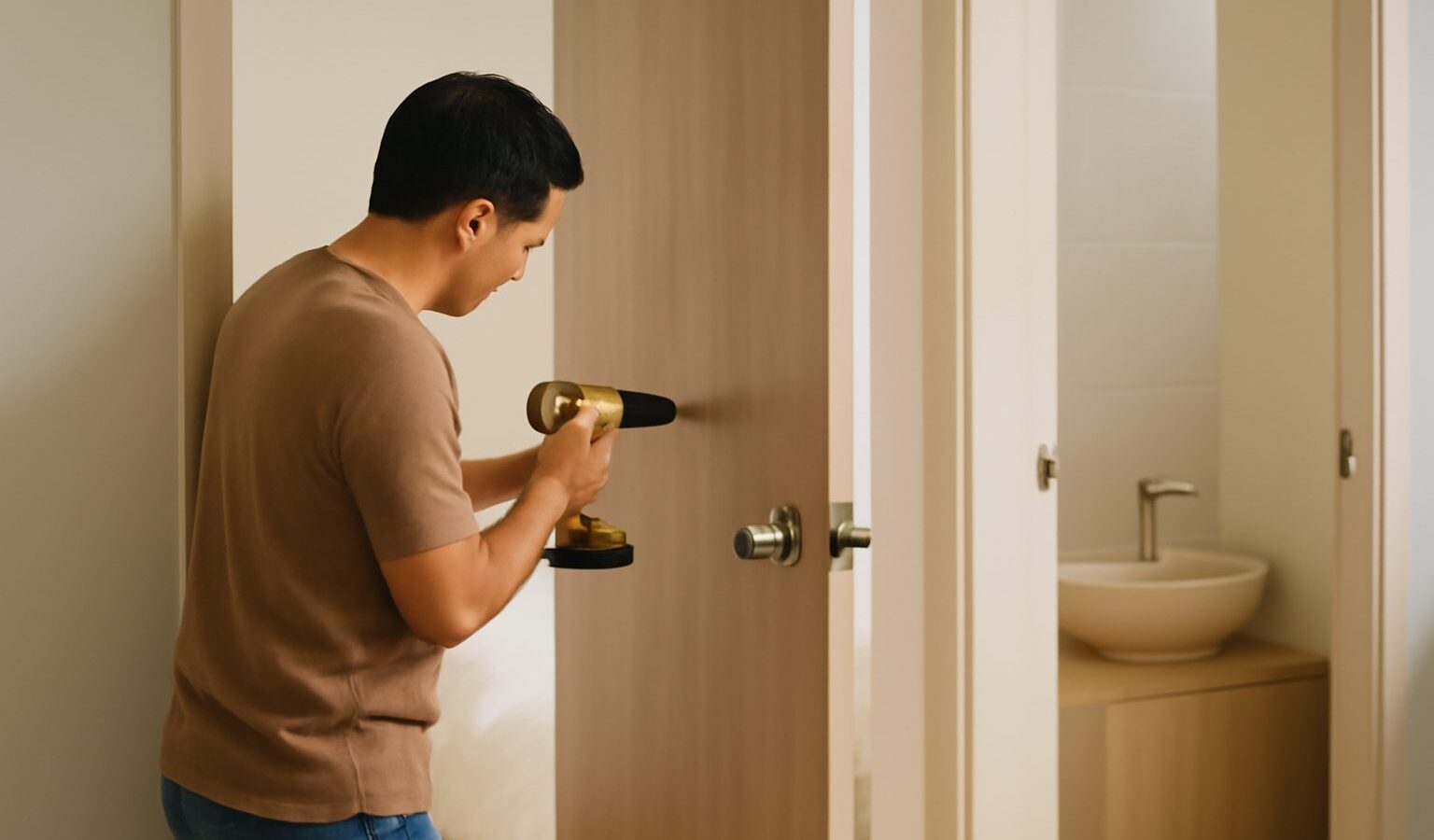
Internal doors take a beating. Over the years, bedroom doors swell and stick, laminate edges peel, hinges sag, and toilet doors suffer from constant humidity. An HDB bedroom door replacement is one of the quicker upgrades you can make to a flat, and it changes both how a room looks and how well it keeps out noise and light.
This guide focuses on internal doors only. It explains the main door types used for bedrooms and toilets, what a replacement job usually involves, and how to plan it so you avoid surprises. For the entrance, see our separate guide to main door and gate ideas for HDB flats.

Signs Your Doors Need Replacing
Some problems can be fixed by adjusting hinges or replacing a lockset. Replacement starts to make sense when you see:
- Swelling or warping, where the door rubs against the frame or will not close without force.
- Peeling laminate or veneer, especially along the bottom edge of toilet doors.
- Rot, mould or soft spots near the base, usually from water exposure.
- Holes or cracks in hollow doors that cannot be patched neatly.
- A damaged frame, where screws no longer hold or the frame has shifted.
- A style change, when the old doors clash with a renovated home.
The Main Door Types Compared
Most internal doors in HDB flats fall into a few categories. The right choice depends on the room, your budget and how much you care about sound, durability and space.
| Door type | Common use | Strengths | Watch-outs |
|---|---|---|---|
| Laminate door | Bedrooms, study rooms | Wide choice of colours and finishes, easy to clean, good value | Edges can chip or peel if knocked or exposed to water |
| Solid or solid-core timber door | Bedrooms where quiet and sturdiness matter | Heavier, better at blocking sound, feels substantial | Higher cost, heavier load on hinges and frame |
| Slide-and-swing door | Toilets and bathrooms | Saves space by sliding and can also swing open fully, often made of water-resistant materials | Needs careful installation; tracks and hinges need occasional cleaning |
| Folding (bi-fold) door | Toilets in older flats | Takes little space when open | Can feel flimsy, gaps reduce privacy |
Laminate doors
Laminate doors have a core, often engineered wood or a hollow structure, finished with a decorative laminate sheet. They are the most common choice for bedrooms because they come in many colours and woodgrain looks and are easy to wipe clean. Ask what the core is made of, since a solid or dense core feels sturdier and blocks more noise than a hollow one.
Solid and solid-core doors
A solid timber door, or one with a solid engineered core, is heavier and more substantial. It reduces sound transfer between rooms, which helps in flats where bedrooms face a busy living room or a corridor. The trade-off is cost and weight; the frame and hinges must be able to support it.
Slide-and-swing doors for toilets
Slide-and-swing doors have become a popular choice for HDB toilets. The door can slide along a track for a narrow opening, or swing out fully when you need more space, such as when moving a bucket or helping an elderly family member. Many are made from water-resistant materials such as aluminium frames with tempered or frosted panels, or PVC and composite boards, which cope with humidity better than standard wood. Check the materials and hardware quality before choosing.
Folding doors
Many older flats came with bi-fold toilet doors. They save space but can become loose and noisy over time. Some homeowners replace them like-for-like; others switch to slide-and-swing doors.
What a Replacement Job Involves
The scope of work depends on whether you replace only the door leaf or the frame too.
Door leaf only. If the frame is in good condition, the contractor removes the old door, fits a new leaf to the existing frame, and installs hinges, a lockset and a door stopper. This is the quickest and least messy option.
Door and frame. If the frame is damaged, warped or needs a new size, it is removed and a new one installed. This involves more work around the wall opening, including some patching and touch-up painting afterwards. Our guide to choosing paint colours for your HDB flat can help if you are repainting at the same time.
Typical steps:
- Site measurement. The contractor measures each opening, since sizes can vary slightly between flats and rooms.
- Choosing materials and hardware. You pick the door type, finish, handles and lock style.
- Fabrication or ordering. Doors may be made to size, which takes some time.
- Removal and installation. Old doors are taken out and new ones fitted, usually within a day for a few doors, depending on scope.
- Adjustment and check. Doors should close smoothly, latch properly and leave an even gap.
HDB Rules and Hiring a Contractor
Renovation works in HDB flats must follow HDB’s renovation guidelines. Rules on which works need a permit, the approved hours for noisy work, and the use of registered contractors can change, so check the current guidelines on the HDB website before you start. HDB keeps a Directory of Renovation Contractors that you can use to confirm a firm is registered.
When getting quotes:
- Get at least two or three quotations for the same scope so you can compare fairly.
- Make sure each quote lists the door type, core material, finish, frame work, hardware, removal and disposal of old doors, and any patching or painting.
- Ask about warranty on the doors and hardware, and what it covers.
- Agree a timeline and check whether doors are made to order.
- Let neighbours know if the work will be noisy, as a courtesy.
If you are doing a bigger renovation, doors are often bundled with carpentry. Our guide to renovating your HDB flat covers the wider process.
Choosing Hardware and Finishing Touches
The door is only part of the result. Hardware and details shape how it feels every day:
- Handles and locks: lever handles are easier for children and older family members than knobs. Toilet doors usually need a privacy lock that can be opened from outside in an emergency.
- Hinges: heavier doors need sturdier hinges, and good hinges reduce sagging over time.
- Door stoppers: protect walls and furniture from the handle.
- Gaps and seals: a small gap at the bottom helps airflow, but a large one lets in light and noise. Ask about seals if you want a quieter room.
- Child safety: finger guards on the hinge side can help with young children. See our room-by-room childproofing guide for more ideas.
Making New Doors Last
- Wipe up water from toilet doors after showers, especially along the bottom edge.
- Keep the toilet ventilated to reduce humidity and mould.
- Tighten loose hinge screws early before holes widen.
- Clean slide-and-swing tracks regularly so they run smoothly.
- Use gentle cleaners on laminate; harsh chemicals can dull or lift the surface.
Replacing internal doors is a manageable project that refreshes a flat without a full renovation. Choose the right type for each room, agree a clear scope with a registered contractor, and confirm the current HDB requirements before work begins.