

If your A-Level results did not open the door you were hoping for, retaking one or more subjects is a real option. Each year, some students choose to retake A-Levels in Singapore, usually as private candidates, to qualify for a specific course or scholarship. Others decide that a different route gets them where they want to go faster.
This guide focuses on the retake decision itself: what a retake actually involves, how to plan a year of study without the structure of school, and the lifestyle trade-offs that nobody puts on the brochure. It is general information. Registration rules, fees and subject conditions are set by the Singapore Examinations and Assessment Board (SEAB) and can change, so check the current details on SEAB’s website before committing.
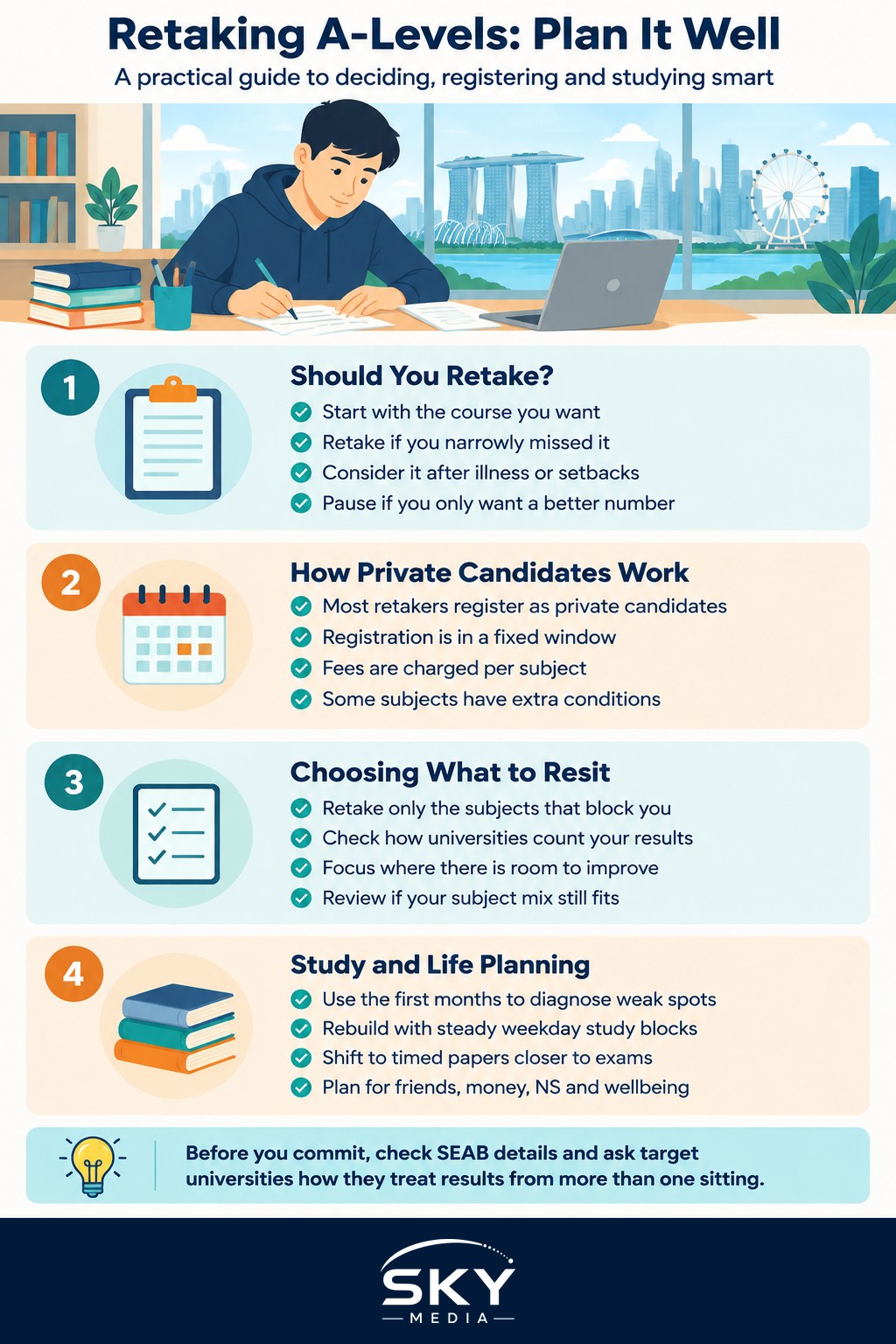
Is a Retake the Right Call for You?
Start with the goal, not the exam. A retake is worth serious thought when:
- A specific course you strongly want has a subject prerequisite or grade you narrowly missed
- Your preliminary exam results and school record suggest the national result was an off day
- You have a clear reason the first attempt went badly, such as illness or a difficult personal period, that is now resolved
- The alternative routes to your goal are much longer or more expensive
It is worth pausing if:
- You are unsure what course you want and are retaking mainly to “get a better number”
- Universities you are targeting may not combine results across sittings in the way you hope
- Your current results already qualify you for a course you would be reasonably happy with
That second point matters. Universities have their own rules on how they treat results from more than one sitting, and these can differ by institution and course. Contact the admissions offices of your target universities and ask directly before you register.
How Private Candidature Usually Works
Most students who retake A-Levels do so as private candidates, meaning they register with SEAB directly rather than through a school.
- Registration happens in a fixed window, usually early in the year for the exams later that year. Missing it generally means waiting another full cycle, so note the dates as soon as SEAB publishes them.
- You register online through SEAB’s candidate services, typically using Singpass for Singapore citizens and permanent residents. Foreigners should check the identification requirements.
- Fees apply per subject, and they are generally higher for private candidates than for school candidates. Check SEAB’s current fee schedule.
- Some subjects have extra conditions. Subjects with practical, coursework or project components, such as the sciences, can have specific rules for private candidates. Read SEAB’s notes on each subject carefully, as this can decide which subjects you are able to retake.
Ask your former junior college or Millennia Institute whether it offers any guidance or resources for retakers. Policies differ, so do not assume either way.
Choosing What to Resit
You do not always need to retake everything. Look at:
- Which grades are blocking your goal. If only one subject falls below a course requirement, focus there.
- How your target universities count results. Some may consider only one sitting, which might push you towards retaking a full combination.
- Your realistic improvement in each subject. A subject where your preliminary grade was far higher than your final result often has more room to recover.
- Your original subject combination. If it no longer fits your goals, read our guide to choosing A-Level subject combinations and consider whether a different mix, within SEAB’s rules, would serve you better.
Comparing Your Main Options
| Option | Structure and support | Main advantages | Main trade-offs |
|---|---|---|---|
| Self-study as a private candidate | You set your own schedule using past notes and practice papers | Lowest cost, full flexibility, can combine with part-time work | Needs strong discipline, no teacher feedback unless you seek it |
| Private candidate with tuition or classes | Regular lessons with a tutor or centre | Structure, feedback, exam technique coaching | Higher cost, quality varies, check credentials and reviews |
| Retake while serving National Service | Study in evenings and weekends | No lost year, keeps you on your NS timeline | Limited energy and time, depends on your vocation and unit |
| Skip the retake and take another route | Apply with current results to another course or institution | Saves a year, starts progress immediately | May not lead to your first-choice course |
Building a Realistic Study Year
Without bells, timetables and classmates, the year can drift. Treat it like a job with a clear structure.
Months one and two: diagnose. Collect your old notes, mark schemes and practice papers. Do one timed paper per subject and honestly list the topics where you lost marks. Our guide on how to study for the A-Levels covers useful methods for revision and practice.
Months three to six: rebuild. Work through weak topics systematically. Aim for focused study blocks on weekdays, roughly matching school hours, and keep at least one day a week fully off.
Months seven onwards: exam practice. Shift to timed papers under exam conditions, then review every mistake. Ask a tutor, a former teacher or a strong peer to check your essays or longer answers where possible.
Throughout: keep a simple weekly log of hours studied and papers completed. Seeing progress on paper helps on days when motivation dips.
The Lifestyle Trade-Offs Nobody Mentions
A retake year is not only an academic decision.
- Your friends will move on. Many will start university, polytechnic or NS. Expect some loneliness and plan regular catch-ups or a study buddy who is also retaking.
- Your routine is yours to protect. Long stretches at home can blur days together. Studying at a public library or study corner on fixed days adds structure.
- Money is a factor. Exam fees, tuition and materials add up. A part-time job can help, but cap the hours so it does not crowd out study.
- National Service timing matters for male students. Retaking may affect, or be shaped by, your enlistment timing. Speak to the Central Manpower Base (CMPB) about your situation rather than assuming deferment is available, and remember that many full-time national servicemen sit A-Level papers as private candidates.
- Your wellbeing comes first. If you feel persistently low or anxious, talk to a counsellor, doctor or trusted adult. A retake year should be challenging, not crushing.
Before You Register: A Quick Checklist
- Confirm with each target university how it treats results from more than one sitting
- Check SEAB’s registration window, fees and any subject-specific conditions
- Decide which subjects to retake and why
- Choose a study approach and work out the full cost
- Discuss timing with family, and with CMPB if NS applies to you
- Write down a backup route in case the retake does not go as planned
Deciding to retake A-Levels in Singapore is a serious commitment, but with a clear goal, honest planning and the right checks with SEAB and your target universities, it can be a very worthwhile one. Whatever you choose, make it a deliberate decision rather than a reaction to results day.
Frequently Asked Questions
Will universities count my best results across two A-Level sittings? Not necessarily. Each university has its own rules on how it treats results from more than one sitting, and these can differ by course. Ask the admissions offices of your target universities directly before you register, so you know whether a partial retake is enough.
Can foreigners retake A-Levels as private candidates in Singapore? Registration is done through SEAB’s candidate services, which typically use Singpass for citizens and permanent residents. Foreigners should check the identification requirements with SEAB before applying, as conditions may differ. Always confirm the current rules on SEAB’s website.
Is it worth paying for tuition when retaking A-Levels? It can be if you struggle with structure or exam technique, since tuition adds regular lessons and feedback. The cost is higher and quality varies, so check credentials and reviews. Self-study is cheaper but needs strong discipline and someone to mark your longer answers.
How do I stay motivated during a retake year at home? Treat it like a job: fixed study hours, a weekly log of papers done and at least one full day off. Studying at a public library on set days adds structure. Staying in touch with a fellow retaker helps with the loneliness many people feel.
Can I retake the A-Levels while doing National Service? Many full-time national servicemen do sit A-Level papers as private candidates, studying in evenings and weekends. How this fits depends on your vocation and unit, and it may be shaped by your enlistment timing. Speak to the Central Manpower Base (CMPB) rather than assuming deferment is available.
Official sources: SEAB · Ministry of Education (MOE)
Further reading: Failing JC1 Promos: Retaining, Moving to Poly and Other Options · How to Appeal After A-Level Results in Singapore · A-Level Results Day: What to Do in the First Week