

Few school results feel as heavy as JC1 promotional exams. After a year of adjusting to a faster pace, new subjects and long days, a disappointing set of promo results can make it feel like your A-Level plans have collapsed. If you are dealing with a JC promotional exam fail, take a breath. You have more options than it might seem, and many students who stumble at this point go on to do well, whether in JC, at a polytechnic or on another route.
This guide explains what promos are for, what usually happens after a poor result, and how to think through each option calmly with your parents and teachers.
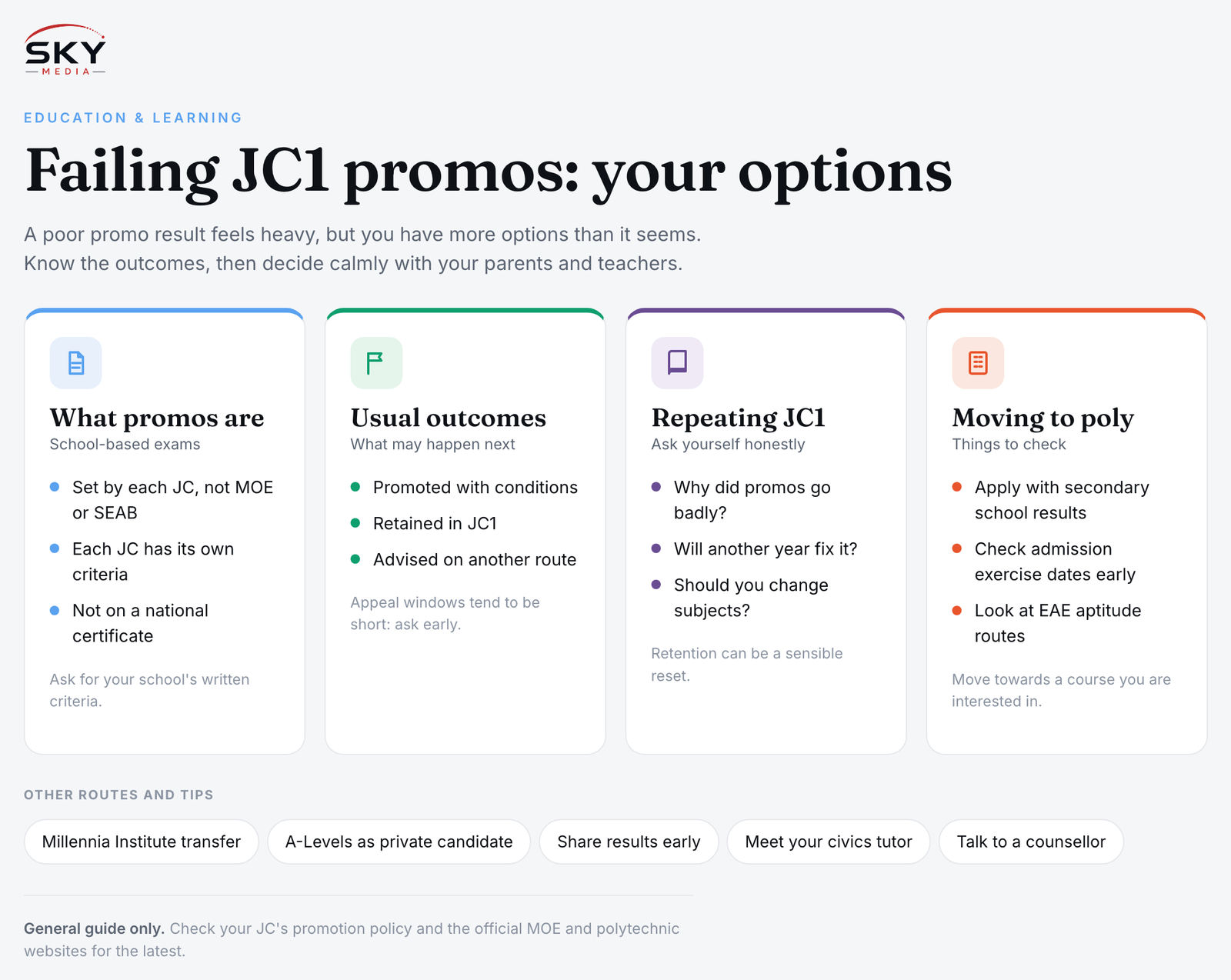
What JC1 Promos Are and Why They Matter
Promotional exams, usually called “promos”, are internal exams held towards the end of JC1. They are set by each junior college, not by MOE or SEAB, and they help the school decide whether a student is ready to move into JC2 and sit for the A-Levels.
Because they are school-based:
- Each JC sets its own promotion criteria. Schools commonly look at how many subjects you passed, your performance in key subjects such as General Paper, and your overall grades, but the exact rules differ between colleges.
- Teachers’ judgement plays a part. Your effort, attendance and progress through the year may be considered, especially in borderline cases.
- The results do not go on a national certificate. Promos matter for progression within your JC, not as a qualification on their own.
Ask your civics tutor or form teacher for your school’s written promotion criteria. Knowing exactly where you fell short makes the next conversation more useful.
The Usual Outcomes After Failing Promos
Depending on your results and your school’s policy, outcomes generally fall into a few categories. Your school will explain which applies to you.
- Promoted with conditions. Sometimes called conditional promotion or promotion on probation. You move to JC2 but must meet certain targets, such as passing later common tests, and you may receive extra support.
- Retained in JC1. You repeat JC1, usually with the same subject combination or a revised one. Schools generally limit how many times a student can be retained, so check the policy with your school.
- Advised to consider another route. Where results suggest the A-Level track is a poor fit, the school may counsel you on alternatives such as a polytechnic diploma or a transfer to a centralised institute.
- Appeal or review. Some schools allow students and parents to appeal a retention decision, especially if there were extenuating circumstances such as illness. Ask about the process and timeline straight away, as windows tend to be short.
Your Options Compared
| Option | What it involves | Often suits students who |
|---|---|---|
| Accept conditional promotion | Move to JC2 with targets and monitoring | Were close to the bar and have a clear plan to improve |
| Repeat JC1 | Another year to rebuild foundations before JC2 | Struggled because of a fixable reason, such as illness or a poor start |
| Switch to a polytechnic | Apply for a diploma using your secondary school results | Prefer applied, hands-on learning or a specific career path |
| Transfer to Millennia Institute | Three-year pre-university route to the A-Levels | Want the A-Level route but at a steadier pace, if a transfer is possible |
| Sit the A-Levels as a private candidate | Study independently or with private tuition | Are highly self-motivated and have a strong reason to stay on the A-Level route outside school |
Thinking Through Retention
Repeating JC1 is not a failure of character. It can be a sensible reset, particularly if your results were dragged down by something specific, such as a difficult home situation, health issues or a subject combination that did not suit you.
Before choosing retention, ask yourself honestly:
- Why did promos go badly? Was it time management, a weak foundation in one subject, or a genuine dislike of the A-Level style of learning?
- Will another year fix it? If the issue was a rocky first term, a second run may help. If you have felt disengaged all year, a different route may serve you better.
- Should you change subjects? Some students do much better when they drop a subject that was a poor fit. Ask whether your school allows a change of combination.
- Can you handle being a year behind your friends? It is normal to feel awkward at first, but most retained students settle in quickly.
Moving From JC to Polytechnic
Many students who leave JC after JC1 thrive at polytechnics. Diplomas are practical, often include internships, and can lead to university later. Our guides on JC vs poly vs ITE pathways and what a poly GPA means for university options explain how this route can still lead to a degree.
If you are considering this switch:
- Admission usually uses your secondary school results. JC students moving to poly typically apply through the admissions exercises using their O-Level results, or SEC results for later cohorts. Your JC1 grades are not the main factor.
- Check the timeline carefully. Polytechnic admission exercises run at set times of the year. Your JC1 results may come out after some windows have closed, so check the Joint Admissions Exercise dates on the official MOE and polytechnic websites as early as possible.
- Look at aptitude-based routes. The Early Admissions Exercise (EAE) lets students apply based on aptitude and interest. Eligibility and timelines are set by the polytechnics, so confirm whether you qualify. Our EAE for poly and ITE explainer covers how it works.
- Choose a course you are interested in. Switching to poly works best when you are moving towards something, not just away from JC.
How to Talk to Your Parents and School
The days after results can be tense at home. A few tips help:
- Share the results early. Hiding them only adds stress later.
- Bring facts, not just feelings. Show your parents the promotion criteria, your subject grades and any options your school has suggested.
- Ask for a meeting with your civics tutor or a school counsellor. They see many students in the same position and can give a realistic view.
- Make a decision together, by the deadline. Write down the options, the pros and cons and the dates for each.
Looking After Yourself After Bad Results
It is normal to feel disappointed, embarrassed or anxious. Talk to someone you trust: a friend, a parent, a teacher or your school counsellor. If low mood, trouble sleeping or worry lasts for weeks or starts affecting daily life, reach out to your school counsellor or a doctor for support.
Remember that promos are a checkpoint, not a final verdict. Whichever path you choose, a thoughtful decision now, made with good information, matters far more than one set of exam papers.
Frequently Asked Questions
Can I appeal if my JC decides to retain me after promos? Some schools allow students and parents to appeal a retention decision, especially where there were extenuating circumstances such as illness. Ask about the process and timeline straight away, as the windows tend to be short. Each JC sets its own policy.
Do I need O-Level or SEC results to apply to a polytechnic after leaving JC1? Admission usually uses your secondary school results, O-Level or SEC for later cohorts, rather than your JC1 grades. Polytechnic admission runs at set times of the year, so check the Joint Admissions Exercise dates on the official MOE and polytechnic websites early.
Is Millennia Institute a realistic option after failing JC1 promos? It can be, if a transfer is possible, since it offers a three-year route to the same A-Levels at a steadier pace. Availability depends on vacancies. Ask your school and MOE about transfer arrangements, and weigh up whether a slower pace is what you need.
Can I sit the A-Levels as a private candidate instead of repeating JC1? It is possible, but it suits only highly self-motivated students with a strong reason to stay on the A-Level route outside school. You study independently or with private tuition. Discuss the practicalities with a school counsellor before deciding.
How should I tell my parents about failing promos? Share the results early, since hiding them adds stress later. Bring facts, such as the promotion criteria, your subject grades and the options your school suggested. Ask for a meeting with a civics tutor or school counsellor so everyone gets a realistic view.
Official sources: Ministry of Education (MOE)
Further reading: Appealing to Change Your Junior College After JAE Posting