

Weekend tutoring, evening delivery shifts, a freelance design project: plenty of people in Singapore earn money outside their main job. Before you say yes to extra work, it helps to understand the moonlighting rules Singapore employees actually face. They come less from one single law and more from three places: your employment contract, your duties to your employer, and, for foreigners, the conditions of your work pass.
This guide focuses on whether a second job is allowed and how to do it properly, not on side income ideas. It is general information, not legal advice. If your situation is unclear, check your contract with HR, speak to a lawyer, or contact the Ministry of Manpower (MOM) or a union for guidance.
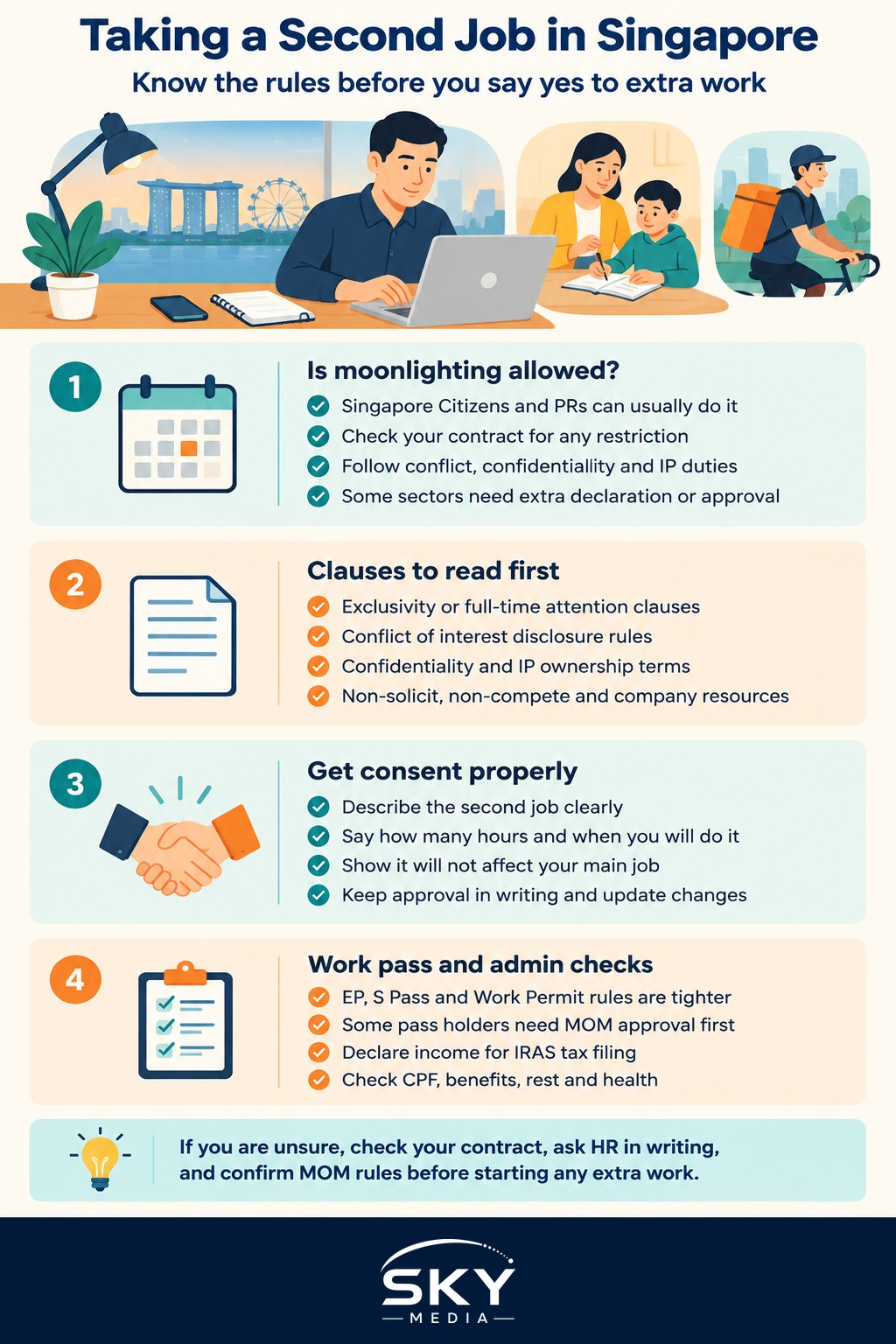
Is Moonlighting Legal in Singapore?
For Singapore Citizens and Permanent Residents, there is no general law that bans holding a second job. You can usually work for more than one employer, run a small business on the side or take freelance projects. The real limits tend to be:
- What your employment contract says. Many contracts include clauses that restrict outside work.
- Your duties to your current employer. Even without a written clause, you are expected to act in good faith, protect confidential information and not compete unfairly.
- Your company’s policies. Employee handbooks often set rules on declaring outside work and conflicts of interest.
- Sector rules. Some regulated roles, such as those in financial services or the public service, have extra declaration or approval requirements. Check the rules that apply to your profession.
For foreigners on work passes, the picture is very different, as explained below.
Contract Clauses to Look For
Pull out your employment contract and the employee handbook and read them carefully. These are the clauses that matter most for a second job.
- Exclusivity or “full time and attention” clause. Some contracts say you must devote your full working time to the employer, or must not take up other employment without written consent. This is the most direct restriction on moonlighting.
- Conflict of interest clause. You may be required to declare any outside interest that could clash with your role, such as working for a supplier, client or competitor.
- Confidentiality clause. You cannot use your employer’s confidential information, client lists or internal know-how in your side work.
- Intellectual property (IP) clause. Some contracts give the employer ownership of work you create during employment, sometimes even outside office hours if it relates to the business. This matters a lot for designers, developers and writers.
- Non-solicitation and non-compete clauses. These may stop you from approaching your employer’s clients or working for a competitor, during employment and sometimes for a period afterwards.
- Use of company resources. Using the company laptop, software licences, email or office time for side work is almost always prohibited.
If a clause seems unclear, ask HR for clarification in writing rather than guessing.
Getting Employer Consent the Right Way
When your contract requires consent, or you simply want to stay on the safe side, a short, honest request usually works better than keeping quiet. Here is a simple approach.
- Describe the second job clearly. State what the work is, roughly how many hours it involves and when you would do it, for example weekends only.
- Address conflicts upfront. Explain why the work does not compete with your employer, does not involve its clients and will not use its resources or information.
- Confirm your main job comes first. Make it clear you will not let the second job affect your working hours, availability for scheduled shifts or performance.
- Get the reply in writing. An email from your manager or HR confirming approval protects both sides if questions come up later.
- Update them if things change. If the side work grows or changes direction, tell your employer again.
Being found to have breached a contract clause can lead to disciplinary action, including dismissal, so disclosure is usually the safer path.
Work Pass Holders: Much Stricter Limits
If you are in Singapore on a work pass, the rules on second jobs are set by MOM and are far tighter than for citizens and PRs. In general:
- Employment Pass (EP) and S Pass holders are tied to the employer named on their pass. Working for anyone else, including freelancing or a paid side gig, is generally not allowed without the relevant approval from MOM.
- Work Permit holders are similarly restricted to the employer and occupation stated on their permit.
- Dependant’s Pass and Long-Term Visit Pass holders typically need their own work pass or a Letter of Consent from MOM before working, depending on current rules.
- Starting your own business while on a work pass is a separate question. Whether you may do it depends on MOM’s rules for that specific pass, and you must check before starting.
Working without the right authorisation can have serious consequences for both the worker and anyone who employs them, including risks to your pass. Always confirm the current requirements on the MOM website before taking up any extra work.
The table below summarises the main differences.
| Situation | Can you take a second job? | What to check first |
|---|---|---|
| Singapore Citizen or PR, no restrictive clause | Usually yes | Conflict of interest, confidentiality and IP terms |
| Singapore Citizen or PR, contract requires consent | Only with employer approval | Written consent from HR or your manager |
| Employment Pass or S Pass holder | Generally no, beyond your pass employer | MOM rules for your pass before any extra work |
| Work Permit holder | Generally no | MOM conditions on your permit |
| Dependant’s Pass or LTVP holder | Only with the right pass or consent | Current MOM requirements for your pass type |
Hours, Rest and Your Health
Two jobs can easily add up to very long weeks. The Employment Act sets rules on hours, overtime and rest days for many employees, and your main employer may expect you to be available for scheduled overtime or shifts. Think about:
- Whether overtime or weekend work in your main job could clash, and whether you will get enough rest.
- Your annual leave and medical leave. Doing paid work for another party while on medical leave from your main job can raise serious questions.
If you notice stress or burnout building up, step back. Your company’s Employee Assistance Programme, if it has one, can offer confidential support.
Tax and CPF on Second Job Income
Extra income comes with admin. Keep these in mind:
- Income tax. Income from all your jobs and freelance work generally needs to be declared to the Inland Revenue Authority of Singapore (IRAS) in your annual tax filing. If you are self-employed on the side, you may need to keep records of income and expenses.
- CPF. If your second job is regular employment, the second employer generally makes its own CPF contributions based on what it pays you. Our guide to CPF contributions for employees explains the basics. If you are a self-employed person, separate MediSave rules may apply. Check with the CPF Board.
- Insurance and benefits. Company benefits such as medical cover usually relate only to your main employer. Check whether you are covered for work injuries in your side job, especially if it is physical work.
A Quick Checklist Before You Say Yes
- Read your contract and employee handbook for exclusivity, conflict, IP and confidentiality clauses.
- Ask for written consent if your contract requires it, or if you are unsure.
- Make sure the side work does not involve competitors, clients or company resources.
- If you hold a work pass, confirm with MOM whether any extra work is allowed.
- Keep records for tax filing with IRAS.
Handled openly, a second job can be a sensible way to build skills or savings. The key is to know your contract, respect your employer’s interests, and, for pass holders, follow MOM’s rules to the letter. If your employer pays late or a pay dispute arises in either job, our guide to late salary in Singapore covers your options.
Frequently Asked Questions
Can I freelance on weekends if I hold an Employment Pass? Generally no. Employment Pass and S Pass holders are tied to the employer named on their pass, and working for anyone else, including freelancing, is generally not allowed without the relevant approval from MOM. Check the current requirements on the MOM website first.
What happens if I take a second job without telling my employer? If your contract requires consent or restricts outside work, a breach can lead to disciplinary action, including dismissal. Disclosing the work and getting written approval from HR or your manager is usually the safer path.
Can my employer claim ownership of what I create in my side business? Some contracts have an IP clause giving the employer ownership of work created during employment, sometimes even outside office hours if it relates to the business. This matters for designers, developers and writers, so ask HR to clarify in writing.
Do I need to declare second-job income to IRAS? Income from all your jobs and freelance work generally needs to be declared in your annual tax filing with IRAS. If you are self-employed on the side, keep records of income and expenses, and check the current guidance on the IRAS website.
Can my spouse on a Dependant’s Pass take on part-time work? Dependant’s Pass and Long-Term Visit Pass holders typically need their own work pass or a Letter of Consent from MOM before working, depending on current rules. Confirm the current requirements for your pass type on the MOM website.
Official sources: Ministry of Manpower (MOM)
Further reading: Training Bonds and Course Fee Clawbacks: What Employees Should Know · Whistleblowing at Work in Singapore: How to Report Wrongdoing Safely · How to Create an Employee Handbook in Singapore