

If you plan to open a restaurant, cafe, snack kiosk, bakery with seating, or a stall in a coffee shop, you will almost certainly need an SFA food shop licence before you can sell food to the public. Broad guides to starting an F&B business usually mention the licence in a single line. This article goes deeper, walking through who needs it, what must be in place before you apply, and how to prepare so the process goes smoothly.
This is general information, not legal advice. Licensing requirements, fees and processing times are set by the authorities and can change, so always confirm the current details on the Singapore Food Agency (SFA) and GoBusiness websites before committing money to a lease or renovation.
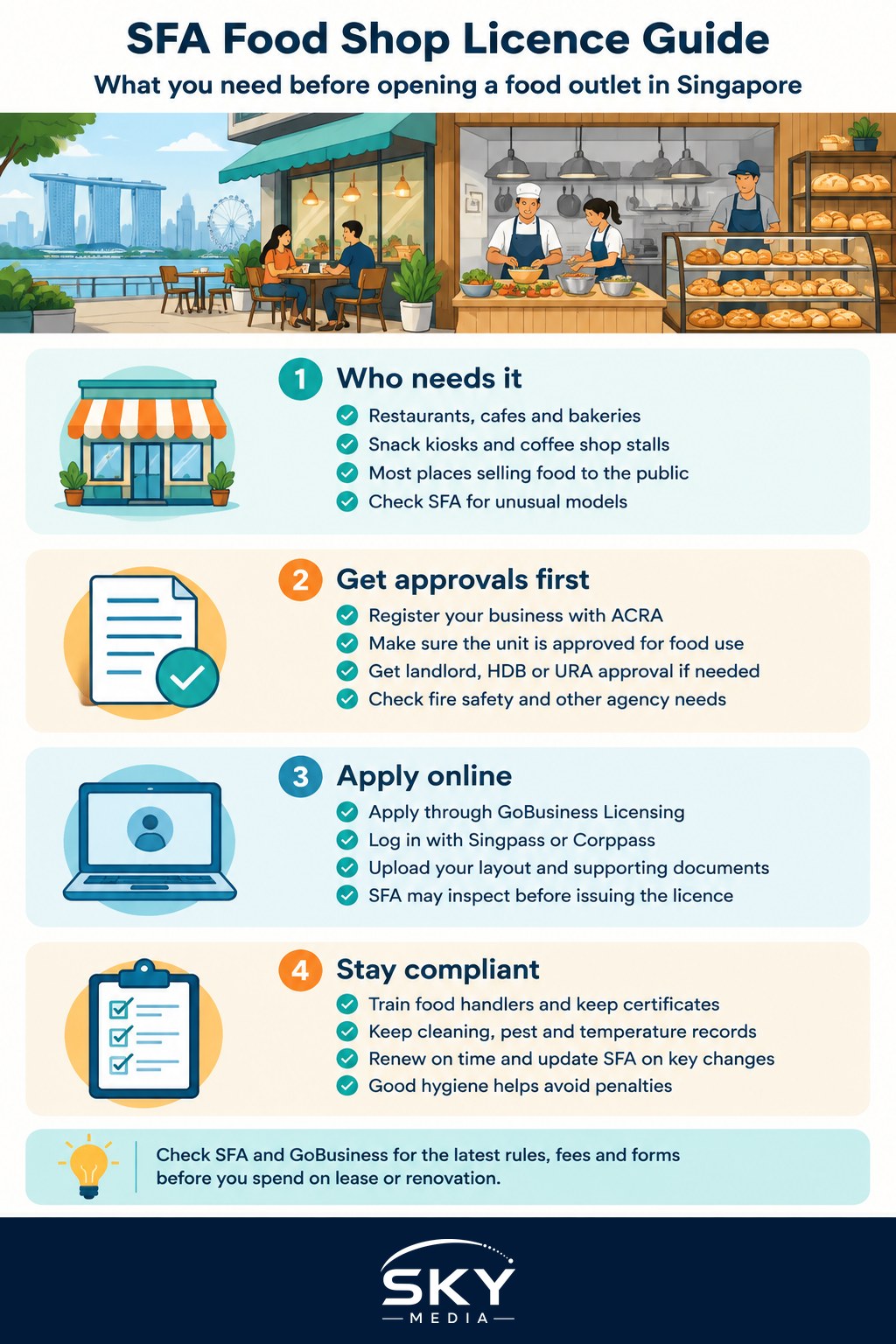
What the Food Shop Licence Covers
The Singapore Food Agency is the national authority responsible for food safety, including the licensing of retail food establishments. A food shop licence is generally required for premises where food is prepared or sold directly to consumers. Examples typically include:
- Restaurants, cafes, bistros and fast-food outlets.
- Snack counters and kiosks in malls.
- Stalls within coffee shops, canteens and food courts.
- Bakeries, confectioneries and takeaway outlets.
Other activities fall under different licences. Food manufacturing and wholesale, hawker stalls in centres managed by the National Environment Agency (NEA), temporary fair stalls and home-based food businesses each have their own rules. If your model is unusual, such as a central kitchen supplying several outlets, a cloud kitchen, or a food truck, check with SFA which licence applies before you sign anything. For an overview of other permits your business may need, see our guide to business licences and permits in Singapore.
Approvals to Secure Before You Apply
The most common mistake new operators make is signing a lease and starting renovation before confirming the premises can legally be used for food. SFA will generally expect the premises to be approved for that use first.
Check these points early:
- Business registration. Your business should be registered with ACRA, the Accounting and Corporate Regulatory Authority, through Bizfile, its online portal. You will need your UEN (Unique Entity Number) for licence applications.
- Planning permission for the premises. The unit must be approved for food use. For private commercial premises this is governed by the Urban Redevelopment Authority (URA), and a change of use may need approval. For HDB shops, check with HDB on the permitted trade for that unit.
- Landlord consent. Your landlord or the management corporation (MCST, the body that manages a strata development) may have its own rules on cooking, exhaust and grease.
- Fire safety. Fit-out works may need fire safety approval from the Singapore Civil Defence Force (SCDF), particularly where kitchens, gas or structural changes are involved.
- Other agencies. Depending on your plans, you may also deal with PUB for grease traps and sanitary works, the Police for a liquor licence if you will sell alcohol, and MUIS if you want halal certification.
Doing this homework before you commit protects you from paying rent on a unit you cannot use.
The Application Process, Step by Step
Applications for SFA licences are made online through the GoBusiness Licensing portal, the government’s one-stop platform for business licences. You will usually log in with Singpass or Corppass, the government’s personal and corporate digital identities. The exact steps and documents can change, but the general flow looks like this.
| Step | What happens | What to prepare |
|---|---|---|
| 1. Confirm premises suitability | Check planning use, landlord consent and any HDB or URA approvals | Tenancy agreement, approval letters |
| 2. Plan the layout | Design the kitchen and food areas to meet SFA’s hygiene requirements | Floor plan or layout plan showing food preparation, storage, washing areas |
| 3. Submit on GoBusiness | Fill in the application and upload supporting documents | UEN, Corppass access, layout plan, details of the person in charge |
| 4. Assessment or inspection | SFA reviews the application and may inspect the premises | Completed fit-out, working sinks, equipment in place |
| 5. Licence issued | You receive the licence and can start operating | Display requirements and record-keeping in place |
A few practical notes on each stage:
- Layout. SFA publishes guidelines on things like separate hand-washing facilities, adequate refrigeration, proper ventilation, smooth and washable surfaces, and keeping raw and cooked food apart. Designing to these from the start avoids costly rework.
- Fees. A licence fee is payable, and amounts can differ by premises type and licence period. Check the current fee on the GoBusiness or SFA site rather than relying on figures from older articles.
- Timing. Processing time depends on whether an inspection is needed and whether your documents are complete. Build buffer time into your opening plan.
Food Safety Training and Staff Requirements
Licensing is not only about the premises. SFA also sets requirements for the people handling food.
- Food handlers. Staff who prepare or handle food are generally required to complete a basic food safety course, commonly known as the Food Safety Course Level 1, and to keep it current through refresher training as required.
- Food Hygiene Officer. Larger establishments may need to appoint a Food Hygiene Officer (FHO), a trained person responsible for food safety practices on site. Check SFA’s current criteria to see if this applies to your outlet.
- Record-keeping. Expect to keep records such as staff training certificates, pest control service reports and cleaning schedules, which inspectors may ask to see.
Plan training before opening day. Courses fill up, and you do not want new staff unable to work because their certification is pending.
Staying Compliant After You Open
Getting the licence is only the start. SFA monitors food establishments and can take enforcement action, including fines, suspension or cancellation, for serious or repeated hygiene lapses. SFA has also been moving towards a framework that recognises operators with strong food safety track records, so consistent good practice can work in your favour over time. Check the SFA website for how the current framework works.
Good habits to build in from day one include:
- Daily cleaning checklists and regular deep cleans.
- A pest control contract with documented visits.
- Temperature checks for chillers and freezers.
- Clear labelling and dating of prepared food.
- Procedures for handling customer complaints about food safety.
Remember to renew your licence before it expires and to update SFA if key details change, such as a change of ownership, business entity or major layout. A new owner or a relocation usually means a new application rather than a simple update.
Common Pitfalls to Avoid
- Signing a long lease before confirming the unit is approved for food use.
- Starting renovation without a layout that follows SFA guidelines.
- Assuming a previous tenant’s licence transfers to you. It generally does not.
- Forgetting separate licences for alcohol, halal certification or outdoor seating.
- Leaving staff training to the last week.
If you are unsure at any stage, contact SFA directly or speak to a qualified consultant familiar with F&B licensing. A short check early on can save weeks of delay later. Operators expanding into other regulated retail can compare the process with our guide on applying for an AVS pet shop licence.
Official sources: Singapore Food Agency (SFA)
Further reading: How to Apply for a Massage Establishment Licence in Singapore · Food Labelling Rules for Packaged Food Sold in Singapore · Basic Food Hygiene Course and Food Handler Registration in Singapore · How to Start a Cloud Kitchen in Singapore