

If you have moved to Singapore, or are helping a family member plan their studies here, you will quickly hear three names whenever someone mentions a private degree in Singapore: SIM, Kaplan and PSB. They are among the best-known private education institutions, but they are not interchangeable, and the “best” one depends on what you need from the degree.
This guide does not repeat the basics of private universities in general. Instead, it helps you decide between the major pathways by looking at how they actually differ, and what you must check before paying any fees.
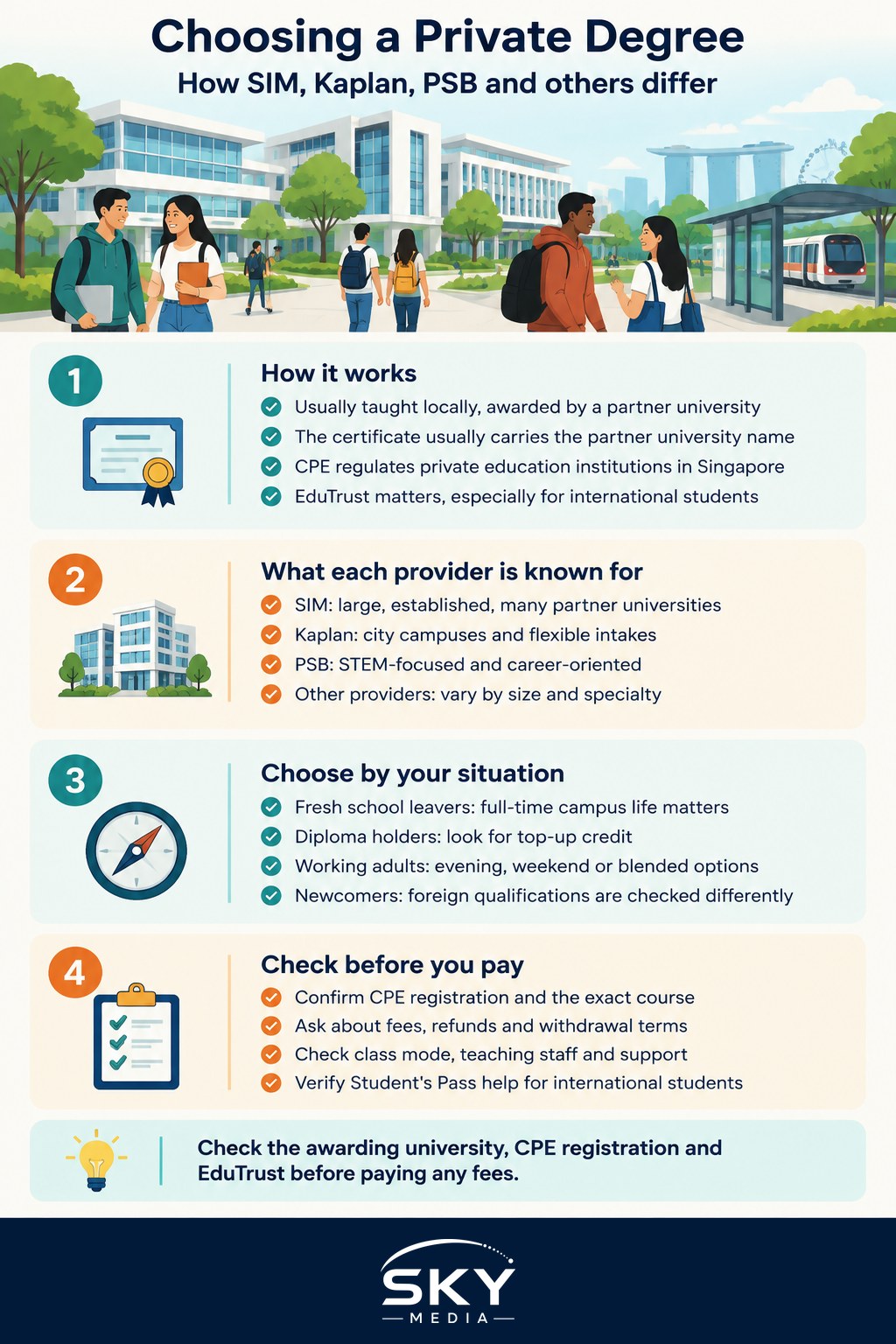
How Private Degrees in Singapore Actually Work
Before comparing providers, it helps to understand the model. Most private degrees in Singapore are delivered locally by a private institution but awarded by a partner university, usually from the UK, Australia, Ireland, the United States or elsewhere. Your certificate normally carries the partner university’s name, not the local provider’s.
A few points matter for every decision:
- The awarding university is what employers and other institutions look at. The local provider shapes your day-to-day experience: timetable, teaching, campus and support.
- Private institutions are regulated by the Committee for Private Education (CPE), which is part of the Skills and Workforce Development Agency (SWDA, formed in 2026 from Workforce Singapore and SkillsFuture Singapore). CPE keeps a register of private education institutions and the courses they are allowed to offer.
- EduTrust is a CPE certification scheme for private schools. Institutions that enrol international students on a Student’s Pass generally need it. Check a provider’s current status on CPE’s website rather than relying on marketing material.
- Private institutions are different from Singapore’s autonomous universities, such as NUS, NTU and SMU, which have their own admissions processes and are publicly funded.
SIM, Kaplan and PSB at a Glance
Each provider has its own character. The table below summarises how they are commonly perceived and what you should verify. Course lists and partner universities change, so treat it as a starting point, not a final answer.
| Provider | Commonly known for | What to verify yourself |
|---|---|---|
| SIM (Singapore Institute of Management, SIM Global Education) | One of the largest and longest-established providers, with a dedicated campus, a wide spread of partner universities and an active student life | Which partner university awards your specific degree, entry requirements for that programme, and intake dates |
| Kaplan Singapore | City-based campuses, flexible intakes and many programmes aimed at diploma holders and working adults topping up to a degree | Whether your diploma qualifies for advanced standing, class schedules, and the awarding university’s reputation in your field |
| PSB Academy | A strong focus on engineering, IT and other STEM areas alongside business, with a practical, career-oriented emphasis | Lab and facility access for your course, the partner university, and any professional accreditation claims |
| Other CPE-registered providers | A wide range of sizes and specialities, from business to hospitality and design | EduTrust status, CPE registration of the exact course, and how long the partnership has existed |
Choosing by Your Situation, Not the Brand
A private degree in Singapore is a big investment of time and money, so begin with your circumstances rather than a provider’s name.
You have just finished A-levels, a foreign high school diploma or an equivalent. You will usually be looking at a full degree, often three years. Campus life, peer group and student support matter more here. Larger providers with a dedicated campus and many clubs tend to suit younger full-time students.
You hold a polytechnic or private diploma. Many providers offer “top-up” degrees, which give credit for your diploma so you finish faster. Compare how much credit each programme grants for your specific diploma. If you are still deciding whether further study makes sense at all, our guide to choosing between a diploma and a degree can help.
You are working full-time. Look for evening or weekend classes, blended learning and flexible intakes. Our article on part-time and flexible degrees explains how these formats work in practice.
You are a newcomer with overseas qualifications. Providers assess foreign certificates differently. If you studied in mainland China, read verifying Chinese qualifications in Singapore before applying, as some providers and employers ask for verified documents.
The Awarding University Matters Most
Two programmes at the same provider can lead to very different outcomes, because they may be awarded by different universities. When you compare options, look past the provider and ask:
- Which university awards the degree, and is it the same degree students receive on its home campus? Some partner universities state that the certificate is identical; others differ. Ask the provider and check the university’s own website.
- Is the university well regarded in your field? A university with a strong name in business may be less known in engineering, and vice versa.
- Is the course accredited by a professional body you care about? For accounting, engineering, psychology and similar fields, professional recognition can matter more than general rankings. Verify any accreditation claim with the professional body itself.
- Does the degree meet your future plans? If you may later apply for postgraduate study, a public sector role or work in another country, check how that institution or employer views the specific awarding university.
Questions to Ask Before You Pay
Private education involves contracts and upfront fees, so protect yourself. Ask every provider you shortlist:
- Is the institution registered with CPE, and is this exact course registered?
- What is the provider’s current EduTrust status?
- What fee protection applies to my payment? CPE requires registered providers to protect students’ fees, and you can ask how this works for your course.
- What is the refund and withdrawal policy, in writing?
- How are classes delivered: full-time, part-time, online or blended? Who teaches them, local lecturers or visiting faculty from the partner university?
- What academic support, career services and internship links are available?
- For international students: does the course support a Student’s Pass application with ICA (Immigration & Checkpoints Authority)? Note that pass conditions, including any work permissions, are set by the authorities and can change.
Fees, intakes, partnerships and regulations change over time. Confirm all current details directly with the provider, CPE and, where relevant, ICA or MOM before you commit.
Visiting and Comparing Providers in Person
Brochures look alike. Visits reveal more. Most providers hold open houses or offer campus tours and course consultations.
- Sit in on a class or info session if allowed, and notice class size and how engaged students are.
- Talk to current students and recent graduates, not just admissions staff. Ask what they would change.
- Check the commute. You may attend classes several times a week for years, so location and transport matter.
- Compare the total cost, including application, exam, materials and any resit fees, not just the headline tuition. Ask for a written breakdown.
- Avoid pressure. A reputable provider will not push you to sign on the spot. Take the paperwork home and read it carefully.
Making Your Final Decision
There is no single best private degree in Singapore. SIM, Kaplan, PSB and other providers each suit different students: young full-timers, diploma holders topping up, working adults or career switchers. Start from your goal, choose the right awarding university for your field, then pick the provider whose format, location and support fit your life.
Do the checks, keep everything in writing and take your time. A careful decision now saves money and frustration later.
Explore more: Adult Education and Part-Time Degrees in Singapore
Frequently Asked Questions
Is a private degree from SIM or Kaplan recognised by employers? Employers mostly look at the awarding university rather than the local provider, since the certificate normally carries the partner university’s name. How a specific employer views that university can vary, so check the field and employer you are targeting.
How do I check if a private school and its course are registered? Look up the institution and the exact course on the Committee for Private Education’s register, and confirm its current EduTrust status there. Do this before paying anything, rather than relying on brochures or an agent’s word.
What is a top-up degree and who is it for? A top-up degree gives credit for a diploma you already hold, so you finish in less time than a full degree. It suits polytechnic or private diploma holders, but compare how much credit each programme grants for your specific diploma.
Can I study part-time while working for a private degree? Many providers offer evening, weekend or blended classes with flexible intakes, which suit full-time workers. Ask about class schedules, how assessments work and whether the format matches what the awarding university offers.
What should I check about fees and refunds before enrolling? Ask for a written breakdown of tuition and extra costs, plus the refund and withdrawal policy in writing. Also ask how your fees are protected under CPE requirements, and avoid providers that pressure you to sign on the spot.
Further reading: Are Online Degrees Recognised in Singapore? · SIT vs SUTD vs SUSS: Choosing Between Them for Your Degree · How to Verify Private School Accreditation in Singapore