
Starting a new job in a new country is exciting and a little nerve-wracking at the same time. If you have just arrived or are about to, getting a feel for work culture in Singapore early will save you plenty of small stumbles and help you settle in faster. The good news is that Singapore is one of the easier places in Asia for a newcomer to adjust to. English is the working language, teams are often international, and workplace norms sit comfortably between Western directness and Asian courtesy. This guide walks you through what to expect, from your first meeting to your first review, in plain and practical terms.
A multicultural, international workplace
Singapore is genuinely diverse, and its offices reflect that. On any given team you might sit next to colleagues who are Singaporean Chinese, Malay, Indian, Eurasian, and a wide mix of professionals from around the region and the wider world. Because of this blend, office culture in Singapore tends to be pragmatic rather than tied to any single national style. People are used to working across cultures, so as a newcomer you will rarely be the only one still learning the ropes.
English is the language of business almost everywhere, so you can expect meetings, emails, and documents to be conducted in it. You will also hear Singlish, the local, colourful blend of English peppered with words from Malay, Hokkien, and other languages. Do not worry about mastering it; colleagues will happily switch to standard English with you. Over time you will pick up friendly staples like “can” (yes, that works), “cannot” (no), and “lah” (a gentle emphasis at the end of a sentence).
Hierarchy, respect, and face
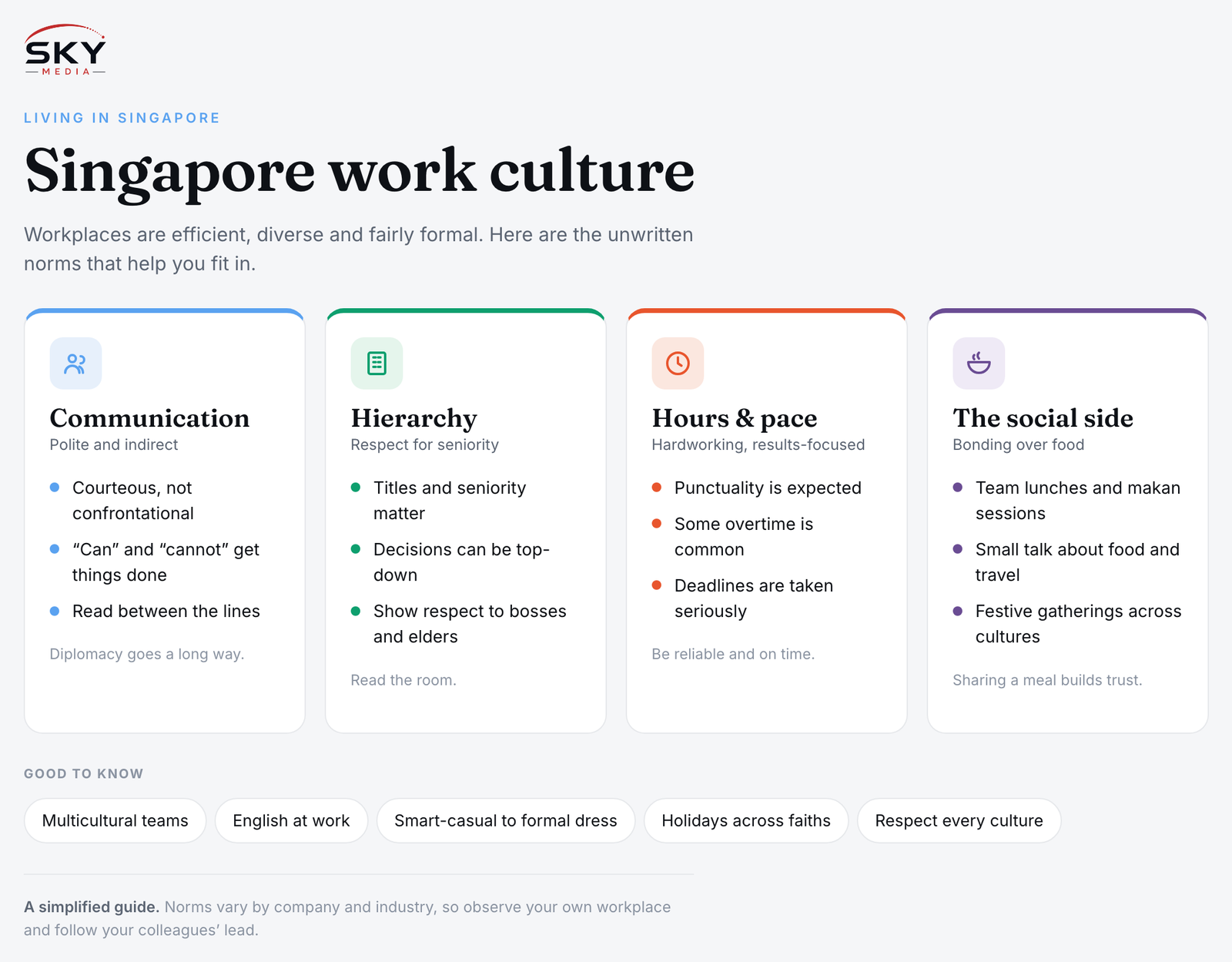
One of the first things many newcomers notice is a quiet respect for hierarchy. Titles and seniority carry weight, and decisions often flow from the top. This does not mean the workplace is cold or rigid, but it does shape how people speak up. In a meeting, junior colleagues may wait for a senior person to share a view first, and open disagreement with a boss in front of others is uncommon.
Closely linked to this is the idea of “face,” which is about preserving dignity and avoiding public embarrassment for yourself and others. If you need to raise a concern or correct a mistake, doing so privately and tactfully is usually far better received than calling it out in an open forum. A little diplomacy goes a long way.
That said, the picture is changing. Many multinational companies and, especially, the growing startup scene run on much flatter structures. In those environments you may be encouraged to challenge ideas openly, address senior people by their first names, and take ownership without waiting for permission. When you join a new team, it pays to observe for a week or two and take your cue from how others behave.
Working hours and the pace of work
Standard working hours are typically around 9am to 6pm, Monday to Friday, though this varies by industry. Some sectors, such as finance, law, consulting, and parts of tech, are known for longer hours and busier crunch periods. Others, particularly established multinationals and the public sector, tend to keep more predictable schedules.
Punctuality matters. Turning up on time for meetings and hitting deadlines are taken seriously, and being reliably prompt quickly builds trust. If you are running late, a quick message ahead of time is the courteous thing to do.
You may also come across the local concept of “kiasu,” which loosely translates as a fear of losing out or missing an advantage. In a work setting this can show up as a strong drive to be thorough, prepared, and one step ahead. It is not hostility; it is a competitive diligence, and channelling that same preparedness will help you fit right in.
Communication styles
Communication in Singapore often sits between direct and indirect. Colleagues are generally polite and considerate, and they may soften a “no” or a disagreement rather than stating it bluntly. A phrase like “this might be a bit difficult” can, in practice, mean it is not going to happen. Learning to read these gentle signals is a genuinely useful skill.
Here are a few etiquette points worth knowing:
- Meetings: Come prepared, arrive on time, and let more senior colleagues open the discussion in traditional settings. In flatter teams, jumping in is welcome.
- Email: Keep it clear, polite, and reasonably formal at first. A short greeting and a courteous sign-off are standard. Over-familiarity too early can feel out of place.
- Instant messaging: Many teams rely on chat apps for quick coordination. Match the tone your colleagues use.
- Feedback: Give it privately and constructively. Receiving it graciously, without becoming defensive, earns respect.
A quiet observation for your first weeks: notice who speaks first, how decisions are made, and how people say no. Mirroring the room is often smarter than importing the habits of your last workplace.
Dress codes and everyday etiquette
Dress varies by sector. Banking, law, and client-facing roles usually lean towards smart or business formal, while creative agencies, tech firms, and startups are often smart-casual or genuinely relaxed. Singapore’s climate is warm and humid all year, so lightweight, breathable office wear is your friend, and a light layer is handy because indoor air-conditioning can be surprisingly cold. When in doubt on your first day, dress a touch more formally, then adjust once you see what your colleagues wear.
Small courtesies count. A polite greeting, remembering names, and joining team lunches all help you build rapport. Sharing food and eating together is a big part of bonding here, so accepting an invitation to lunch or a coffee run is a friendly, low-effort way to connect.
Work-life balance realities
The honest picture on work life balance is mixed and depends heavily on your industry and employer. Singapore is hardworking and results-focused, and in demanding sectors long hours and after-hours messages can be a reality. At the same time, awareness of wellbeing has grown, flexible and hybrid arrangements have become more common, and many employers now make a real effort to protect personal time.
A few things to keep in mind:
- Annual leave for full-time staff commonly starts around 14 days a year and rises with tenure, alongside public holidays that reflect the country’s many communities.
- Norms around replying to messages in the evening vary widely from one team to the next, so watch how your own colleagues handle it rather than assuming.
- If balance matters to you, it is fair to ask about typical hours and flexibility during interviews. The answers tell you a lot about a company’s culture.
For anything tied to your legal entitlements, such as leave, working hours, and rest days, the Ministry of Manpower (MOM) is the authority to confirm details with, since specifics can change over time.
Tips for newcomers adjusting
Settling into a new work culture in Singapore is mostly about observing, staying open, and being patient with yourself. A few pointers that tend to help:
- Watch before you act. Spend your first weeks learning how your specific team operates. Every office blends the local norms differently.
- Be punctual and dependable. Reliability builds trust quickly and is noticed.
- Read between the lines. Pay attention to softened language and indirect cues.
- Respect seniority, but do not be invisible. Contribute thoughtfully; you can be respectful and still add value.
- Say yes to lunch. Informal time together builds the relationships that make work smoother.
- Ask questions gracefully. Curiosity is welcome when it is genuine and considerate.
A note for mainland-Chinese professionals
If you are arriving from mainland China, you will find much that feels familiar, including respect for hierarchy, the importance of relationships, and a strong work ethic. A few differences are worth noting. The working language is English, not Mandarin, even though many colleagues speak it, so leaning on English at work helps you integrate. Communication tends to be a little more understated, and the pace and management style can feel less top-down than you may be used to, especially in multinational and startup settings. Singlish and local references take a little time to decode, and that is completely normal. Give yourself a few months, stay curious, and you will find your footing.
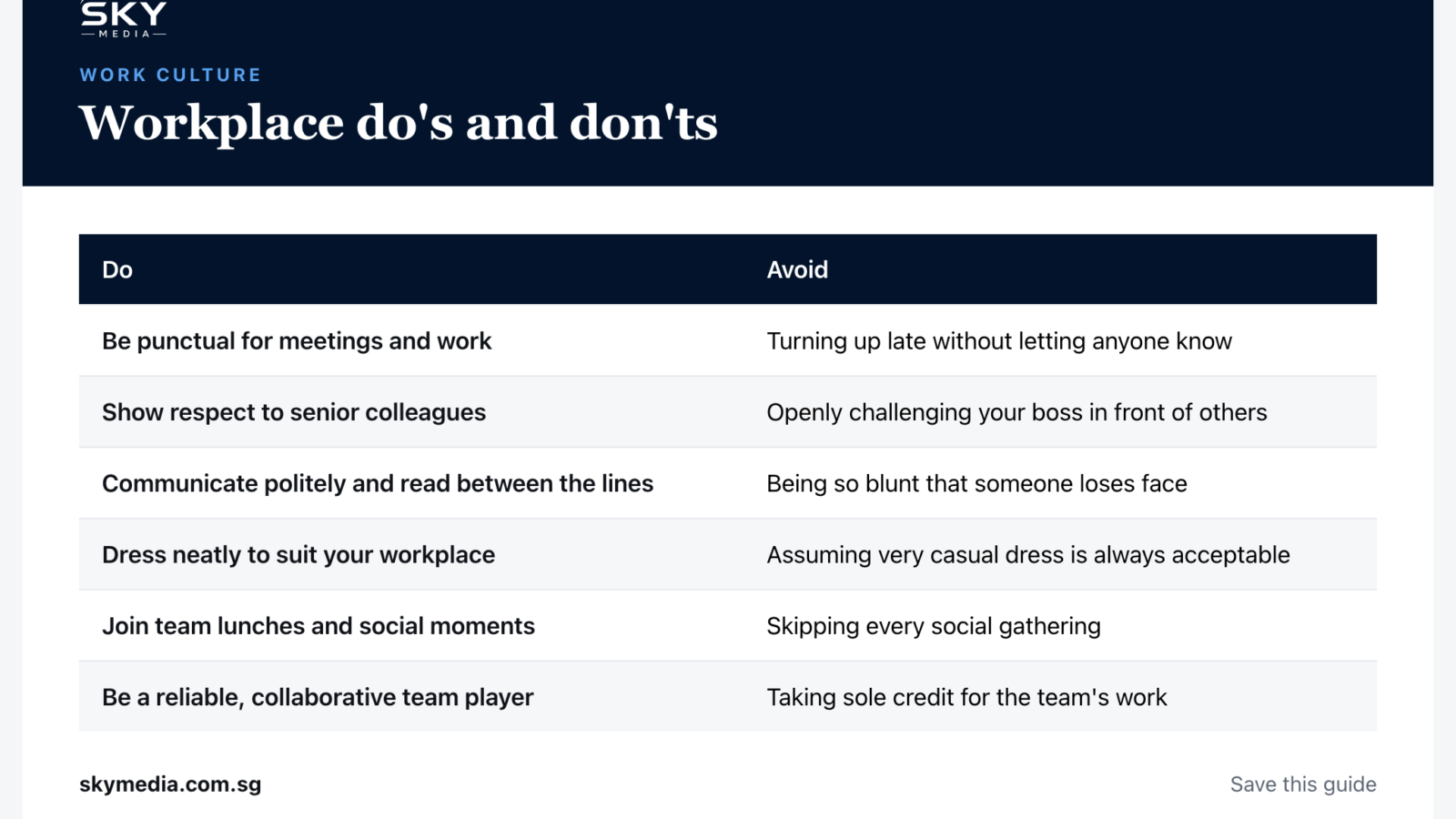
Here are the everyday do’s and don’ts at a glance:
| Do | Avoid |
|---|---|
| Be punctual for meetings and work | Turning up late without letting anyone know |
| Show respect to senior colleagues | Openly challenging your boss in front of others |
| Communicate politely and read between the lines | Being so blunt that someone loses face |
| Dress neatly to suit your workplace | Assuming very casual dress is always acceptable |
| Join team lunches and social moments | Skipping every social gathering |
| Be a reliable, collaborative team player | Taking sole credit for the team’s work |
The bottom line
Work culture in Singapore rewards people who are prepared, respectful, and adaptable. It carries a real respect for hierarchy and courtesy, yet it is modern, international, and increasingly flexible, particularly in younger companies. Lead with reliability, read the room, be generous with small courtesies, and give yourself time to learn the unwritten rules. Do that, and you will settle in far sooner than you expect.
Explore more: Getting a job in Singapore and Singapore work pass guide