
Booking karaoke sounds simple until you arrive and find the room too cramped for your group, the microphones crackling, or your favourite songs missing from the system. Karaoke rooms in Singapore range from tiny two-person booths in shopping malls to large party suites with their own bathrooms and dining menus. Knowing what to look for before you book makes the difference between a great night and a frustrating one.
This guide focuses on the practical side: how rooms differ, what makes a good sound setup, how to check the song library, and which booking terms matter. It works whether you are planning a birthday, a team outing, a family gathering or a quiet solo practice session.
The Main Types of Karaoke Rooms
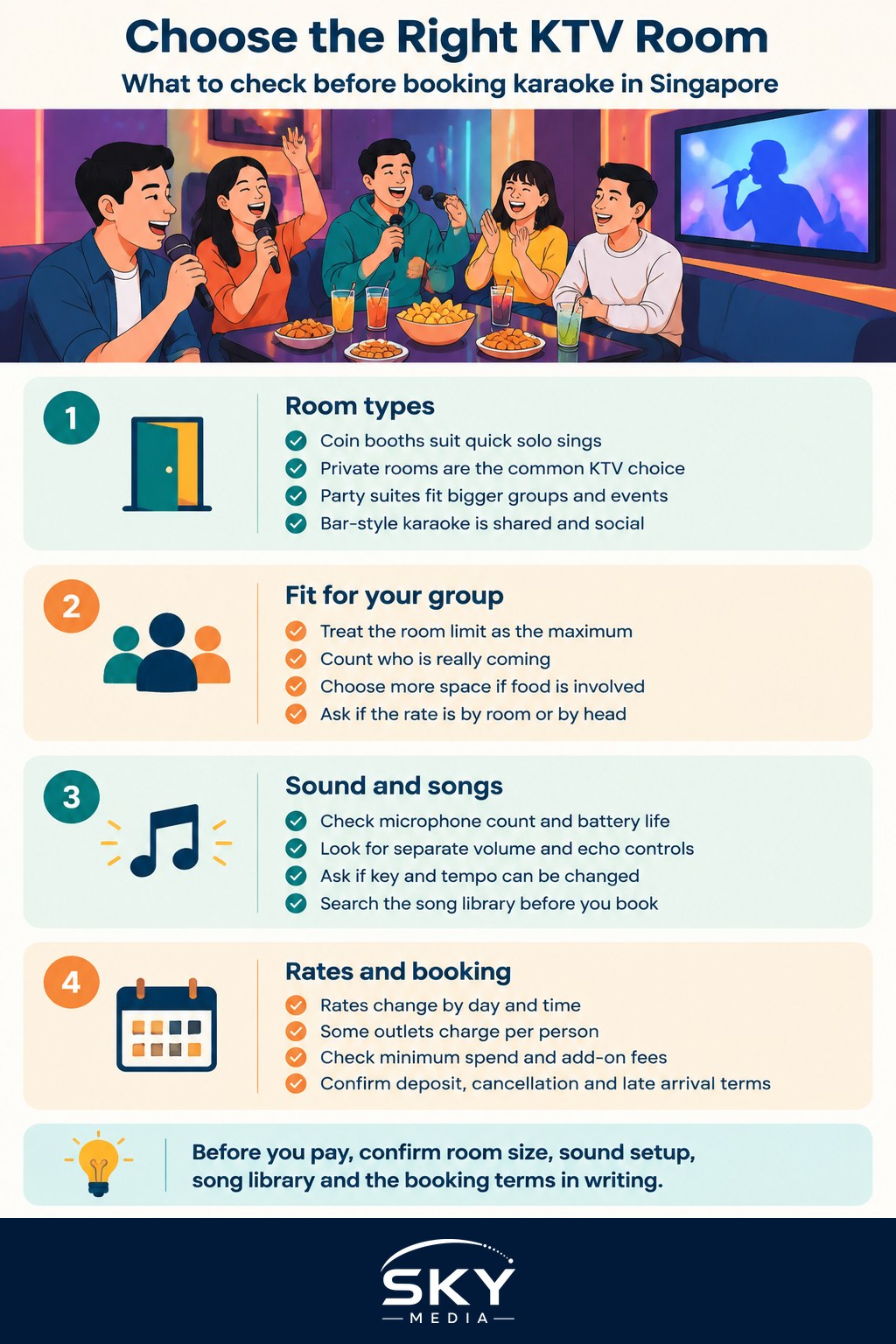
Karaoke outlets in Singapore generally fall into a few formats. Each suits a different kind of outing.
- Coin or self-service booths. Small, glass-fronted pods, often in malls or arcades, that fit one to three people. You pay per song or per short block of time. Good for a quick sing, practice, or killing time between errands.
- Standard private rooms. The most common format at KTV (karaoke television) outlets. A closed room with sofas, a screen, a song selection panel and usually two microphones. Sizes are often labelled small, medium and large based on headcount.
- Party rooms and suites. Larger rooms for big groups, sometimes with a small stage, extra speakers, mood lighting, a private bathroom or a bigger food and drink menu. Popular for birthdays and company events.
- Lounge or bar-style karaoke. A shared stage in a bar or restaurant where you sing in front of other patrons. Less private, more social.
| Room type | Typical group size | Best for | Watch out for |
|---|---|---|---|
| Coin or self-service booth | 1 to 3 | Practice, short solo sessions | Limited comfort, short time blocks |
| Standard private room | 3 to 10 | Friends, family, casual nights | Peak-hour surcharges, minimum spend |
| Party room or suite | 10 and above | Birthdays, team events | Higher minimums, strict time limits |
| Bar or lounge stage | Open audience | Social nights out | Waiting for your turn, less choice |
If you are new to the wider scene, including how KTV outlets work and the etiquette inside, our overview of karaoke and KTV in Singapore is a helpful starting point.
Matching Room Size to Your Group
Outlets usually quote a capacity for each room. Treat the upper number as the absolute maximum, not the comfortable figure. A room “for eight” can feel crowded with eight adults, bags and plates of food.
A few practical rules:
- Count the people who will actually turn up, then round up one size if more than half your group plans to eat during the session.
- For children’s parties, a larger room gives space to move around and keeps little ones away from cables and equipment.
- If guests will arrive in waves, ask whether you can start in a smaller room and move up, or whether the room is fixed once booked.
- Ask whether there is a per-person charge on top of the room rate, since some outlets price by room and others by head.
Judging the Sound System and Equipment
Sound quality is where karaoke rooms differ most, and it is hard to judge from photos. Look for these signs, either in reviews or when you first walk in.
Microphones. Wireless microphones are standard. Check that there are enough for your group (two is common, some rooms offer more on request) and that batteries are fresh. A good outlet will swap a faulty mic quickly.
Speakers and echo. Decent rooms let you adjust the echo (reverb), microphone volume and music volume separately. Being able to lower the backing track while raising your voice makes a big difference for less confident singers.
Key and tempo controls. The ability to change a song’s key is valuable if the original is too high or low for you. Most modern systems offer this, but confirm before booking if your group has specific needs.
Screens and acoustics. A clear screen with readable lyrics, plus soundproofing so you are not hearing the room next door, separate the better outlets from the rest.
If you are not satisfied with the sound in the first few minutes, ask staff to check it or move you. It is easier to fix early than to suffer through a whole session.
Checking the Song Library Before You Go
A song library that suits your group matters as much as the room itself. Singapore outlets typically stock Mandarin, Cantonese, English, Japanese and Korean songs, with varying depth in Malay, Tamil, Hokkien and other languages.
Before booking:
- Ask whether the outlet publishes a song list online or in an app, and search for a few favourites.
- Find out how often the library is updated if your group likes recent chart hits.
- Check whether songs play with the original music video, a generic background video, or lyrics only. Some people care a lot about this.
- If you plan to sing in a less common language, ask directly rather than assuming.
People who sing regularly and want to improve, rather than just have a fun night, may find more ideas in our piece on karaoke and singing as a hobby, which covers practice habits and building confidence.
Understanding Pricing and Booking Terms
Karaoke pricing in Singapore varies widely by outlet, time of day and day of the week, and it changes often, so always confirm the current rates directly with the outlet. Rather than chasing a specific price, understand the structures you might see.
Time-based room rates. You pay per hour or per block (for example, a three-hour package). Daytime and weekday sessions are usually cheaper than evenings, weekends, eves of public holidays and the festive season.
Per-person rates. Some outlets charge each guest, sometimes with a drink or snack included.
Minimum spend. Larger rooms may require a minimum spend on food and drinks. Clarify what counts towards it.
Add-on charges. Ask whether prices include service charge and GST (Goods and Services Tax), and whether there are fees for extending time, corkage for outside drinks, or bringing your own cake.
Booking and cancellation terms. Check whether a deposit is needed, how late you can cancel or change headcount, and what happens if your group arrives late. Some outlets start the clock at your booked time regardless.
For peak dates such as Friday nights, birthdays near public holidays, or the weeks around Christmas and Chinese New Year, book early and get confirmation in writing, such as a message or email.
Practical Checks on the Day
A few simple habits make the session smoother:
- Arrive a little early to sort out payment, deposits and room assignment.
- Test every microphone and the volume controls before the first song.
- Agree a fair song queue so quieter guests get turns too.
- Keep track of time, since staff may give only a short warning before your session ends.
- Check the final bill against what you agreed, including service charge and any extensions.
If your group is the type that enjoys a mix of activities, the same planning approach of checking capacity, timing and cancellation terms works well for other group outings, such as the options in our guide to escape rooms in Singapore.
Choosing Well Comes Down to Fit
The best karaoke room is the one that fits your group, your songs and your budget. Start with headcount, check the sound equipment and song library, then read the pricing and cancellation terms carefully. With those basics covered, all that is left is picking your opening song.
Frequently Asked Questions
Can I bring my own food and drinks into a karaoke room? It depends on the outlet. Some allow outside food, some charge corkage for outside drinks or a cake, and some require a minimum spend on their own menu. Ask when you book and get the policy in writing so there are no surprises on the bill.
Are karaoke rooms suitable for children? Many outlets welcome family groups and children’s parties, but policies on age and opening hours differ. Ask before booking. A larger room gives children space to move around and keeps them away from cables and equipment.
How do I choose a karaoke outlet for a group that sings in different languages? Ask the outlet to search for a few songs from each language in your group before you book, rather than assuming. Mandarin, Cantonese, English, Japanese and Korean are usually well stocked, while Malay, Tamil or Hokkien depth varies.
How do we split the karaoke bill fairly? Agree on the method before the session starts. Check whether pricing is per room or per head, and what the service charge and GST add. Splitting the final bill equally is simplest, but extras such as drinks can be paid separately by those who ordered them.
Do I need to book karaoke in advance on weekends? For popular slots such as Friday nights, weekends and festive periods, booking ahead is wise, and you should ask for confirmation in writing. Weekday daytime visits are often easier to walk into, but call first, since availability and rates differ by outlet.
Further reading: Setting Up Home Karaoke: Mics, Apps and Speakers