

“Say sorry to your brother.” Most parents have said it, and most have heard the flat, eye-rolling “sorry” that follows. The word gets said, the moment passes, and nothing is actually fixed. If you want to teach your child to apologise in a way that means something, the goal is not the word itself. It is helping your child understand what went wrong, take ownership, and do something to repair it.
This guide focuses on that repair step: what to do after a conflict, a broken toy, a hurtful comment or a playground shove, so your child learns to make things right rather than just recite a word to end the trouble.
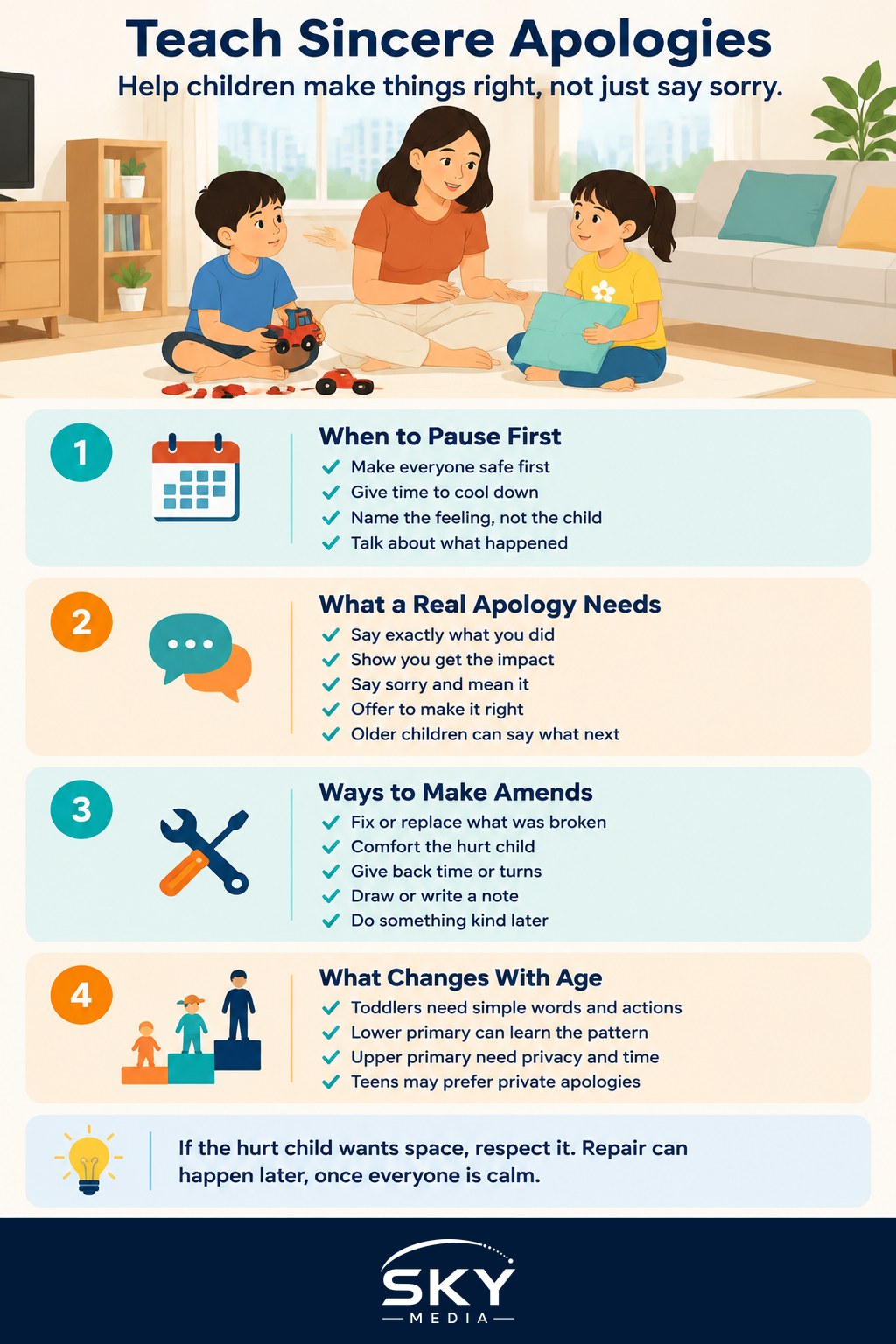
Why Forced Apologies Often Backfire
When children are pushed to say sorry straight away, a few unhelpful lessons can sneak in:
- “Sorry” becomes a password. Say it, and the adult stops talking. Children learn that the word gets them out of trouble, not that it fixes anything.
- The hurt child feels ignored. A mumbled apology rarely makes the other person feel better, and they may feel pressured to say “it’s okay” when it is not.
- Shame takes over. A child who feels humiliated in front of others may become defensive, deny what happened, or blame someone else next time.
None of this means apologies do not matter. They matter a great deal. It means the timing and the content matter more than the speed.
Calm Down First, Then Talk
Children cannot reflect while they are still flooded with anger, fear or embarrassment. Neither can adults. Before asking for any apology:
- Make everyone safe. Separate children if needed, and check on the child who was hurt first. This also models care.
- Give time to cool down. A few minutes of quiet, a drink of water or some slow breathing helps. Techniques from teaching your child mindfulness and relaxation are useful here.
- Name the feeling, not the label. Try “You were really frustrated when he took your blocks”, instead of “You were naughty”.
- Then talk about what happened. Ask open questions: “What happened?”, “How do you think she felt?”, “What could help now?”
This step is where empathy is built. Our guide to teaching your child emotional intelligence goes deeper into helping children recognise feelings in themselves and others.
The Four Parts of a Sincere Apology
A sincere apology has more than one word in it. You can teach children a simple pattern that grows with them.
- Say what you did. “I pushed you off the swing.” Specific, not vague.
- Show you understand the effect. “That hurt, and it scared you.”
- Say sorry and mean it. “I’m sorry I did that.”
- Offer to make it right. “Can I help you up? Do you want a turn first next time?”
Older children can add a fifth part: what they will do differently. “Next time I’m angry, I’ll walk away and tell an adult.”
The table below compares a quick, forced “sorry” with an apology that actually repairs.
| Situation | Forced apology | Repair-focused apology |
|---|---|---|
| Grabbing a sibling’s toy | “Sorry.” (toy kept) | “I took your car. Sorry. Here it is, you can play first.” |
| Saying something unkind | “Sorry, okay?” | “I said your drawing was ugly. That was mean. I’m sorry. I like the colours.” |
| Breaking something by accident | Silence or blaming | “I knocked your vase. I’m sorry. Can I help clean up or save to replace it?” |
| Leaving a friend out | “Fine, sorry.” | “I didn’t let you join. That felt lonely. Sorry. Want to play with us now?” |
Making Amends: The Step Most Families Skip
Repair is what makes an apology real. It also gives the child who caused harm a way to feel good about themselves again, which reduces shame and defensiveness. Ideas for making amends:
- Fix or replace. Help rebuild the block tower, tape the torn page, or contribute pocket money towards something broken, if appropriate for their age.
- Comfort. Fetch an ice pack, offer a hug if the other child wants one, or bring a favourite toy.
- Give back time or turns. If they hogged the tablet, the other child gets the next turn.
- Draw or write a note. Younger children can draw a picture. Older children can write a short message, which is helpful if saying it aloud is hard.
- Do something kind later. Amends do not have to happen in the heat of the moment. A small kind act the next day still counts.
Let the hurt child have a say, too. Ask: “What would help you feel better?” Sometimes the answer is simple. Sometimes they just need space, and that is also okay.
Age-by-Age Expectations
Children develop at different rates, so adjust your expectations.
- Toddlers and preschoolers. They are just beginning to understand other people’s feelings. Keep it simple: name the feeling, show a repair action, and model the words. “Let’s give it back and say sorry together.”
- Lower primary. They can learn the four-part pattern with prompting. Practise during calm moments with role-play, puppets or storybooks.
- Upper primary. They can reflect more deeply and plan what to do differently. Expect some pride and defensiveness, and allow time and privacy.
- Teens. They may prefer to apologise privately or by message. Respect their dignity, but still expect ownership and repair.
If a child repeatedly hurts others, seems unable to show remorse, or is in conflict at school often, speak to their teacher or the school counsellor. Professionals can help work out what is behind the behaviour.
Model It at Home
Children learn most from watching. When you snap at your child, forget a promise or blame them unfairly, apologise using the same pattern: “I shouted at you when I was stressed. That wasn’t fair. I’m sorry. Let’s start again.” This shows that apologising is a sign of strength, not weakness, and that adults are also responsible for repairing mistakes.
Siblings and grandparents can be part of this too. If extended family often expect a quick “sorry”, gently share your approach so everyone is aiming for the same thing.
Small Habits That Help
- Praise sincere effort, not just the word: “You helped her rebuild it. That was kind.”
- Avoid making apologies a public performance in front of a crowd.
- Accept that some apologies will take time, and come back to it once things are calm.
- Read stories where characters make mistakes and fix them, then talk about it.
Teaching a child to apologise sincerely is a long project, not a single lesson. With patience and plenty of modelling, “sorry” becomes the start of making things right, not the end of the conversation.