

Teenagers sit in an awkward gap. Many children’s programmes feel babyish by Secondary 1, yet adult hobby classes can be pitched at working professionals with a different pace, different jokes and sometimes an age limit. A good teen workshop in Singapore bridges that gap: it treats a 13 to 17 year old as a capable learner, hands them real tools and lets them leave with something they made themselves.
This guide is for parents trying to find that middle ground. It covers the workshop types that tend to work well for older kids, how to tell whether a class is genuinely pitched at teens, and what to check before you pay.
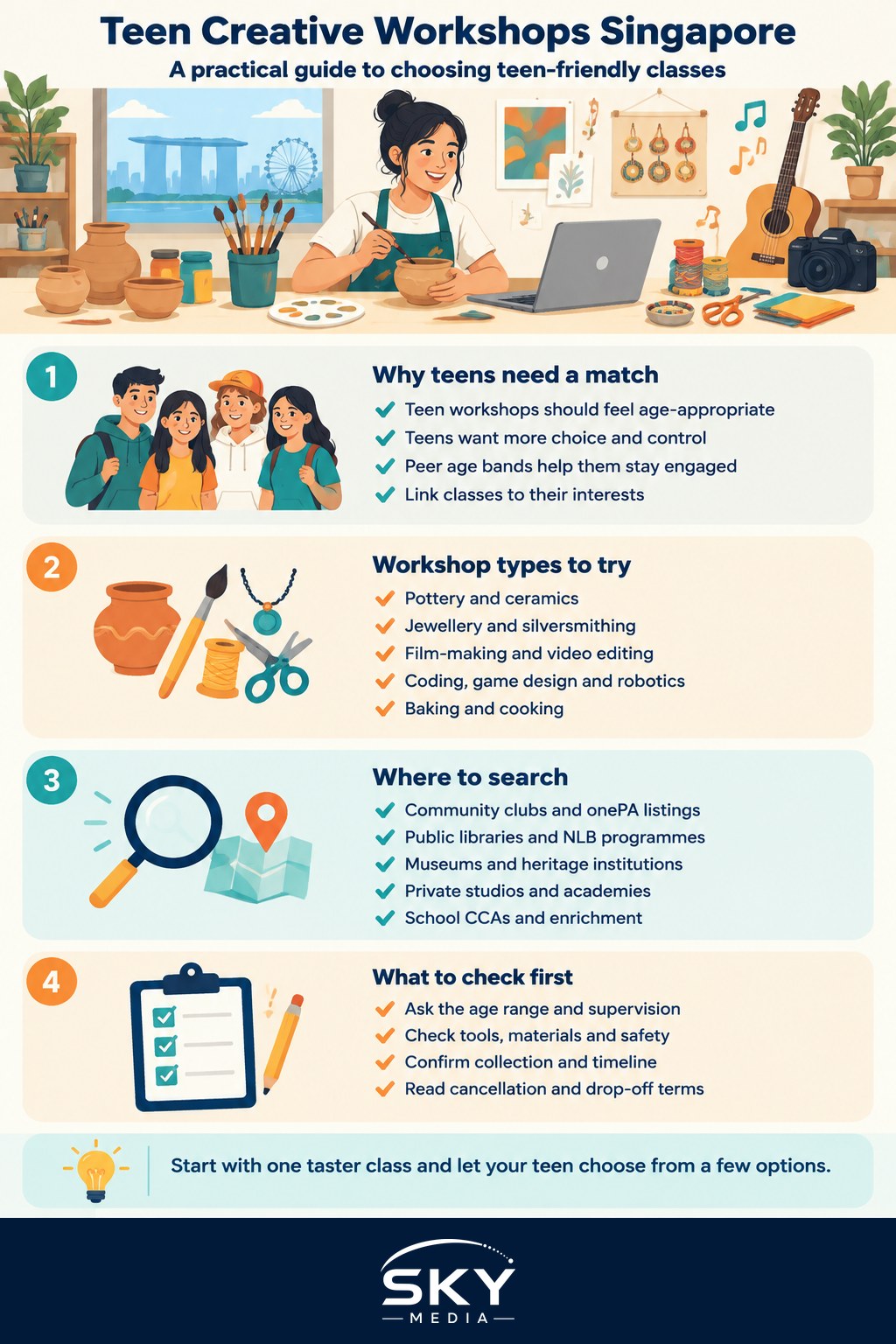
Why Teens Need a Different Kind of Workshop
Younger children usually enjoy structured crafts where every step is shown and the end result is fairly fixed. Teenagers tend to want more control. They respond better when an instructor explains the technique, then steps back and lets them make choices about colour, design or story.
Older kids also care about the social setting. A 15 year old placed with a room of eight year olds will often disengage, even if the activity itself is interesting. On the other hand, a class full of adults can feel intimidating. Workshops that group participants by age band, or that run teen-only sessions during school holidays, usually get the best response.
Finally, teens are building a sense of identity. A workshop that connects to something they already care about, such as music, fashion, games or social media content, is far more likely to stick than one chosen purely because it looks educational.
Creative Workshop Types That Suit Teenagers
Here are the categories that commonly run teen-friendly sessions in Singapore. Availability changes by season, so treat this as a menu of ideas rather than a fixed list.
- Pottery and ceramics. Wheel throwing and hand building are absorbing, screen-free and satisfying. Note that pieces usually need to be fired and collected later, sometimes weeks afterwards.
- Jewellery and silversmithing. Teens learn to saw, file and polish metal into rings or pendants. These classes use sharp tools and heat, so age limits are common.
- Film-making and video editing. Short courses teach shooting, storyboarding and editing on phones or laptops, which channels an existing interest in content creation into a real skill.
- Illustration, comics and digital art. Good for teens who already doodle. Look for classes that cover composition and character design rather than simple colouring.
- Coding, game design and robotics. Project-based sessions where teens build a small game or program a robot tend to hold attention better than lecture-style lessons.
- Music production and songwriting. Beat-making on software, basic recording and lyric writing appeal strongly to music-loving teens.
- Baking and cooking. Practical and confidence-building, and it overlaps neatly with the life skills every teenager needs before adulthood.
- Leathercraft, terrarium building and candle making. Shorter, one-session crafts that work well as a first try or a group outing with friends.
- Creative writing. Workshops on short stories, poetry or scriptwriting suit quieter teens who prefer words to tools.
If you want a broader view of the adult and all-ages options, our guide to art classes and creative workshops covers the wider landscape. The point here is to filter for formats that respect a teenager’s ability.
Where to Look for Teen Workshops in Singapore
You do not need to rely on one source. Parents commonly find good options through:
- Community clubs and the People’s Association. Courses are listed on the onePA portal and are often reasonably priced. Check the stated age range on each listing.
- Public libraries. The National Library Board runs programmes for youth, including writing, digital and maker sessions. Many are free or low cost, but popular ones fill quickly.
- Museums and heritage institutions. School holiday programmes sometimes include teen-level workshops linked to exhibitions.
- Private studios and academies. Pottery studios, art schools, coding schools and music studios frequently run holiday camps for older kids.
- School CCAs and enrichment. Your teen’s school may already offer clubs or external partner programmes, which can be a low-commitment way to test an interest.
Because offerings and prices shift regularly, always check the current schedule and fees directly with the organiser rather than relying on old social media posts.
How to Tell If a Workshop Is Pitched at the Right Level
Many listings say “suitable for all ages”, which can mean anything. Use the comparison below to judge whether a class will feel right for an older child.
| What to look at | Feels too young | Pitched well for teens | Built for adults |
|---|---|---|---|
| Age range stated | 5 to 12, or “kids” | 12 to 17, or teen-only session | 18 and above, or 16+ with guardian |
| Teaching style | Every step demonstrated, same result for all | Technique taught, then room for own choices | Fast pace, assumes prior experience |
| Tools used | Safety scissors, pre-cut kits | Real tools with supervision | Full studio equipment, little hand-holding |
| Class mix | Young children, parents often stay | Peers of similar age | Working adults, evening slots |
| Outcome | Fixed craft to take home | Personal project they designed | Skill progression across several sessions |
If a listing does not state an age range, message the organiser and ask who usually attends. A good provider will answer honestly.
Practical Checks Before You Book
Before paying, run through these points with the organiser:
- Minimum age and supervision. Some studios require a guardian for under-16s, or simply do not accept under-12s.
- Safety for tool-heavy classes. Ask about protective gear, instructor-to-student ratios and how sharp or hot equipment is handled.
- Class size. Smaller groups mean more individual guidance, which matters for skills like wheel throwing.
- What is included. Check whether materials, firing, packaging or software licences are part of the fee or charged separately.
- Collection and timelines. For pottery and some crafts, finished pieces may be ready only after a waiting period.
- Cancellation and rescheduling terms. Teens’ schedules change around exams and CCAs, so flexible terms are valuable.
- Drop-off arrangements. Confirm whether teens can be dropped off alone and what happens if a session ends early.
Getting Your Teen On Board
The best workshop is the one your teen actually wants to attend. Instead of booking on their behalf, try shortlisting three options and letting them choose. Offering a friend’s place in the same session can turn a hesitant “maybe” into an enthusiastic yes.
Keep expectations relaxed. A one-off taster is a low-risk way to test interest before committing to a multi-week course. If your teen loves it, they can progress to longer programmes. If not, you have still given them a new experience and some insight into what they enjoy.
It also helps to frame workshops as their own time rather than another enrichment obligation. Older kids already face plenty of structured demands, and a creative class works best when it feels like a break. Our guide on parenting teenagers in Singapore has more on balancing guidance with independence at this age.
Making the Most of the School Holidays
The June and year-end school holidays are when most teen-specific programmes appear, so start looking a few weeks before term ends. Popular holiday camps can fill early.
Consider mixing formats across a holiday: one longer course to build a real skill, plus a couple of one-off sessions for variety. Encourage your teen to share or display what they make, whether that is a bowl on the dining table, a short film shown to the family or a story read aloud. That recognition often matters more to them than the workshop itself, and it can spark the next interest worth exploring.
Further reading: Things to Do in Singapore With Teenagers · Mandarin-Friendly Workshops in Singapore for Newcomers · Knitting and Crochet Workshops