

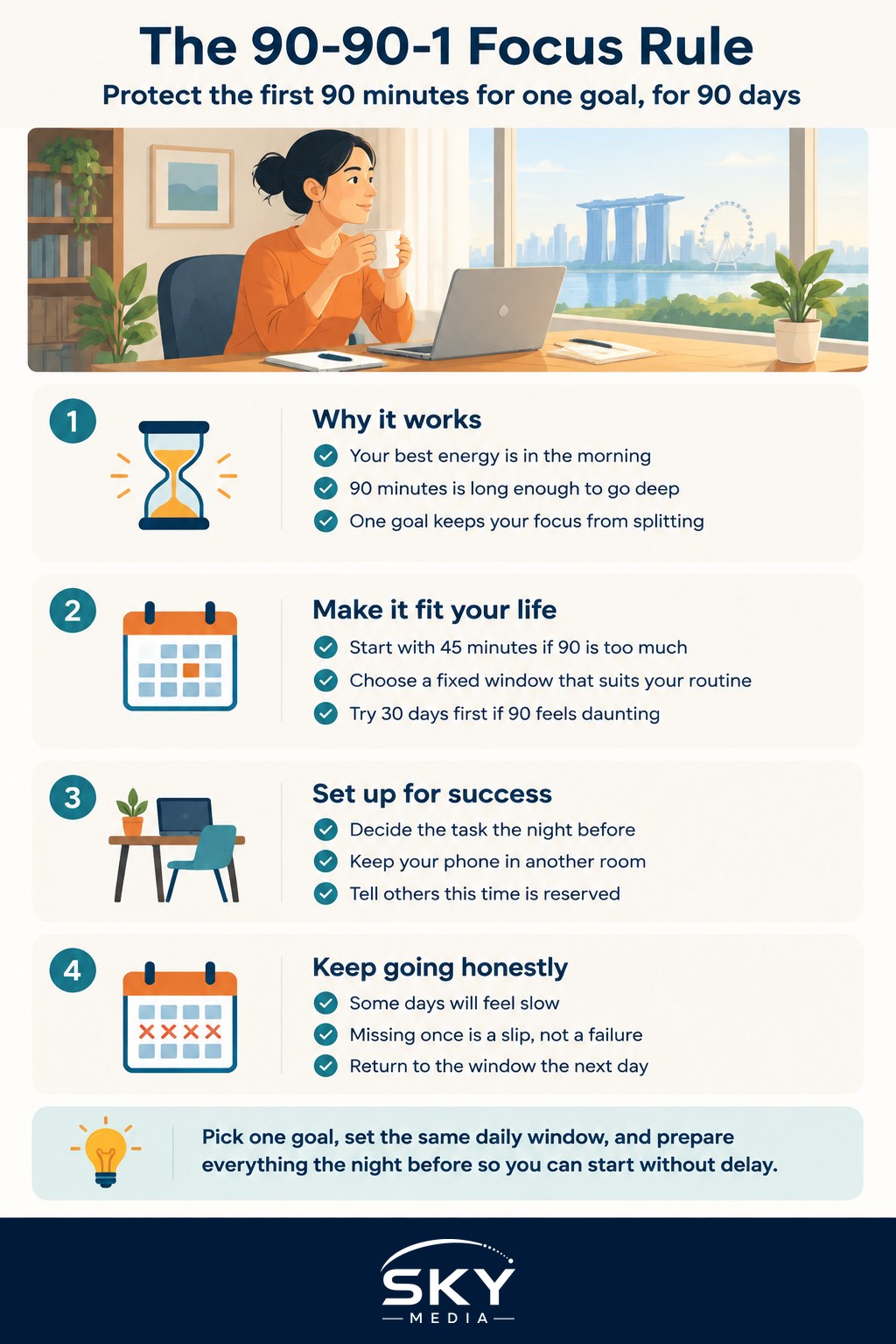
Big goals usually die not from lack of ambition but from lack of protected time. You mean to write the book, build the side project, or study for the qualification, but the day fills up and the goal keeps sliding to tomorrow. The 90-90-1 rule is a simple structure designed to stop this from happening. The idea is to spend the first 90 minutes of your day, for 90 days, working on the one goal that matters most to you. First thing, before the emails, before the noise, one goal gets your freshest attention.
It is a demanding commitment, and it is not magic. But the logic behind it is sound, and for the right goal at the right season of life, it can move something that has been stuck for years.
Why the First 90 Minutes Matter Most
The morning has a quality the rest of the day rarely matches. Your mind is rested, the inbox has not yet claimed you, and the endless small requests of a Singapore workday have not started arriving. By protecting that window for one goal, you are giving your best energy to what you say matters most, rather than to whatever happens to shout first.
The 90 minutes also fits how attention works. It is long enough to get past the awkward warm-up and into real, focused work, and short enough to sustain without burning out. This is the kind of concentrated session that deep work is built on, where you protect a block of time from interruption and go deep on one thing.
The “one” in the rule is just as important as the ninety. You do not spread the window across three goals. You pick a single priority and let the others wait. That focus is uncomfortable, because most of us have several things we want to make progress on. But scattering your best hour across many goals is how none of them get finished.
Making 90 Minutes Realistic in Singapore
Ninety minutes before work is a big ask if you already leave home at seven for a long commute. Be honest about your life before you commit. The rule is a template, not a law, and adapting it is wiser than forcing it and quitting in a week.
Some realistic adaptations:
- If a full 90 minutes is impossible, start with 45 and protect that fiercely.
- If mornings truly do not work because of family or commute, choose a different fixed window and keep the “first, before other demands” spirit.
- If 90 days feels daunting, commit to 30 days first and review how it went.
The non-negotiable parts are that it is the same window each day, it goes to one goal, and it comes before the day’s reactive work swallows you. If you are not a morning person, it helps to understand your chronotype and energy, so you place the block where your focus is genuinely strongest rather than where a rule tells you to.
Setting Up the Window So You Actually Use It
The first few days are the hardest, because the habit is not yet automatic. Reduce the friction in advance. The night before, decide exactly what you will work on so you do not waste the fresh 90 minutes deciding. Lay out what you need. Put your phone in another room. A distraction-free workspace makes a real difference here, because a single notification can shatter the focus you are trying to build.
Guard the window from other people gently but clearly. Let colleagues and family know that this slot is spoken for. You are not being selfish, you are being deliberate, and most people respect a clear boundary when it is stated kindly.
Track the days simply. A calendar with a cross on each day you show up is enough. The visible chain of crosses becomes its own quiet motivation, and it turns an abstract 90 days into ninety small, doable decisions.
Keeping Expectations Honest
The 90-90-1 rule is not a guarantee. Some days the 90 minutes will feel unproductive, and that is normal. Deep work has slow days. What matters is that you kept the appointment with your goal, because consistency over 90 days beats a few brilliant sessions followed by silence. Progress on meaningful work is usually gradual and often invisible until, one day, you look back and see how far the daily minutes carried you.
Be kind to yourself when you miss a day, as you will. Missing once is a slip, not a failure. The trap is letting one missed morning become a missed week. Just return to the window the next day. Learning how to get back on track after falling off matters more than a perfect streak, because nobody sustains perfection over three months of real life.
Choose your one goal, pick your window, and protect it tomorrow morning. You do not need to feel motivated, you just need to show up. Ninety days of your best minutes, given to the thing you care about most, can quietly build something you once thought you had no time for.
Further reading: The 1 Percent Better Principle · The Rule of Three for Daily Focus