
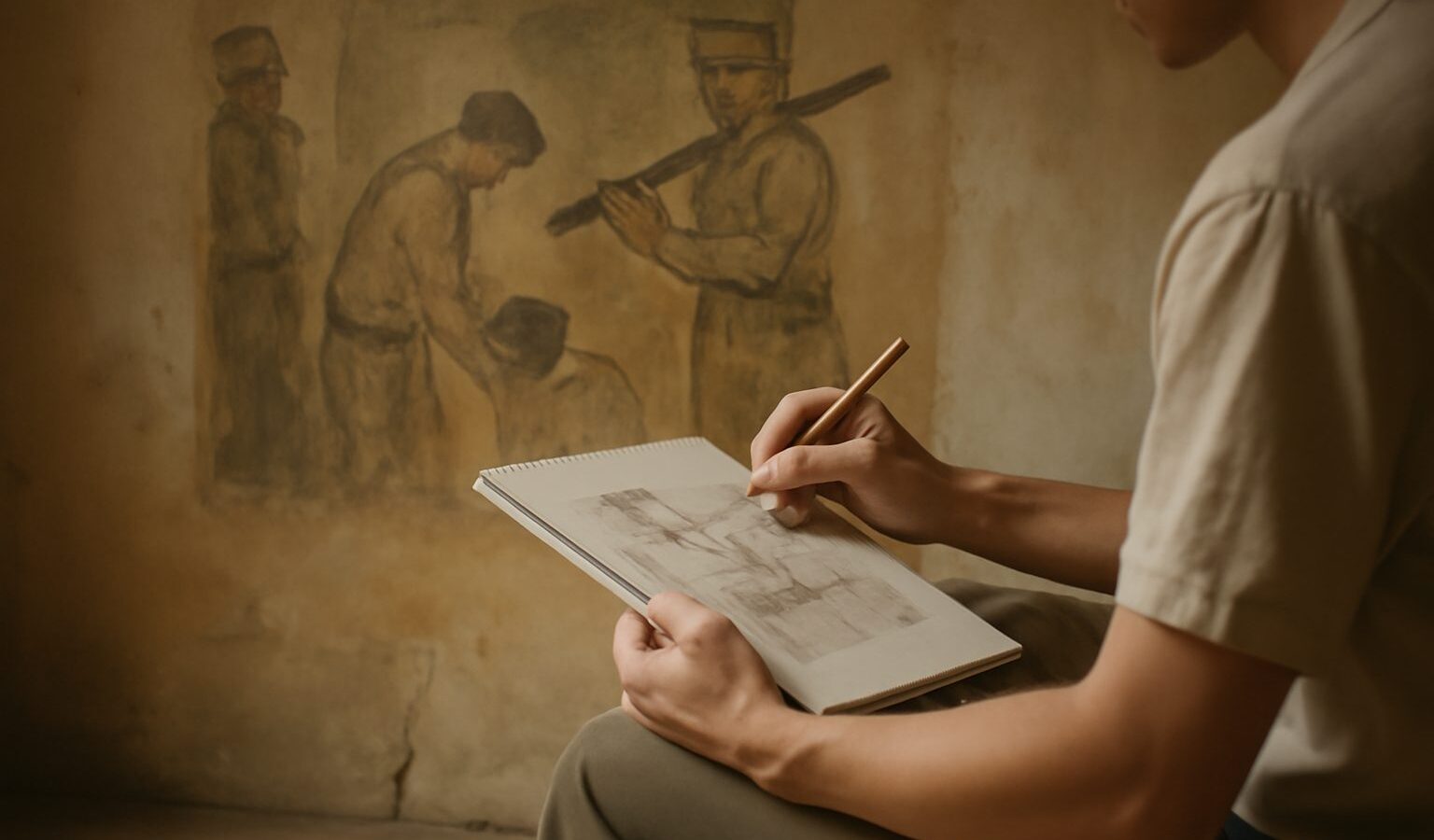
Among the most moving pieces of wartime heritage in the country, the Changi murals singapore remembers are five Christian wall paintings created by a British prisoner of war inside a small chapel during the darkest years of the Japanese Occupation. They are quiet works, made in poor health and under captivity, yet they speak of faith, endurance and human dignity in conditions that were designed to strip all three away. To stand before them, or before the faithful replicas that now allow the public to see them, is to be reminded of what ordinary people carried through an extraordinary and terrible time.
This article treats that history with the seriousness it deserves. The suffering of prisoners of war and of civilians during the Occupation was real and immense, and the murals are best understood not as decoration but as a memorial made by a suffering man for his fellow captives.
Who Made the Murals and Why
The murals were painted by Stanley Warren, a British bombardier who was taken prisoner after the fall of Singapore in February 1942. Held at the Changi military site, which the Japanese used as a large prisoner-of-war camp, Warren was seriously ill for much of his captivity, weakened by dysentery and other hardships that afflicted so many prisoners. It was during this period of sickness and confinement that he began to paint.
Working in a room that served as a chapel, Warren produced five large murals on Biblical themes, images such as the Nativity, the Crucifixion, the Ascension and other scenes drawn from Christian tradition. He worked with whatever materials could be scrounged in a camp that had almost nothing to spare, using improvised brushes and pigments gathered from what was at hand. His health was fragile throughout, and completing the works was itself an act of perseverance.
The purpose was pastoral rather than artistic display. The chapel was a place where prisoners could gather for worship, and the murals were meant to offer comfort, hope and a sense of the sacred to men who were far from home and uncertain whether they would ever return. In a setting shaped by hunger, fear and loss, they provided a focus for prayer and a reminder of something larger than the camp walls. That intention is central to their meaning, and it is why they are remembered with such tenderness today.
Rediscovery, Restoration and Meaning Today
After the war the site passed through various military uses, and for a time the murals were hidden, covered over and largely forgotten. It was only years later that they were rediscovered, and efforts were made to trace the artist. Stanley Warren, who had survived the war and returned to Britain, was eventually located and invited back to Singapore. In a series of return visits during the following decades, he worked to restore the paintings he had made as a young prisoner, a poignant reunion between an artist and the work born of his captivity.
Because the murals sit within a working military area, public access has always been managed carefully. To allow more people to encounter them, faithful replicas have been created so that the story and the images can be shared with visitors, students and families. If you wish to view the originals, it is best to check the current arrangements and any commemorative openings through official heritage channels, as access is limited and subject to change.
The Changi murals belong to a wider fabric of remembrance that runs through the island. They sit alongside the broader story of Singapore in the Second World War, and they speak to the generation that lived through occupation and rebuilt afterwards, a story connected to that of the Pioneer Generation who came of age in the years that followed. Understanding these works also deepens an appreciation of how a small and multiracial society carries shared memory across communities that suffered together.
What makes the murals endure is not technical grandeur but honesty. They were made by a man who was ill and imprisoned, for companions who needed hope, in a place built for despair. As heritage, they ask little of us except to remember, and to honour those who endured. Visited quietly and thoughtfully, they remain one of the most humane records of the wartime years, a testament that even in captivity the human spirit reached for faith, comfort and grace.