
The Hakka community in Singapore carries a heritage distinguished by resilience, industry and a deep sense of shared identity. Known throughout Chinese history as a people shaped by migration, the Hakka brought their traditions of hard work and mutual support to the island, where they contributed to its crafts, trades and communal institutions. Their story, marked by perseverance and strong communal bonds, forms an important chapter in the history of Singapore’s Chinese dialect groups.
Origins and Migration to Singapore
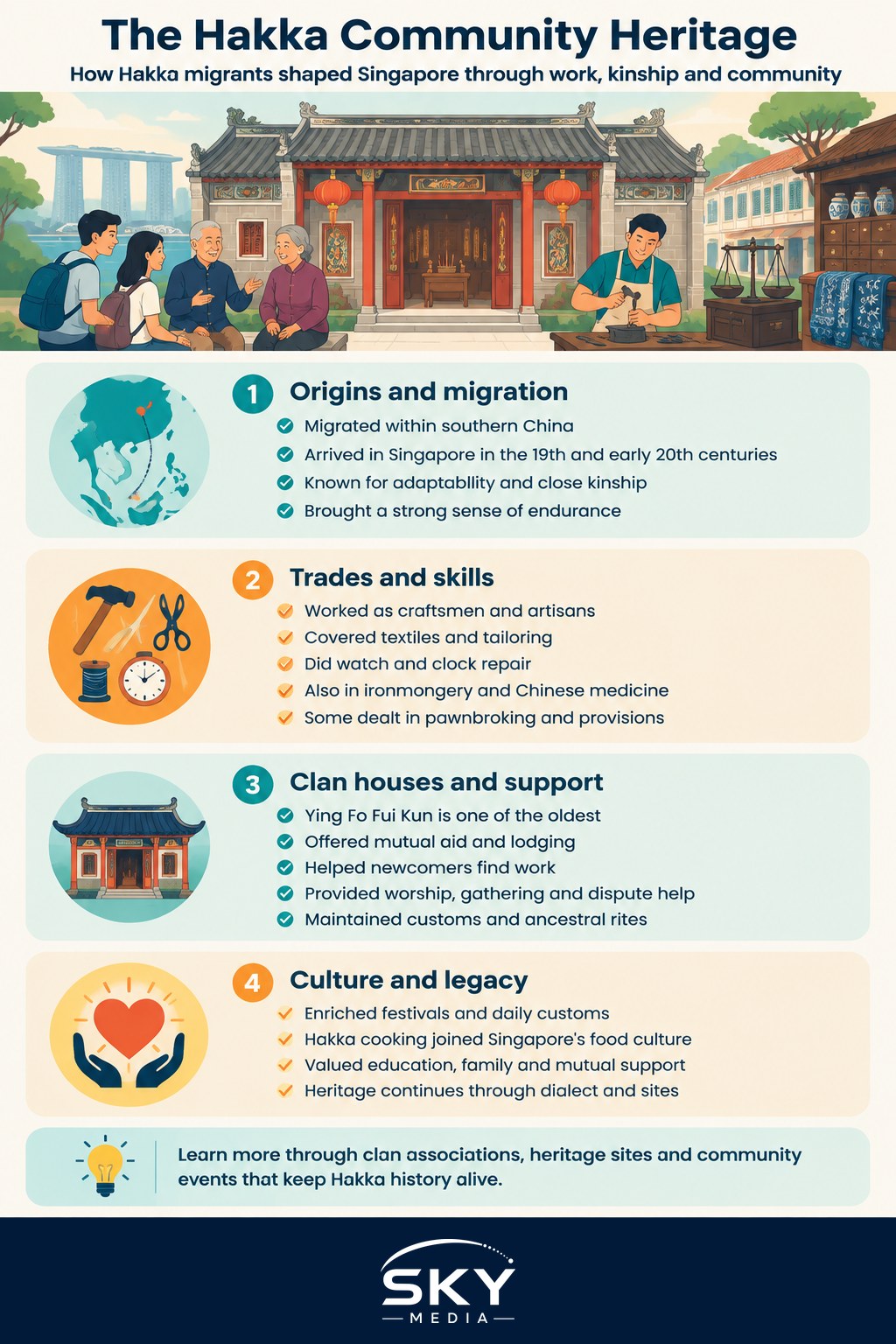
The Hakka, whose name is often understood to mean guest people or guest families, are a Chinese community with a long history of migration within China itself. Over centuries they moved and resettled across the southern provinces, including areas of Guangdong, Fujian and neighbouring regions, developing a strong culture of adaptability, self reliance and close kinship. This heritage of movement gave the Hakka a distinct identity and dialect, and a reputation for endurance and diligence.
When the Hakka migrated to Singapore during the nineteenth and early twentieth centuries, they brought this same spirit of enterprise and community. Because other dialect groups had already established themselves in many trades, the Hakka often found their livelihoods in particular niches and skilled occupations. They became known as craftsmen and artisans, working in trades such as textiles, tailoring, watch and clock repair, ironmongery and traditional Chinese medicine. The Hakka were also associated with the pawnbroking trade and with dealing in goods and provisions, building modest but steady enterprises through careful work. To understand how the Hakka fit alongside the other communities, readers may explore Singapore’s Chinese dialect groups and their distinct paths.
Ying Fo Fui Kun, Clan Associations and Temples
One of the most significant symbols of Hakka heritage in Singapore is Ying Fo Fui Kun, one of the oldest Hakka clan associations on the island. Established in the nineteenth century, it served as a vital institution for the Hakka community, offering mutual aid, lodging, employment connections and a place for worship and gathering. The clan house helped newcomers settle, mediated disputes, cared for members in times of hardship and maintained the rites and customs that bound the community to its ancestral roots. As a historic clan house, it stands today as a treasured heritage landmark and a reminder of the community’s early presence.
Institutions such as Ying Fo Fui Kun reflect the wider importance of clan associations in Singapore, which were essential to the survival and cohesion of migrant communities far from home. The Hakka also maintained temples and shrines, honouring deities and ancestors and providing spiritual anchors for festivals and communal life. The pooling of resources and support through such bodies mirrors the broader tradition described in accounts of the role of the kongsi in early Singapore.
Trades, Craftsmanship and Cultural Contributions
The Hakka reputation for craftsmanship and careful enterprise shaped their contribution to Singapore’s economy. As artisans, tradesmen and shopkeepers, they provided skills and services that supported daily life, from repairing timepieces to preparing traditional remedies and dealing in provisions. Their involvement in trades that demanded precision, patience and trust reflected the values of thrift and diligence long associated with Hakka culture, qualities born of a history of resettlement and self reliance.
The Hakka also enriched Singapore’s cultural life through their customs, festivals and cuisine. Hakka cooking, known for its hearty and homely character, became part of the island’s shared culinary heritage, though this article celebrates community heritage rather than serving as a food guide. The community’s strong emphasis on education, family and mutual support contributed to the social fabric, and successful Hakka individuals gave back through philanthropy and community leadership. This outlook forms part of the wider Nanyang Chinese identity in Singapore, shaped by generations of migration and adaptation.
Heritage and Identity Today
Today the Hakka community continues to preserve its heritage through its clan associations, cultural events and the safeguarding of historic sites such as its clan houses. While fewer young people speak the Hakka dialect fluently, many still identify proudly with their Hakka roots and take an interest in the language, customs and remarkable migratory history of their forebears. Efforts to document and celebrate Hakka heritage help ensure that this legacy endures for future generations.
The Hakka heritage is a story of resilience and quiet contribution. From the enduring presence of a historic clan house to the skilled hands of craftsmen and traders, the community’s legacy of perseverance, industry and solidarity remains woven into the wider tapestry of Singapore, honoured as part of the nation’s rich and diverse cultural inheritance.
Frequently Asked Questions
How are Hakka people different from Hokkien, Teochew and Cantonese? They are a separate Chinese dialect group with their own language, migration history and customs. The article notes the Hakka moved repeatedly within southern China, which shaped a reputation for self reliance. In Singapore, that background also steered many into particular trades rather than the ones other groups already dominated.
Can the public visit Ying Fo Fui Kun? Visiting arrangements are not stated in the article, so it is best to contact the clan association first. Clan houses are often working community premises rather than open museums, so access may depend on events or appointments. Asking ahead also shows respect for members who use the space.
Why were so many Hakka in pawnbroking and traditional medicine? Other dialect groups had already taken hold of many established trades, so the Hakka tended to build livelihoods in niches that suited careful, trust based work. Trades such as pawnbroking, tailoring and traditional Chinese medicine rewarded patience and a good reputation, which fit the thrift and diligence associated with Hakka culture.
How can I trace my Hakka ancestry in Singapore? Start by asking older relatives for ancestral village names, dialect spellings of the family name and any clan association your family used. Clan associations sometimes keep member records, and national archives and libraries hold historical records. Names were often romanised in dialect, so try several spellings when searching.
Do young Singaporeans still speak Hakka? Fewer young people speak Hakka fluently today, though many still identify with their Hakka roots. Interest in the language and customs continues through clan associations and cultural events. Passing it on at home, with grandparents or at community gatherings, is usually what keeps a dialect alive.
Further reading: The Cantonese Community Heritage · The Hainanese Community Heritage