
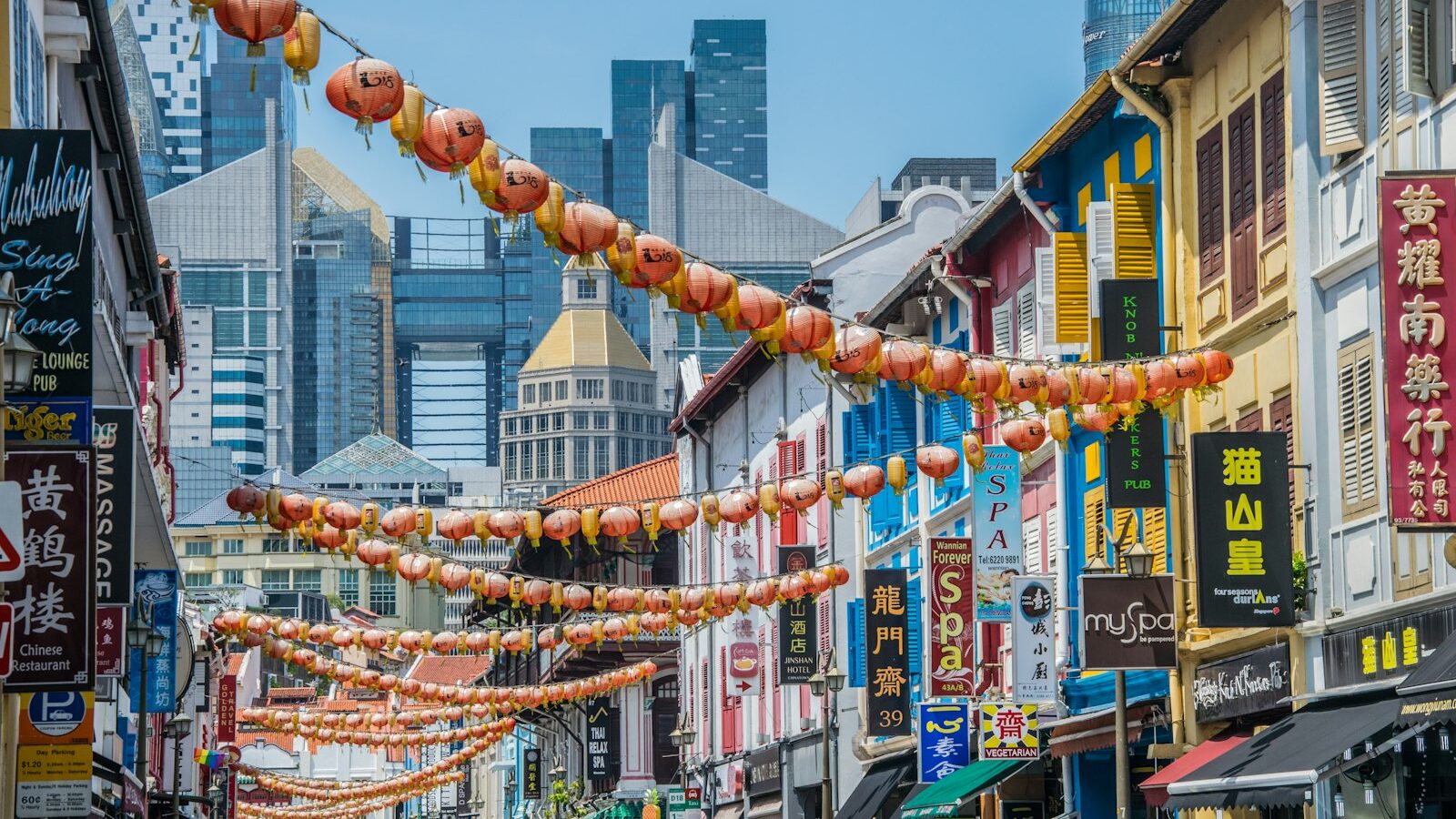
Soon after arriving, many newcomers from the mainland notice something that is easy to feel but hard to name. The person serving you kopi looks Chinese, speaks some Mandarin, celebrates Lunar New Year, and yet is unmistakably Singaporean, not a fellow mainlander. Understanding Nanyang Chinese identity Singapore has developed over generations helps make sense of that gap, and it makes settling in far smoother. This is not about who is more authentically Chinese. It is about recognising a distinct branch of the Chinese world that grew up in Southeast Asia, so you can meet it with respect rather than surprise.
Who the Nanyang Chinese Are
“Nanyang” (南洋) literally means the Southern Ocean, the old term for the maritime region of Southeast Asia. From the nineteenth century onwards, large numbers of people left the southern coastal provinces of China, mainly Fujian and Guangdong, and settled across what is now Singapore, Malaysia, Indonesia, and beyond. Their descendants are the Nanyang Chinese, and in Singapore they form the majority of the population today.
A useful distinction to learn early is between the words 华人 (huaren, ethnic Chinese) and 中国人 (zhongguoren, a citizen of China). Most Chinese Singaporeans describe themselves as 华人, meaning they are ethnically Chinese but nationally and culturally Singaporean. Calling a local person 中国人 can land awkwardly, because it implies a nationality they do not hold. This single vocabulary difference sits at the heart of Nanyang identity, and getting it right signals that you understand where you are.
These communities have been in the region for well over a century. Many families have never lived in China and have no direct memory of it, yet they have carefully preserved festivals, clan associations, temples, and food traditions. The result is a heritage that is genuinely Chinese in root and genuinely Southeast Asian in flavour.
The Dialect Groups Beneath the Surface
One of the most important things to grasp is that “Chinese Singaporean” is not a single, uniform group. It is a federation of dialect communities, each with its own language, cuisine, and customs, brought over from different parts of southern China.
- Hokkien (from southern Fujian) is the largest group, and Hokkien words pepper everyday Singlish.
- Teochew (from the Chaoshan area of Guangdong) is known for its porridge, its braised duck, and its own opera.
- Cantonese (from Guangdong) shaped much of the roast-meat and dim-sum food culture.
- Hakka and Hainanese are smaller but historically influential, with Hainanese linked to the story of Hainanese chicken rice.
For a Mandarin-speaking newcomer, this matters in practical ways. An older Singaporean may be far more comfortable in Hokkien or Cantonese than in Mandarin, and dialect surnames are sometimes romanised differently from the Hanyu Pinyin you know (Tan rather than Chen, Ng rather than Huang, Ong rather than Wang). Recognising these as the same names in a different clothing helps you connect the dots.
Why It Feels Familiar Yet Different
Nanyang Chinese culture shares its bones with the mainland, the same zodiac, the same reverence for family, many of the same festivals, but the everyday expression has drifted over a century of separate development. Language is the clearest example. Singaporean Mandarin has its own vocabulary and rhythm, borrows from English, Malay, and dialects, and is written in simplified characters in official use. Some words differ from mainland usage in ways that can cause small confusions, so a light, curious attitude serves you well.
The table below sketches some broad contrasts. Treat it as orientation rather than a rulebook, because individuals vary enormously and many Singaporeans move fluidly between worlds.
| Aspect | Mainland Chinese background | Nanyang Chinese in Singapore |
|---|---|---|
| Self-description | 中国人 (Chinese national) | 华人 (ethnic Chinese, Singaporean) |
| Home languages | Mandarin, plus a regional dialect | Mandarin, English, dialects, some Malay |
| Written script | Simplified characters | Simplified in official use, traditional seen too |
| Everyday payments | WeChat Pay, Alipay | PayNow, cards, cash |
| Cultural reference points | Mainland media, national holidays | Local, regional, and Western influences |
The point of the table is not to rank the two. It is to show that a shared ethnic heritage can produce two confident, complete identities that simply grew in different soil.
Peranakan Heritage and Cultural Blending
No account of Nanyang identity is complete without the Peranakans, sometimes called Straits Chinese or Baba-Nyonya. These are descendants of early Chinese settlers who intermarried with local Malay communities and blended the two cultures over generations. Peranakan cuisine, with dishes like laksa and ayam buah keluak, is one of Singapore’s culinary treasures, and Peranakan beadwork, tiles, and kebaya dress are part of the national heritage story.
The Peranakans are a vivid reminder that Nanyang Chinese identity has always been open to its surroundings. Living among Malay, Indian, and Eurasian neighbours, and later within a multiracial nation, shaped a culture that is Chinese at its core but comfortable with mixture. For a newcomer, this is reassuring: integration here does not ask you to erase who you are, but it does invite you to appreciate a version of Chineseness that has learned to share space.
Meeting the Culture With Respect
You do not need to master every dialect or festival to show respect. A few gentle habits go a long way, and they help you avoid the small missteps that newcomers sometimes stumble into.
- Use 华人 for local Chinese Singaporeans unless you know someone is a fellow mainlander. It acknowledges their Singaporean identity.
- Do not assume shared politics or opinions simply because of shared ethnicity. Singaporeans are citizens of their own country with their own views.
- Be curious about dialect food and festivals rather than treating them as lesser versions of mainland ones. They are traditions in their own right.
- Adjust your Mandarin lightly. Slow down, watch for local vocabulary, and switch to English when it genuinely helps communication.
- Learn the local etiquette around festivals, funerals, and gifts, which may follow older southern-Chinese customs your family stopped observing.
Approached this way, the differences become interesting rather than jarring. Many newcomers find that understanding Nanyang heritage deepens their own sense of being Chinese, because it shows how far the culture has travelled and how many forms it can take. If you want to dig further, the National Heritage Board’s museums and the clan associations around Chinatown are welcoming and informative starting points.
Nanyang Chinese identity is not a puzzle to solve so much as a neighbour to get to know. Meet it with an open mind, learn the vocabulary that matters, and you will find that being a newcomer from China in a majority-Chinese city is full of small, warm points of connection, alongside the differences that make Singapore its own place.
Explore more
Culture becomes concrete when you see it in the calendar and on the page. Compare the festival calendars in China festivals Singapore marks differently, get a feel for the written language in simplified and traditional Chinese in everyday Singapore, and understand how officialdom records ethnicity in how race classification (CMIO) works for newcomers.