

The Wheel of Life is a simple self assessment tool that helps you see, at a glance, how satisfied you are across the different areas of your life. Instead of a vague feeling that “something is off”, the Wheel of Life turns your life into a picture you can read in seconds, showing which areas are thriving and which quietly need attention. This guide explains the tool and how to use it well.
What the Wheel of Life is
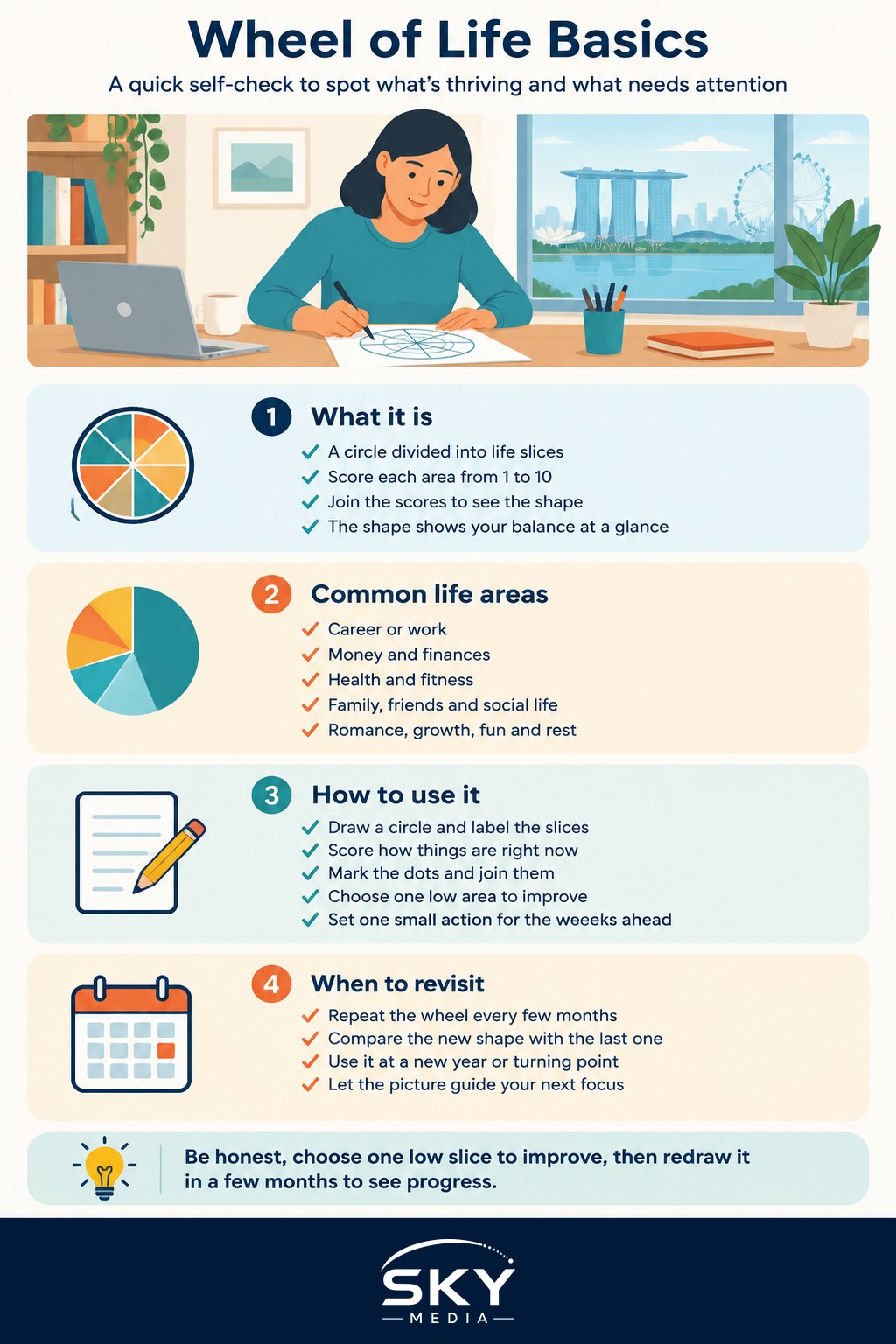
Picture a circle divided into slices, like a pie or a bicycle wheel with spokes. Each slice represents one area of your life. You give each area a score, usually from one to ten, based on how satisfied you feel with it right now. When you mark and join the scores, you get a shape that shows your overall balance.
A life in balance produces a large, roundish shape. A life pulling hard in one direction produces a lopsided, dented shape that would give a bumpy ride if it were a real wheel. The visual is the point: your eyes spot the imbalance faster than words ever could.
The common life areas are:
- Career or work
- Money and finances
- Health and fitness
- Family
- Friends and social life
- Romance or partner
- Personal growth and learning
- Fun, recreation and rest
You can rename or replace these to fit your own life. Someone deeply involved in faith or volunteering might add a spiritual or community slice.
Why it works
The Wheel works because we are bad at judging our lives as a whole. We fixate on the loudest area, often work, and lose sight of the rest until something breaks. By forcing a separate score for each area, the Wheel makes the neglected slices visible before they become crises.
It also turns a fuzzy mood into concrete information. “I feel unsettled” becomes “My health is a three and my social life is a two, while work is a nine”. That specificity tells you exactly where to act.
Finally, it is fast. The whole exercise takes fifteen minutes, which makes it easy to repeat every few months and watch your shape change over time.
Step by step
Step 1: Draw the wheel. Sketch a circle and divide it into six to eight slices, one per life area. Label each slice.
Step 2: Score each area from one to ten. One means deeply dissatisfied, ten means fully satisfied. Score how things truly are now, not how you wish they were or fear they are.
Step 3: Mark and join the scores. For each slice, put a dot at the right distance from the centre, then join the dots. The centre is zero, the outer edge is ten.
Step 4: Look at the shape. Notice the dents and the bulges. Which areas are low? Which are high? Is the overall wheel roundish or badly lopsided?
Step 5: Choose one area to improve. Do not try to fix everything. Pick the one low area that, if raised, would lift the most. Often it is health or rest, because these quietly support all the others.
Step 6: Set one small action. Turn the chosen area into a single concrete step for the coming weeks. Small and specific beats grand and vague.
Step 7: Repeat in three months. Redraw the wheel later and compare. Progress you can see keeps you going.
A worked example
Consider Daniel, a 40 year old manager in Singapore who feels tired and irritable but cannot say why. He draws his Wheel of Life and scores each area honestly.
His scores come out as: Career 9, Money 8, Health 3, Family 6, Friends 3, Romance 7, Personal growth 5, Fun and rest 2.
The shape is dramatic. His work and money slices push right to the edge, while health, friends and rest cave in towards the centre. On a real wheel, this would be almost undriveable. The picture confirms what his tiredness was trying to tell him: he has poured everything into career and finances while starving his body, his friendships and his rest.
Rather than overhaul his whole life, Daniel picks the one area with the widest ripple effect: fun and rest, scored two. He reasons that better rest would also lift his health and his mood at home. His single action is to protect one screen free evening a week for something restful, and to stop checking work messages after ten at night.
Three months later he redraws the wheel. Rest has risen to five, health has crept to five as he sleeps better, and even family has ticked up because he is less short tempered. One targeted change rounded out several slices at once.
Wheel of Life versus a simple to do list
The Wheel is a diagnostic tool, not a planner. It tells you where to aim before you decide what to do.
| Aspect | Wheel of Life | To do list |
|---|---|---|
| Purpose | See where you stand | Get things done |
| View | Whole life at once | One task at a time |
| Output | A balance picture | A set of actions |
| Best used | Every few months | Every day |
| Answers | Where should I focus | What is next |
The two pair naturally. Use the Wheel to decide which area needs love, then let your to do list carry the small actions that raise its score.
Getting the most from it
- Be honest, not aspirational. The tool only helps if the scores are true. Nobody else needs to see them.
- Do not chase all tens. Perfect balance is not the goal, and some seasons of life are meant to lean one way, such as when studying hard or caring for a newborn. The aim is awareness, not a flawless circle.
- Watch the change, not just the snapshot. A single wheel is useful; a series of them over a year shows real movement and patterns.
- Focus on one slice at a time. Trying to raise every area at once usually raises none.
When to use it
The Wheel is ideal at natural turning points: the start of a year, a birthday, the end of a busy season, or any moment you feel adrift. It also fits neatly inside a broader yearly review, giving your reflection a clear starting picture.
The Wheel of Life will not fix anything by itself. What it does is make the invisible visible, so you stop guessing and start choosing where your attention goes. Draw one this week, score it honestly, pick a single slice to nudge upward, and check back in a few months. A rounder, steadier life usually begins with one clear look at the shape you are in now.
Explore more: How to Do a Life Audit · How to Do a Personal Yearly Review · Finding Your Personal Values
Frequently Asked Questions
How do I score an area when parts of it are good and parts are bad? Think about your overall satisfaction rather than averaging every detail. If your career is rewarding but the hours are punishing, score how you feel about it as a whole. Writing a short note beside the score helps you remember what the number meant.
Can teenagers or students use the Wheel of Life? Yes, with areas adjusted to their stage, such as studies, friends, family, health, interests and rest. It can open up a good conversation with a parent or teacher. Keep it relaxed, and avoid treating the scores as marks.
Can I do the Wheel of Life with my partner? Yes. Complete your own wheels separately, then share and compare. Differences in scores can reveal what each person needs. Listen without defending, and pick one shared area to work on together.
What do I do if many of my scores are very low? Low scores can feel heavy, but they show where support is needed. Pick one area to nudge first and ask someone you trust for help. If you feel persistently low or overwhelmed, a doctor or counsellor can support you.
How can I raise a low score in money or finances? Begin by getting a clear picture of income, spending and debts, then pick one small action such as a simple budget. Increase the score one step at a time. For bigger decisions, consider a licensed financial adviser.