
Stand in the fastener aisle of any hardware shop and the choice can feel overwhelming, with rows of little boxes and drawers holding dozens of near-identical bits of metal. Yet choosing well is simpler than it looks once you understand what each one is for. Screws, nails and fixings are just different ways of holding two things together, and picking the right one is the difference between a repair that lasts and one that pulls loose in a month. This plain-English guide walks a complete beginner through the main types, what they suit, and how to choose without overthinking it, all grounded in the kind of small jobs common in an HDB or condo flat.
You will not need most of what the shop sells. A small, well-chosen selection covers almost everything a home DIYer does, from assembling flat-pack furniture to hanging a shelf.
Screws, Nails and Fixings: What Each One Does
It helps to start with the basic difference between the three, because people often reach for the wrong category entirely.
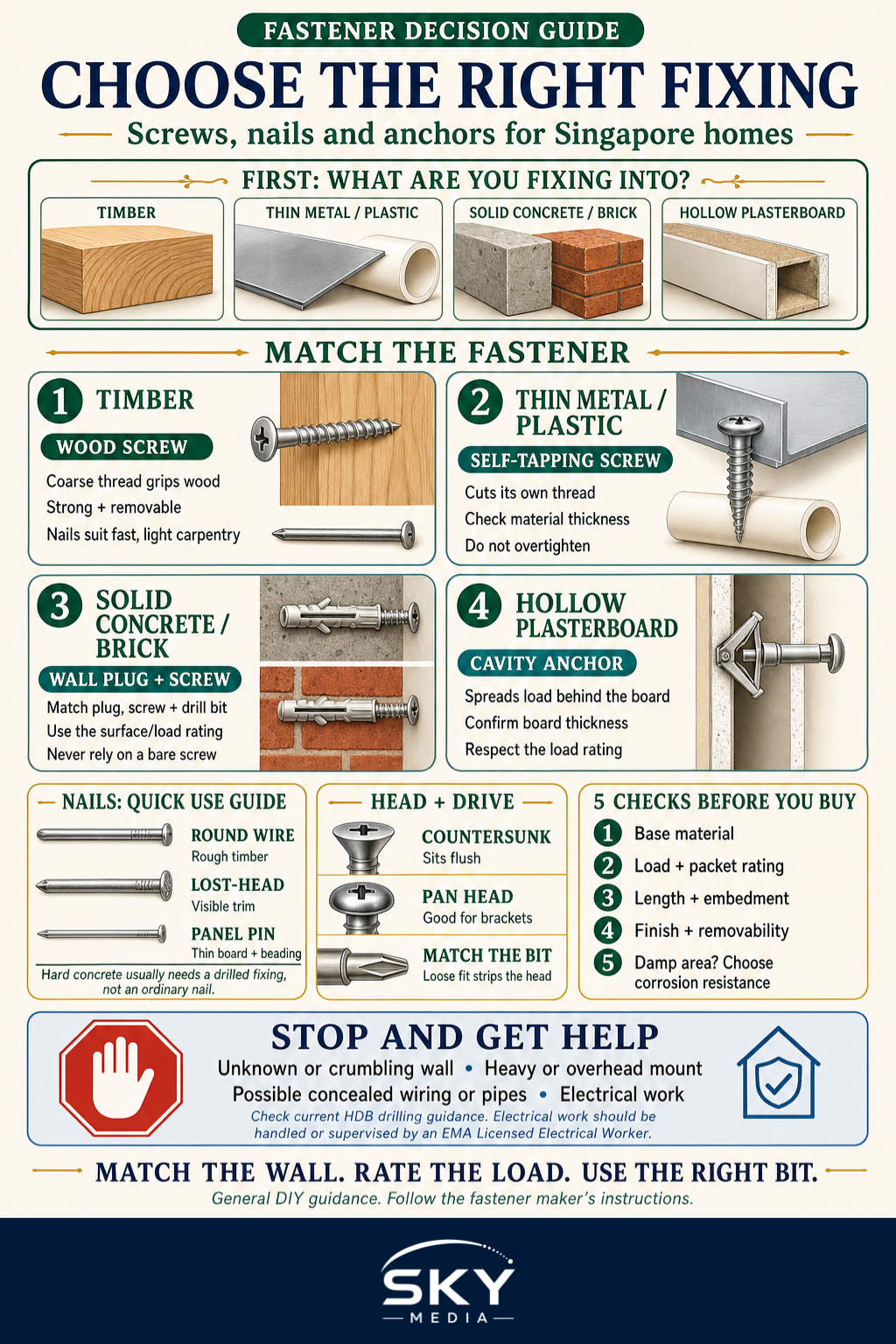
- Screws have a threaded shaft that bites into material as you turn them. They hold firmly, resist pulling out, and can be undone later, which makes them the go-to for furniture, fixtures and anything you might want to remove.
- Nails are smooth and driven in with a hammer. They go in fast and flex well under load, so they suit rough carpentry, timber framing and fixing thin sheets, but they hold less tightly than screws and are awkward to remove cleanly.
- Fixings is a broad term for the extra hardware that helps a screw or bolt grip a difficult surface, such as wall plugs, anchors, brackets and bolts. On the hard concrete walls common in Singapore flats, a fixing is usually what makes a fastener hold at all.
As a rough rule, use screws where strength and reusability matter, nails where speed and a bit of flex help, and fixings whenever you are attaching to masonry or hollow walls.
The Common Types of Screws
Most home jobs use just a few screw types, and the packet will name them. The key things to read are the material, the head shape and the drive, which is the pattern the screwdriver or bit fits into.
- Wood screws have a coarse thread for gripping timber and are your default for furniture and shelving.
- Self-tapping screws cut their own thread as they go, handy for thin metal, plastic and some flat-pack fittings.
- Machine screws have a fine, even thread and pair with a nut or a threaded hole, common inside appliances and brackets.
- Masonry screws are hardened to bite directly into concrete or brick, sometimes without a plug, though a pilot hole is usually still needed.
Screw heads matter for the finish. A countersunk head sits flush with the surface, which is neat for furniture, while a raised or pan head stands slightly proud and suits fixing brackets. For the drive, Phillips (a cross) and Pozidriv (a cross with extra marks) are the most common, and hex or Torx (a star) give a firmer grip for heavier work. Always match the screwdriver or drill bit exactly to the drive, because a loose fit chews up the head and leaves you stuck.
The Common Types of Nails
Nails are simpler, but the right one still matters. A finishing nail in structural work, or a huge nail in delicate trim, will end badly.
- Round wire nails are the general-purpose choice for rough timber work where looks do not matter.
- Oval and lost-head nails have small heads that sink below the surface, so they are tidier for visible woodwork.
- Panel pins are thin, fine nails for light work such as fixing thin board or beading.
- Masonry nails are hardened for driving into concrete or brick, though on hard HDB walls a drilled fixing is usually more reliable and less likely to shatter.
For most flat dwellers, nails see far less use than screws, since drilling and plugging suits concrete walls better than hammering. Keep a small pack for picture-frame repairs and light timber jobs and you will rarely need more.
Fixings for Walls and Heavier Loads
This is where Singapore homes differ from what many online guides assume. The structural walls in HDB and condo flats are often concrete or reinforced concrete (RC), which are far too hard for a bare screw or nail. To hang anything of substance, you need a fixing.
A wall plug, the small sleeve you push into a drilled hole, lets a screw grip solid walls. For hollow partition walls, often plasterboard (a thin panel with a gap behind), you need plasterboard plugs or cavity anchors that spread the load behind the board instead. For heavy items such as a TV bracket, masonry bolts or resin anchors do the serious work, and that job is often worth handing to a fitter. Matching the fixing to your wall type is essential, and there is a companion guide on wall anchors and plugs that covers it in detail.
| Fastener | Best for | Holds by | Removable? |
|---|---|---|---|
| Wood screw | Furniture, shelving in timber | Thread biting into wood | Yes |
| Self-tapping screw | Thin metal, plastic, flat-pack | Cutting its own thread | Yes |
| Nail | Rough carpentry, light timber | Friction and flex | Not cleanly |
| Wall plug and screw | Concrete or RC walls | Plug expanding in the hole | Yes |
| Cavity anchor | Hollow plasterboard walls | Spreading behind the board | Sometimes |
How to Choose Without Overthinking It
When you are standing in the shop, run through a short mental checklist and the choice usually makes itself.
- What are you fixing into? Timber, metal, solid concrete or hollow plasterboard. This decides screw versus nail, and whether you need a fixing at all.
- How heavy is the load? Light frames forgive a lot; shelves and brackets need the right thread, length and, on masonry, the right anchor.
- How long should it be? The fastener should pass through the item and well into the base material, with a little to spare, never poking out the other side.
- Does it need to look neat? Choose a countersunk head or a fine nail for visible work, and match materials so it sits flush.
- Will it get damp? In humid Singapore, and especially near kitchens, bathrooms and outdoor areas, choose corrosion-resistant stainless or galvanised fasteners so they do not rust and stain.
A few honest cautions. Do not force a screw with the wrong bit, as you will strip the head. Do not rely on a nail or bare screw in a concrete wall, because it will not hold. For anything heavy or safety-critical, spread the load across several fixings and respect the weight limits on the packet. If a fixing feels wrong, if the wall crumbles, or if the job involves electrical or structural work, stop and call a professional. With a small kit of the right screws, nails and fixings, most everyday repairs and assemblies at home become quick, tidy and genuinely satisfying.