
Among the communities that make up our island’s rich social fabric is one that is smaller in number but deeply woven into the story of Singapore. Eurasian culture Singapore has grown alongside its Chinese, Malay and Indian communities, and it carries a heritage of mixed European and Asian ancestry, distinctive food, and a strong sense of family and faith. This guide offers a warm and respectful introduction for anyone curious to understand the Eurasian community as one of the many threads that make this home so colourful.
Like every community here, Eurasians are not a single, uniform group. Families differ in ancestry, language, religion and the traditions they keep. What follows is a general overview offered with care, and the best way to learn more is always to listen to Eurasian friends and neighbours share their own family stories.
Who Are the Eurasians?
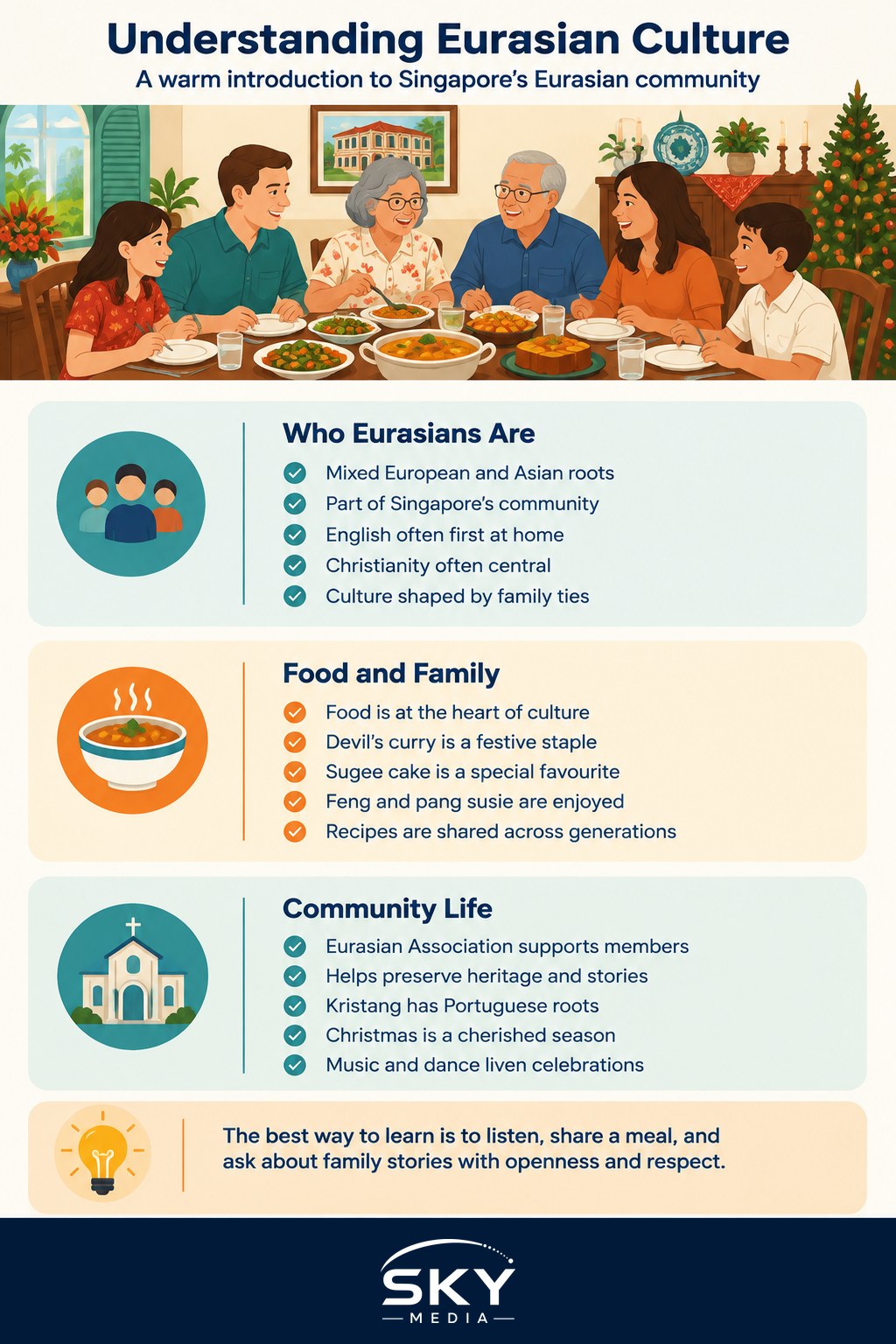
The Eurasian community traces its roots to the meeting of European and Asian peoples across centuries of trade and settlement in the region. Ancestries often include Portuguese, Dutch and British lines mingled with local and regional Asian heritage, and many families carry surnames that reflect this blend. The community took shape in the port cities of the region long before modern Singapore, and settled here as the island grew into a trading hub.
Today Eurasians are recognised as one of Singapore’s communities, sometimes grouped under the “Others” category in official terms alongside people of many backgrounds. English is typically the first language at home, and Christianity, particularly the Catholic faith, has historically been central to community life, though families vary in their beliefs and practices. The community’s history is one of adaptation and quiet contribution, in fields from public service and sport to music and the arts.
What holds the community together is less a single ancestry than a shared culture: a warmth of hospitality, a love of family gatherings, a distinctive cuisine, and a pride in a heritage that bridges East and West. It is a living culture, passed down at the dining table and at community events as much as in any record book.
Food at the Heart of the Culture
If there is one place where Eurasian culture shines most vividly, it is the kitchen. Eurasian food is a delicious fusion, blending European techniques with the spices and ingredients of the region, and many dishes are treasured family recipes handed from one generation to the next.
The most famous dish is devil’s curry, a fiery, tangy curry traditionally served at Christmas and other celebrations. Rich with vinegar, chillies and mustard, it is a dish built for a crowd and often tastes even better the next day. Another beloved centrepiece is sugee cake, a moist, buttery cake made with semolina and almonds, served at weddings, festive gatherings and special occasions. Between these sit a whole spread of home-style dishes, from feng, a curry of mixed meats, to pang susie, savoury sweet buns, and prawn or seafood dishes touched with tamarind and spice.
Food is more than nourishment in the community; it is memory and belonging. Recipes are often guarded and shared within families, adjusted to each cook’s hand, and brought out for the gatherings that mark the year. Sharing a Eurasian meal is one of the warmest ways to appreciate the culture.
Here is a small taste of some dishes you might encounter, offered as an introduction rather than a complete menu.
| Dish | What it is | Often served at |
|---|---|---|
| Devil’s curry | Spicy, tangy meat curry with vinegar | Christmas, celebrations |
| Sugee cake | Rich semolina and almond cake | Weddings, festive occasions |
| Feng | Curry of mixed meats and spices | Family gatherings |
| Pang susie | Soft savoury sweet buns | Everyday and festive tables |
The Eurasian Association and Community Life
Community life is supported by the Eurasian Association, a body that has long served as a gathering point for Eurasians in Singapore. It works to preserve and promote the community’s heritage, supports members through welfare and education efforts, and organises events that bring families together and share the culture with the wider public. For many, it is a place to connect with others who grew up with the same food, faith and family stories.
The Association and community members have also worked to document Eurasian heritage, from recipes and family histories to the Kristang language, a creole with Portuguese roots that some elders still speak and that younger enthusiasts are working to keep alive. Efforts like these help ensure that a smaller community’s culture is not lost as generations pass.
Community life also plays out through the year in gatherings large and small. Christmas is a particularly cherished season, when Eurasian homes fill with the smell of devil’s curry simmering and sugee cake cooling on the counter, and extended families come together across generations. Weddings, christenings and reunions are other occasions when the food, music and warmth of the culture come to the fore. Music and dance, including lively social dances enjoyed at celebrations, have long been part of community gatherings, adding to the festive spirit. These moments are where younger Eurasians absorb the traditions of their elders, ensuring the culture is carried forward not as a museum piece but as a living part of family life.
For those outside the community, the best way to appreciate Eurasian culture is with openness and respect. Accept the invitation to a meal, ask about the story behind a dish, and enjoy the generous hospitality that is a hallmark of Eurasian homes. Understanding grows through genuine friendship far more than through any summary.
The Eurasian community is a reminder that Singapore’s strength lies in its diversity. A culture born of many meetings, carried forward in kitchens, churches and family gatherings, it adds its own warm flavour to the shared life we all enjoy on this island. To understand it is to understand a little more of what makes Singapore home.
Explore more
Singapore Social Norms
How to Be a Good Neighbour
Building a Social Life
Joining Interest Groups and Clubs
Frequently Asked Questions
Are Eurasians in Singapore a single, uniform community? No. Like every community here, Eurasian families differ in ancestry, language, religion and the traditions they keep. Ancestries often mix Portuguese, Dutch and British lines with local and regional Asian heritage. The best way to learn is to listen to Eurasian friends share their own family stories.
What is the Kristang language? Kristang is a creole with Portuguese roots that some Eurasian elders still speak. The Eurasian Association and community members have worked to document it, and younger enthusiasts are helping keep it alive so the culture is not lost as generations pass.
What does the Eurasian Association do? It is a gathering point for Eurasians that works to preserve and promote the community’s heritage, supports members through welfare and education efforts, and organises events for families and the wider public. For many, it connects them with others who grew up with similar food and faith.
What is the best way to try Eurasian food as an outsider? Accept an invitation to a meal if you receive one, and ask about the story behind each dish. Dishes like devil’s curry and sugee cake are often family recipes. Look out for community events, where the food and music are shared with the wider public.
Why is Christmas especially important in Eurasian homes? It is a cherished season when homes fill with the smell of devil’s curry and sugee cake, and extended families gather across generations. Christianity, particularly the Catholic faith, has historically been central to community life, though families vary in their beliefs and practices.