

A university open house in Singapore can feel like a festival: packed lecture theatres, booths for every faculty, campus tours, free tote bags and crowds of students and parents. It is easy to spend a whole day wandering and come home with a stack of brochures but no clearer idea of which course suits you.
This guide is about using the day well. It shows you how to shortlist courses before you go, which questions actually reveal what a course is like, and how to compare your options afterwards. If you are still deciding which universities to consider at all, start with our broader guide to choosing a university in Singapore, then come back to this one.
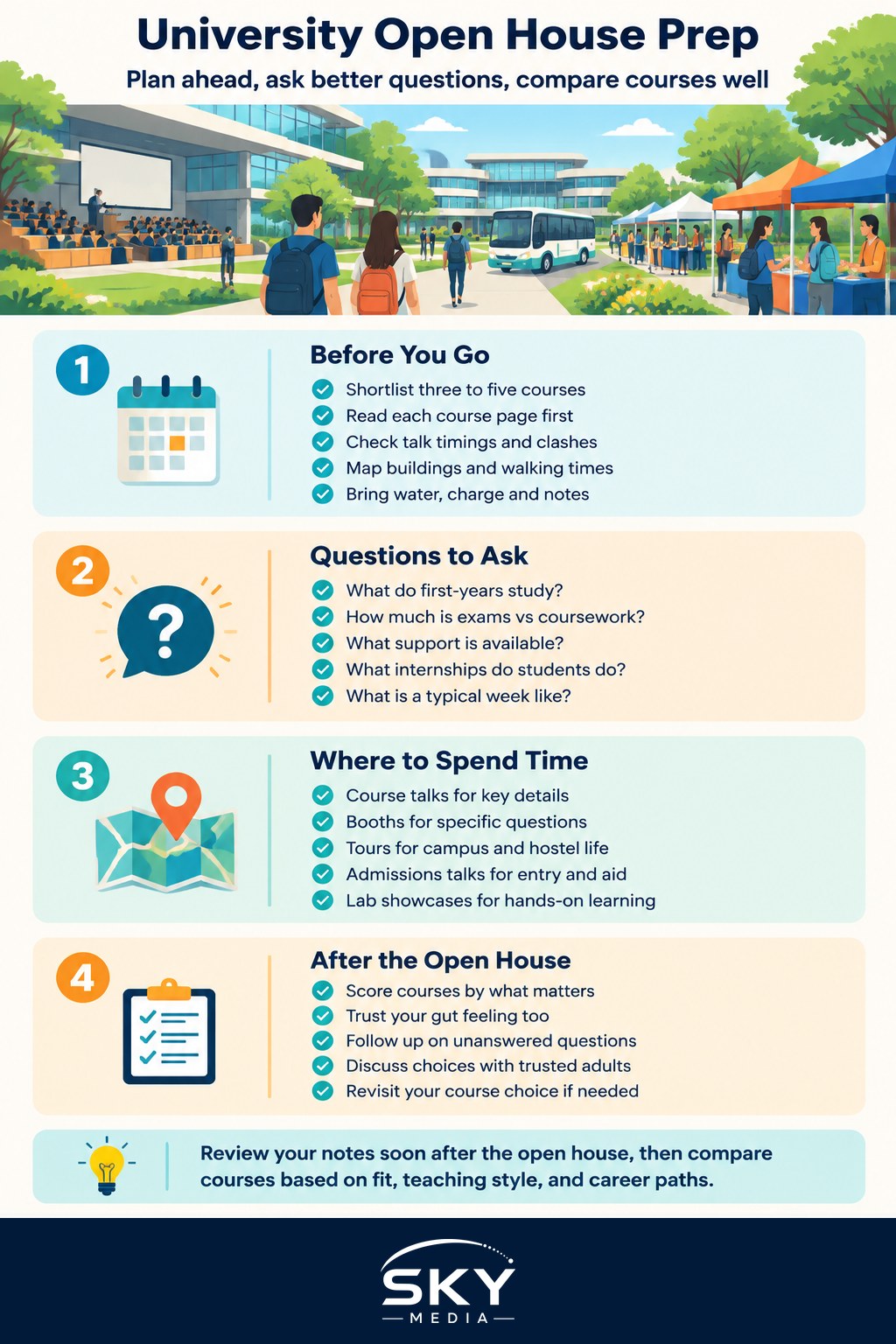
When Open Houses Happen and What to Expect
Singapore’s autonomous universities, such as NUS, NTU, SMU, SUTD, SIT and SUSS, typically hold their main open houses early in the year, around the period when many students are applying. Private institutions and overseas university campuses hold their own sessions at different times. Dates and formats change from year to year, and some universities run online or hybrid events alongside campus days, so check each university’s official admissions page for the current schedule.
A typical open house includes:
- Course and faculty talks in lecture theatres, often on a timed schedule
- Faculty booths where you can speak to lecturers and current students
- Campus and hostel tours led by student volunteers
- Admissions and financial aid talks covering application steps, scholarships and bursaries
- Lab, studio and facility showcases for courses like engineering, design and the sciences
Before the Day: Shortlist and Plan
Walking in without a plan is the most common mistake. A little homework beforehand lets you spend your time on conversations rather than queues.
- Shortlist three to five courses. Read each course page on the university website. Note the core modules, specialisations, internship requirements and any interview or portfolio steps.
- Check the programme schedule. Talks for popular courses often clash. Decide which ones you must attend in person and which you can catch on a recorded session or webinar if one is offered.
- Map your route. Campuses in Singapore are large. Note which buildings host your talks and how long it takes to walk or take the internal shuttle between them.
- Write your questions down. Prepare a short list for each course using the ideas in the next section.
- Bring the basics. A water bottle, a phone with charge, a notebook or notes app, and comfortable shoes for a lot of walking. For tips on dressing for the day, see what to wear for school open houses in Singapore.
If a parent is coming along, agree beforehand on who will lead the conversations. Lecturers and student ambassadors generally prefer to hear directly from the prospective student.
Questions That Reveal What a Course Is Really Like
Brochures tell you what a course offers. Good questions tell you what studying it is actually like. Use these as a starting point and adapt them.
About the curriculum
– What do first-year students study, and how much choice do they have?
– How much of the grade comes from exams versus projects and coursework?
– Can students take modules from other faculties or do a second major or minor?
About teaching and support
– What are typical class sizes for tutorials and labs?
– How easy is it to get help from lecturers outside class?
– What academic and wellbeing support is available if a student is struggling?
About outcomes
– What kinds of internships do students usually do, and does the faculty help find them?
– What roles do graduates typically go into?
– Are there overseas exchange or study trip opportunities, and how competitive are they?
For current students
– What surprised you most about this course?
– What is a typical week like for you?
– If you could choose again, would you pick the same course?
Current students are often the most honest source. Ask them about workload, culture and what they wish they had known.
Talks, Booths and Tours: Where to Spend Your Time
Each part of an open house gives you different information. This table helps you decide what to prioritise.
| Activity | What you learn | Best for | Tip |
|---|---|---|---|
| Course talks | Structure, modules, entry requirements | Your top two or three courses | Arrive early, popular talks fill up |
| Faculty booths | Answers to specific questions | Clarifying details and comparing courses | Go during talk sessions when booths are quieter |
| Campus and hostel tours | Daily life, facilities, distances | Anyone planning to stay on campus | Ask guides about hall life and commuting |
| Admissions and aid talks | Application process, scholarships, bursaries | Students and parents planning finances | Note deadlines and documents needed |
| Lab and studio showcases | Hands-on learning style | Engineering, science and design applicants | Ask what equipment first-years actually use |
Thinking About Admissions and Funding
Most open houses include admissions and financial aid talks. Even if they feel less exciting, they are worth attending.
- Entry requirements and selection. Ask how applications are assessed, whether there are interviews, aptitude tests or portfolios, and how polytechnic, A-level and international applicants are considered.
- Aptitude-based admissions. Some universities consider achievements and interests beyond grades. Ask how to present these well.
- Scholarships and bursaries. Note the types available and the application timelines. Our guide to university scholarships in Singapore explains the main kinds and what they usually involve.
- Tuition grants and fees. Fees and subsidies depend on citizenship and the course, and they change, so confirm the current figures with the university directly.
Do not rely on what friends heard last year. Admissions rules and deadlines are updated, so always check the official admissions website.
After the Open House: Compare and Decide
The day itself is only half the work. Within a day or two, while it is still fresh, review your notes.
- Score each course on what matters to you, such as interest in the subjects, teaching style, career paths, campus life and cost.
- Note your gut feeling. Did you feel excited listening to one faculty and bored at another? That reaction is useful information.
- Follow up on gaps. Email the faculty or admissions office about questions you did not get to ask.
- Talk it through. Discuss your shortlist with parents, teachers or a school career counsellor.
- Revisit your course choice. If the open house changed your mind about a field, our guide on choosing a university major can help you think it through.
Making the Day Count
A university open house is one of the few chances to hear directly from the lecturers and students you may spend the next few years with. Shortlist your courses, plan your route, bring sharp questions and compare notes afterwards. With that approach, you will leave with a clearer picture of where you fit, not just a bag full of brochures.
Further reading: University Orientation Camps in Singapore: What to Expect · How School Open Houses in Singapore Help You Choose