

A violin that is too big is one of the quickest ways to put a young beginner off the instrument. The left arm overstretches, the wrist collapses, the shoulders tense up and the notes never quite land in tune. A violin size chart for a child solves most of this, but only if you measure properly and know how to read the result. This guide walks you through measuring arm length at home, what the fractional sizes actually mean, and how to tell when your child is ready to move up.
If your child has not started lessons yet, our guide to learning the violin covers teachers, practice routines and exams. This piece focuses only on getting the size right.
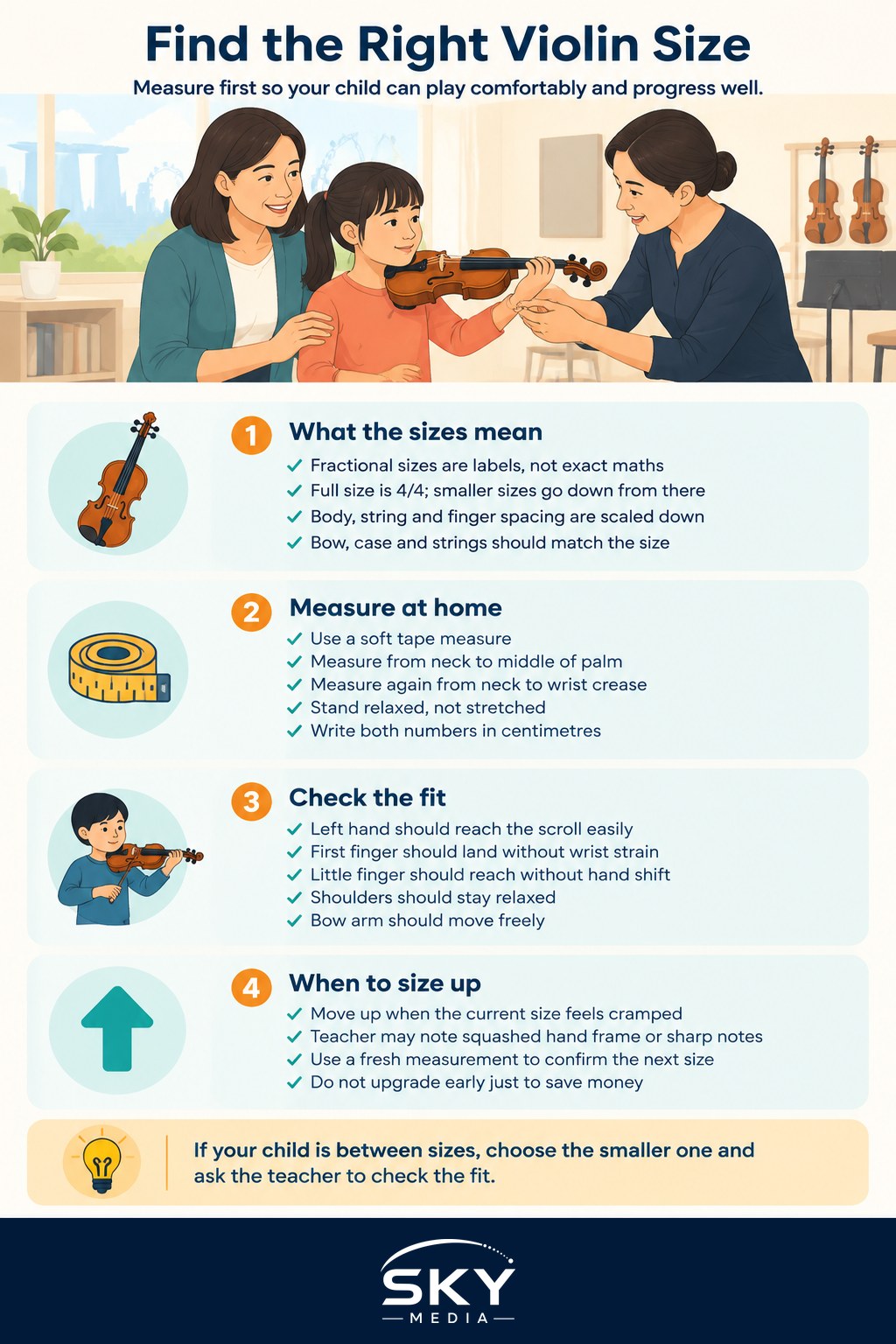
What the Fractional Sizes Mean
Children’s violins come in “fractional” sizes, written as fractions of a full-size instrument. A full-size violin is called a 4/4. Smaller ones run down through 3/4, 1/2, 1/4, 1/8, 1/10 and 1/16.
The fractions are labels, not exact maths. A 1/2 violin is not half the length of a full size; it is only a few centimetres shorter. What changes is the body length, the string length and the spacing between notes on the fingerboard, all scaled down so a smaller hand and arm can reach comfortably.
A few things worth knowing:
- The bow is sized too. Each violin size has a matching bow length. A full-size bow on a 1/2 violin will feel heavy and unbalanced.
- The case and strings are size-specific. Strings for a 1/4 will not fit a 3/4.
- Labels can vary slightly by maker. Two 3/4 violins from different workshops may differ by a few millimetres, which is another reason to try before you commit.
- Some makers skip sizes. The very smallest sizes (1/16 and 1/32) are not always stocked and are mainly for very young starters in programmes that begin around age three or four.
How to Measure Your Child’s Arm at Home
Measuring takes two minutes and a soft tape measure. Do it with your child standing relaxed, not stretching.
- Ask your child to stand straight and hold their left arm out fully to the side, palm facing up, parallel to the floor.
- Measure from the side of the neck (where the violin would sit under the jaw) along the arm to the middle of the palm. This gives the most comfortable fit.
- For a second reading, measure from the neck to the wrist crease. Some teachers use this to check whether a child could manage a size up.
- Note both numbers in centimetres. Measure twice, as children tend to shrug or reach.
Then compare the neck-to-palm measurement with the chart below. If your child falls between two sizes, choose the smaller one. A slightly small violin is easy to play well; a slightly large one encourages tension and poor posture that can take months to unlearn.
Violin Size Chart for a Child
These ranges are a general guide used widely by teachers and shops. Ages are rough, since children of the same age vary a lot in arm length and hand size.
| Violin size | Neck to middle of palm (approx.) | Typical age range (rough guide) |
|---|---|---|
| 1/16 | 36 to 39 cm | 3 to 4 years |
| 1/10 | 39 to 42 cm | 4 to 5 years |
| 1/8 | 42 to 46 cm | 5 to 6 years |
| 1/4 | 46 to 51 cm | 6 to 8 years |
| 1/2 | 51 to 56 cm | 8 to 10 years |
| 3/4 | 56 to 59 cm | 10 to 12 years |
| 4/4 (full size) | 59 cm and above | 11 or 12 years to adult |
Treat the age column as the least reliable part of the chart. Arm length is what matters. A tall seven-year-old may need a 1/2 while a petite eleven-year-old may still be comfortable on a 1/2.
The Hands-On Fit Test (Better Than Any Chart)
A chart narrows the choice. The final check should be done with the violin in your child’s hands, ideally with their teacher present.
With the violin in playing position, resting on the left shoulder and held by the jaw:
- The scroll test. Your child should be able to curl the fingers of the left hand comfortably around the scroll (the curly end) with the elbow slightly bent. If the arm has to be fully straight to reach, the violin is too big.
- The first-finger reach. In normal playing position, the first finger should land on the first note without the wrist bending backwards.
- The fourth-finger stretch. The little finger should reach its note without the whole hand shifting. Small hands often struggle here first.
- Relaxed shoulders. Watch for the left shoulder rising or the head tilting sharply. Both are signs of strain.
- The bow check. The bow arm should be able to draw a full bow without the elbow locking or the bow tip drifting off the strings.
Most teachers in Singapore are happy to check sizing at a lesson, and many music shops will let a child try several sizes.
When to Move Up a Size
Children usually move up a size every one to two years during growth spurts, but there is no fixed timetable. Look for these signs:
- The scroll test is now easy with the elbow quite bent, and the arm looks cramped.
- Your child’s teacher mentions that the hand frame looks squashed or that notes are consistently sharp because fingers are too big for the spacing.
- The bow arm runs out of room before the bow does, or your child is consistently playing with only part of the bow.
- A fresh measurement puts your child comfortably in the next range, not just at the edge.
Do not upgrade early “to save money”. A violin that is even slightly too large can hold back progress, especially around exam time when tone and intonation matter most.
The jump from 3/4 to full size deserves special care. Full size is the last change, so it is tempting to rush it, but it is also where the instrument gets noticeably heavier. If your child is borderline, wait a few months.
Rent, Buy or Trade In?
Because children may go through three or four sizes, many Singapore families rent fractional violins or buy from shops that offer trade-in or upgrade arrangements. General points to weigh:
- Renting suits younger children who will outgrow sizes quickly. Ask what is included (bow, case, rosin), who pays for repairs, and whether rental paid can be credited towards a purchase later.
- Buying second-hand can be good value, but have a teacher or luthier (a violin maker or repairer) check for cracks, a warped bridge or a bent bow.
- Trade-in schemes vary widely. Read the terms carefully, especially any conditions about wear and tear.
- Humidity matters here. Singapore’s humid climate can affect glue joints, pegs and bow hair. Store the violin in its case away from direct air-con vents and windows, and ask the shop about simple humidity control.
Terms, prices and availability differ between shops, so compare a few before committing.
Common Sizing Mistakes Parents Make
- Buying by age alone. Always measure.
- Buying “one size up to grow into”. This works for school shoes, not violins.
- Forgetting the bow. A mismatched bow undoes the benefit of the right violin.
- Not asking the teacher. Your child’s teacher sees their posture every week and will usually spot a poor fit before you do.
If you are curious about sizing in other parts of life, the same “measure first, then try” logic applies in our guide to clothing sizes and fit. And if you are thinking of picking up the instrument yourself alongside your child, read about learning the violin as an adult.
Getting the size right is a small step, but it lets your child focus on what matters: enjoying the music and building good habits from the very first lesson.