
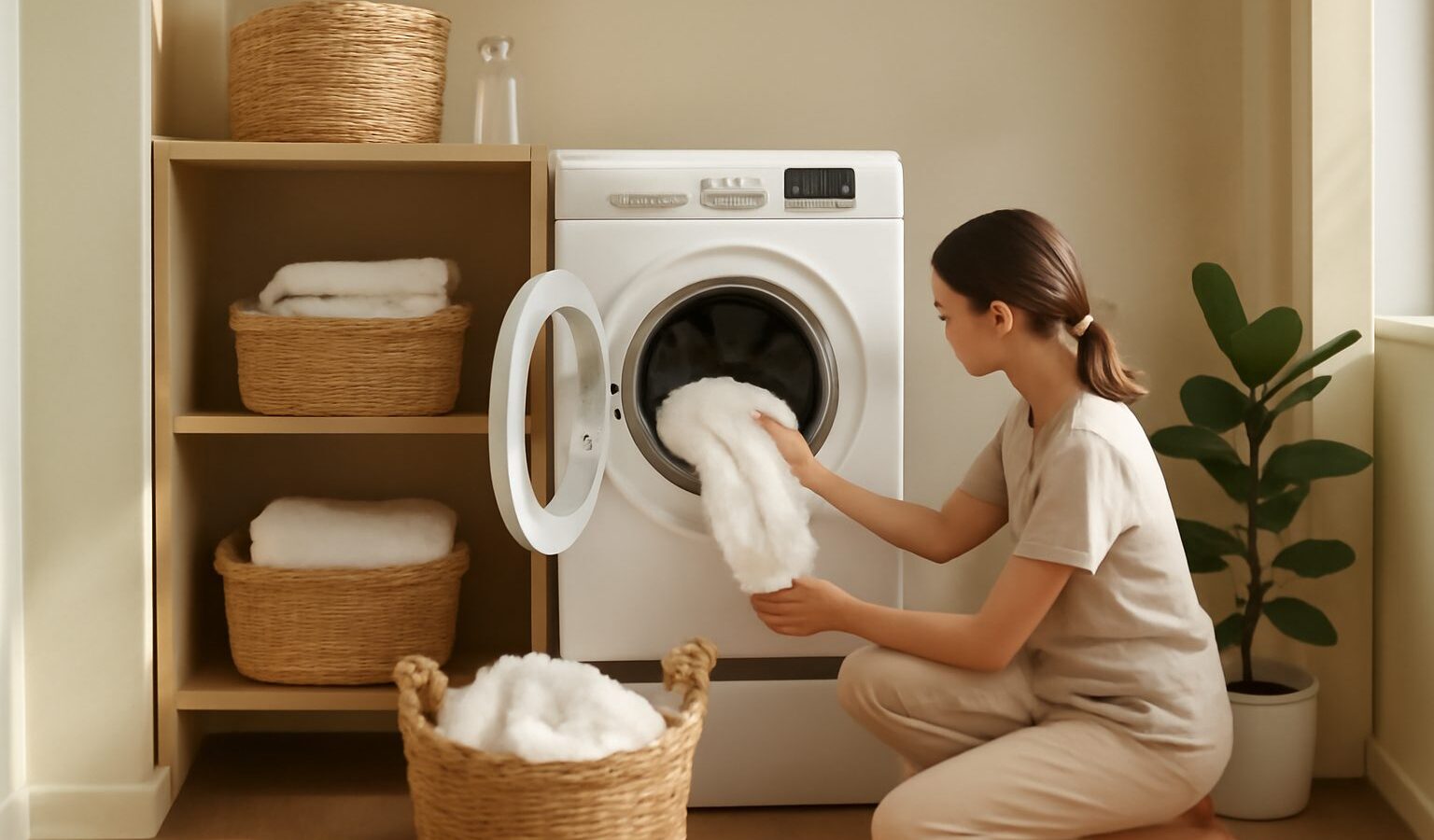
Buying a washing machine in Singapore sounds simple until you stand in the appliance aisle and realise every model promises something different, and none of them tell you whether it fits your service yard. Add our climate to the mix, where laundry can hang for two days and still smell damp, and the humble washer suddenly matters more than you thought. This guide walks through front versus top load, whether a dryer is worth the space, and how to size everything for a typical HDB flat without overpaying for features you will never use.
Front Load or Top Load for Your Flat
The first fork in the road is the loading style, and both suit different homes. Front loaders open at the front and let you stack or slot a dryer above them, which is the usual choice when the service yard is narrow. They tend to wash more gently, use less water, and spin faster, so clothes come out drier and ready for the rack sooner. The trade-off is a longer wash cycle and the need to bend down to load them.
Top loaders open from the top, fill faster, and let you toss in a forgotten sock mid-cycle. They are often cheaper and easier on the back, which suits older residents. The downsides are higher water use and a bulkier footprint that cannot take a stacked dryer.
A few points that decide it for most flats here:
- Front load if your service yard is tight, you want to stack a dryer, or you care about water efficiency.
- Top load if you want a lower price, faster cycles, and easier loading without bending.
- Door swing and hinge side matter in a cramped yard, so check which way the front-loader door opens before buying.
Do You Even Need a Dryer Here
Plenty of Singapore households have never owned a dryer, drying everything on bamboo poles or a service yard rack. That works, but our weather makes it unreliable. During the year-end monsoon or a stretch of afternoon storms, clothes can hang for days, and the humidity leaves that faintly sour smell no amount of detergent fixes. Families with young children, shift workers, and anyone in a low-floor unit with poor airflow feel this most.
A dryer is not a luxury so much as a hedge against the weather. Even households that air-dry most loads keep a dryer for towels, bedsheets, and school uniforms that must be ready by morning. If you rarely see direct sun on your drying area, a dryer quietly earns its keep. For more on beating the damp without a machine, our guide on drying laundry in humid weather covers the airflow and dehumidifier tricks that help.
That said, be honest about space and cost before committing. A dryer adds heat and a little to your electricity bill, and in a small flat the extra unit competes for precious service-yard room.
Combo Machine or a Separate Dryer
If you decide a dryer makes sense, the next question is whether to get a single washer-dryer combo or two separate machines. A combo does both jobs in one drum, saving floor space, which is why it is popular in compact flats and rentals. The catch is that combos usually dry a smaller load than they wash, take a long time to dry, and you cannot wash and dry at the same time.
Separate machines, often a front loader with a dryer stacked on top, dry faster, handle full loads, and let you run back-to-back cycles. They cost more and need the vertical space and a stacking kit. For a small household that dries occasionally, a combo is a sensible compromise. For a busy family doing daily laundry, separates pay off.
| Laundry setup | Best for | Space needed | Trade-off |
|---|---|---|---|
| Front load washer only | Air-drying households, small flats | One slot | Weather-dependent drying |
| Top load washer only | Budget buyers, easy loading | One wider slot | More water, no stacking |
| Washer-dryer combo | Rentals, tight service yards | One slot | Small dry loads, slow drying |
| Separate washer and dryer (stacked) | Busy families, frequent drying | Vertical stack | Higher cost, more space |
Costs vary widely between brands and models, so treat this as a shape rather than a price list and compare current offers at Courts, Harvey Norman, Gain City, or on Shopee and Lazada during the big sales.
Heat-Pump or Vented Dryers
Not all dryers work the same way, and the difference matters in our closed-up flats. Vented dryers blow hot, moist air out through a hose, so they need an opening to the outside, which many HDB service yards do not have. Condenser dryers collect the moisture in a tank you empty, needing no vent but releasing heat and running warm.
Heat-pump dryers are the newer, gentler option. They recycle heat instead of dumping it, so they use noticeably less electricity, run cooler, and are kinder to fabrics, though they dry more slowly and cost more upfront. In a small, warm flat, the lower heat output alone is a real comfort win.
- Vented is cheap to buy but needs an external vent, which most flats lack.
- Condenser needs no vent but adds heat and humidity to the room.
- Heat pump costs more but saves energy, runs cooler, and treats clothes gently.
For most HDB and condo homes without a vent, a heat-pump or condenser dryer is the practical choice, and heat pump wins on running cost over the years.
Sizing, Efficiency and Installation
Match the drum size to your household rather than buying the biggest. A couple manages well with a mid-size washer, while a family of four or five wants a larger drum to cut the number of loads. Crucially, measure your service yard first, including the door frame you have to carry the machine through, and leave clearance for the door swing and the tap and drain.
On running costs, look for the energy label, the tick rating you see on the appliance, and check both the energy and water efficiency marks. A higher-rated machine costs a little more upfront but is cheaper to run over its life, which adds up with frequent laundry. Our guide on energy-efficient appliances explains how to read these labels and weigh the payback.
For installation, a standard washer usually just needs a tap, a drain point, and a power socket, and many retailers include basic setup. But anything beyond a simple plug-and-connect belongs to a professional. If you need a new water point, a dedicated drain, or an extra power socket in the service yard, engage a licensed plumber and a licensed electrician, and in an HDB flat check HDB renovation rules and permits before altering pipes or wiring. Never overload an old socket or run a machine off a daisy-chained extension cord.
Explore more
Once your laundry corner is sorted, weigh the running costs with our energy-efficient appliances guide so you buy something cheap to run, not just cheap to buy. Pair that with drying laundry in humid weather in Singapore for the airflow and dehumidifier habits that keep clothes fresh between machine cycles. For the wider appliance haul, our home appliance shopping in Singapore guide points you to where and when to buy.