
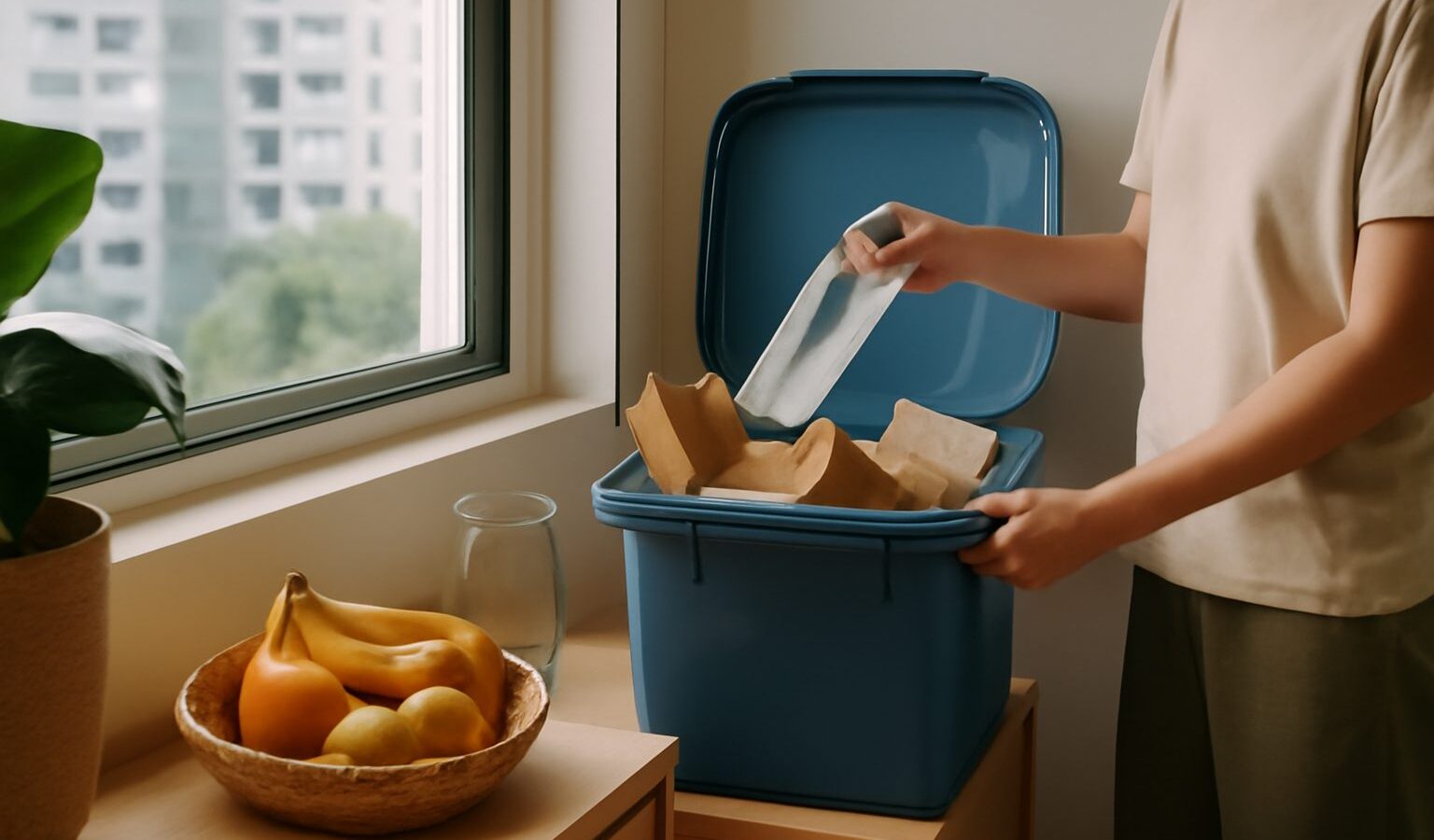
Most of us have a blue recycling bin somewhere close by, tucked near the void deck, the lift lobby or the multi-storey carpark. You rinse a bottle, drop in a stack of flattened boxes, and feel that small flicker of doing the right thing. But what happens to your recycling after the truck rolls away? Does it really get a second life, or does it quietly end up burned with everything else?
The honest answer is: it depends, mostly on how clean and correct your recycling is. Understanding the journey helps you recycle in a way that actually counts, rather than out of habit or hope. Here is what really happens, step by step, in the Singapore system.
From Your Blue Bin to the Sorting Facility
Singapore uses a commingled, or single-stream, recycling system. That means paper, plastic, metal and glass all go into the same blue bin, and the sorting happens later at a facility rather than in your kitchen. It is convenient, and it is a big reason recycling here is easy to start. The trade-off is that everything relies on a good clean-up further down the line.
A licensed public waste collector empties the bins on a schedule and takes the mixed load to a Materials Recovery Facility, usually shortened to MRF. Your recycling is not sorted at the block. It travels as a jumbled mix of bottles, cans, cardboard, newspapers and, unfortunately, quite a lot of things that should never have been there in the first place.
This is the moment where your effort either pays off or gets undone. A rinsed jar and a flattened box sail through. A half-eaten packet of chicken rice, a bag of soiled tissues or a leaking bottle of soya sauce can spoil the paper and cardboard around them, turning genuinely recyclable material into contaminated waste. If you want the full picture on this, our guide to avoiding recycling contamination breaks down the biggest offenders.
Inside the Materials Recovery Facility
At the MRF, the mixed recycling is tipped out and sent along conveyor belts through a series of clever separation steps. It is part machine, part manual, and genuinely satisfying to picture:
- Manual pre-sorting: workers pull out obvious rubbish and large contaminants, such as bulky plastic bags, hoses or anything that could jam the machinery.
- Screens and shakers: angled rotating screens let smaller flat items like paper tumble one way while round items like bottles and cans roll another.
- Magnets: powerful overhead magnets lift out steel and tin cans.
- Eddy currents: a clever magnetic trick repels aluminium, flinging drink cans off the line into their own stream.
- Optical sorters: sensors identify different plastic types by the way they reflect light, and puffs of air nudge each type into the right bay.
- Final manual checks: people do a last quality pass, because no machine is perfect.
The sorted materials are then baled into big compressed blocks by type, ready to be sold to recyclers who turn them back into raw material. Clean, well-sorted bales are worth more and are far more likely to find a buyer.
What Actually Gets a Second Life
Not every material recycles equally well, and it is worth being clear-eyed about this rather than assuming everything transforms into something new.
- Paper and cardboard are among the most reliably recycled materials, as long as they are dry and clean. They are pulped and made into new paper products.
- Metals recycle beautifully. Aluminium and steel cans can be melted and reformed again and again with little loss in quality.
- Glass bottles and jars can be crushed and remelted, though colour mixing and breakage make this trickier.
- Plastics are the messy middle. Common bottle plastics have established markets, but many mixed or flimsy plastics are hard to recycle economically and may not find a buyer.
Materials that cannot be recycled here are sometimes exported to specialist recyclers overseas, and sometimes, if too contaminated or low value, they end up going to waste-to-energy instead. That is not a failure of your good intentions, but it is a reason to focus on the materials that genuinely close the loop.
Why Contamination Sends Recycling to the Incinerator
Here is the uncomfortable truth: a blue bin that is too dirty or too full of the wrong things can be rejected entirely and sent straight for incineration. One greasy pizza box or a bin bag of food waste can drag a whole load down. Understanding what belongs and what does not is the single most useful thing you can learn.
| What you put in | Blue bin? | What to do instead |
|---|---|---|
| Rinsed drink bottles and cans | Yes | Empty, give a quick rinse, drop in loose |
| Clean, dry cardboard and paper | Yes | Flatten boxes to save space |
| Greasy food containers or pizza boxes | No | Bin the soiled part; recycle any clean lid |
| Used tissues, napkins and nappies | No | General waste bin |
| Plastic bags of recyclables tied shut | No | Empty items in loose; bags trap and spoil them |
| Batteries, bulbs and old electronics | No | Use the e-waste channels, not the blue bin |
The rules do get updated, so always check the current NEA blue-bin guidance rather than relying on memory or an old poster. When in doubt, leave it out: one wrong item in the general waste bin is better than one wrong item ruining a whole batch of recycling.
Where the Rest of Our Rubbish Goes
Recycling is only one part of Singapore’s waste story, and seeing the whole picture makes the stakes clearer. Everything that is not recycled, including rejected recycling, is sent to waste-to-energy plants. There, it is burned to generate electricity, and the process shrinks the volume dramatically. You can read more in our explainer on how waste-to-energy works.
The ash that remains, along with material that cannot be burned, is barged out to Semakau Landfill, our only landfill, built out at sea. It is a beautiful, carefully managed place, but it has finite space, and that is precisely why recycling matters. Our piece on Semakau Landfill and why it matters explains just how much is riding on us throwing away less.
The Bigger Picture: Singapore’s Zero Waste Ambitions
Recycling well is a personal habit, but it sits inside a national plan. Under the Singapore Green Plan, there are moves to make producers more responsible for the packaging and products they put out, an approach known as Extended Producer Responsibility, or EPR. In plain terms, the idea is that whoever makes and sells something should help pay for collecting and recycling it at the end of its life. Our guide to Extended Producer Responsibility unpacks what this means for everyday shopping, and a beverage container return scheme is part of the same shift, covered in the beverage container return scheme.
None of this replaces the humble act of rinsing a bottle and putting it in the right bin. If anything, it raises the value of doing it well. Your clean, correctly sorted recycling is what keeps the whole system worth running.
So the next time you stand at the blue bin, you can picture the journey ahead: the truck, the conveyor belts, the magnets and the bales, and the real second life waiting for material that arrives clean. Recycle for the outcome, not just the gesture, and your small habit becomes a genuine contribution to keeping Singapore’s waste in check.