
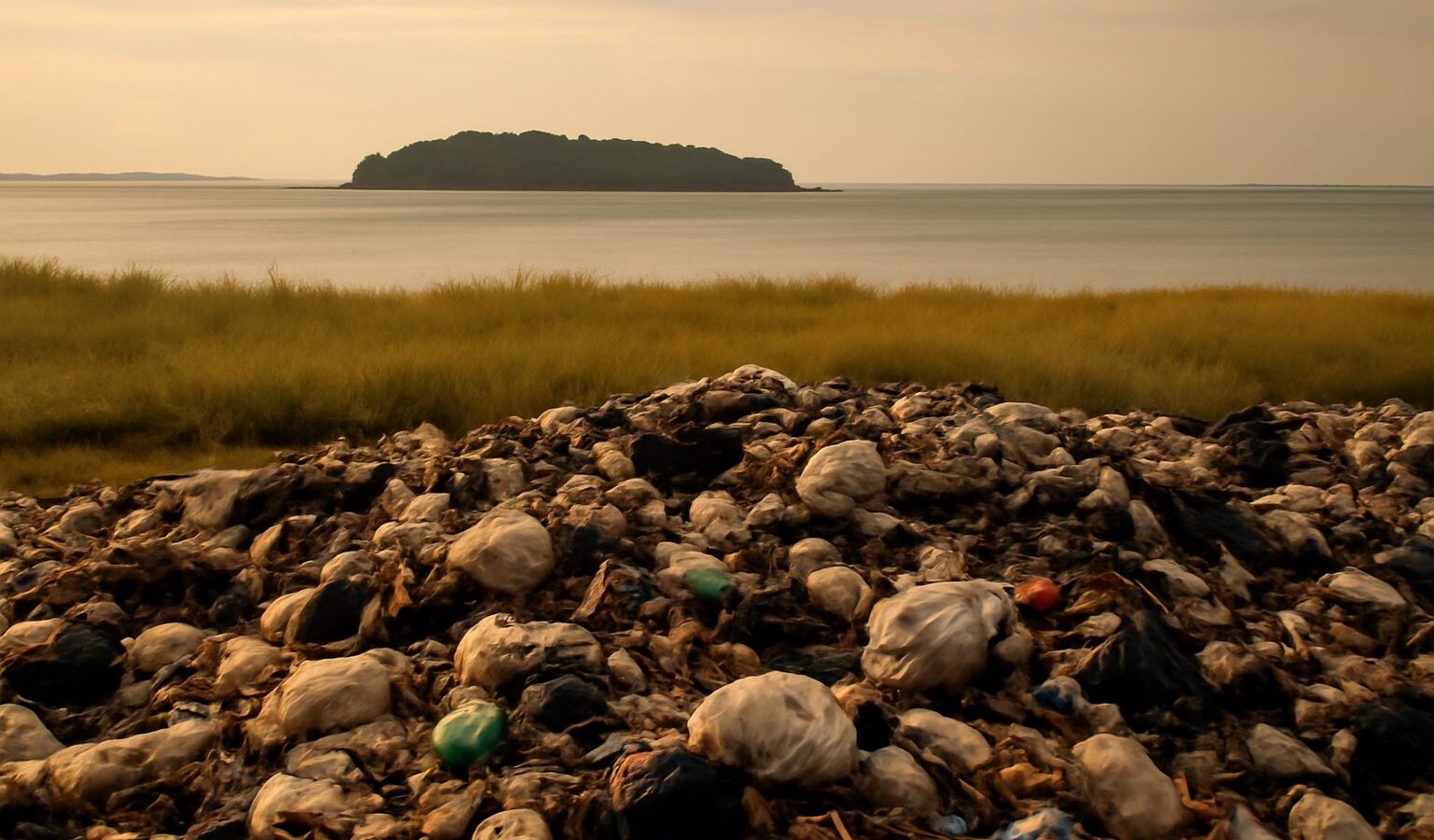
Most of us never see where our rubbish actually ends up. In Singapore, a surprising amount of it travels out to sea. Semakau Landfill is a man-made island about eight kilometres off the southern coast, and it is the final resting place for what we cannot recycle or burn. If you have ever wondered what happens after the bin truck drives off, or why the authorities keep nudging us to waste less, Semakau Landfill is the quiet reason behind it. It is the nation’s only landfill, and it will not last forever.
What Semakau Landfill Actually Is
Semakau Landfill was created near Pulau Semakau by enclosing a stretch of sea with a long rock perimeter wall, or bund, lined to keep waste from mixing with the surrounding water. Inside this lagoon, cells are filled one at a time, then covered over with soil and greenery. The result looks less like a rubbish tip and more like a grassy coastal park, with trees, ponds and open sky.
Two things are worth understanding straight away. First, mainland Singapore simply ran out of room for a landfill decades ago, so we built one offshore. Second, most of what goes there is ash, not raw rubbish. Almost everything we throw away that cannot be recycled is first burned at a waste-to-energy plant, which shrinks its volume dramatically. Only the leftover ash, together with a small amount of waste that genuinely cannot be incinerated, is barged out to Semakau. For the full picture of that burning step, see our guide on how waste-to-energy works in Singapore.
From Your Bin to the Island
The journey from your HDB rubbish chute to an offshore cell has several stops. Understanding it makes clear why every item you divert really does count.
- General waste from homes, hawker centres and businesses is collected and taken to a waste-to-energy plant.
- The waste is burned at high temperature, which reduces its volume by a large margin and generates electricity in the process.
- The remaining ash, plus non-incinerable waste such as certain construction debris, is sent to the Tuas Marine Transfer Station.
- There it is loaded, sealed, onto covered barges and shipped to Semakau Landfill.
- On the island the material is tipped into a lined cell. When a cell is full it is capped, covered with soil and planted over.
Anything you place correctly in the blue recycling bin, or keep out of the bin altogether, skips this entire chain. If you are unsure what belongs in that blue bin, our guide on what happens to your recycling in Singapore walks through it.
Why It Matters: A Landfill With a Deadline
Semakau is finite. Every cell that fills is gone for good, and there is no obvious site for a second offshore landfill. Early plans expected the island to last only into the 2030s. Better waste habits and improved incineration have already stretched that horizon, but the direction of travel is clear: the more we bury, the sooner it fills. Because these projections change with our behaviour, the National Environment Agency (NEA) publishes the current estimate, so check the latest figure rather than relying on an old headline.
This is the thinking behind the Singapore Green Plan and the Zero Waste Masterplan, which aim to cut the amount of waste sent to Semakau. The table below shows where different materials realistically end up, which helps explain where your choices make the biggest difference.
| Waste type | What happens to it | Reaches Semakau? |
|---|---|---|
| Clean recyclables (paper, metal, most plastics, glass) | Sorted and sent for recycling | No, if recycled correctly |
| General non-recyclable waste | Burned at a waste-to-energy plant | Yes, as ash |
| Food and garden waste | Incinerated, or composted where facilities exist | Yes, as ash |
| Non-incinerable waste (some construction debris) | Barged directly to the landfill | Yes, directly |
The lesson is simple. Recycling correctly keeps material out of the burn-and-bury stream entirely, while contaminated recycling often ends up incinerated anyway. Avoiding recycling contamination is therefore one of the most direct ways to protect Semakau’s remaining space.
The Surprising Wildlife on a Landfill
Here is the part that surprises visitors. Semakau is genuinely alive. Mangroves were replanted along its edges, and the intertidal flats around the island support corals, seagrass, crabs, herons and other shorebirds. It has become an unlikely showcase for how careful engineering and nature can sit side by side.
NParks and its partners run guided walks and intertidal visits at certain times, which are a wonderful way to see this for yourself. If you go, treat it as you would any nature reserve: keep to the marked paths and guided routes, do not remove or damage plants, corals or marine life, and never feed the wildlife. Follow the instructions of your guide and any NParks and NEA rules on the day, as access is managed and seasonal. The corals here are part of the same fragile ecosystem discussed in our piece on protecting our coral reefs in Singapore, and they deserve the same care.
What You Can Do to Extend Its Life
None of this asks for perfection. Small, consistent habits across millions of households add up faster than any single grand gesture. Here is where to start.
- Recycle right, not just often. Rinse containers, keep them loose and dry, and leave out anything you are unsure about rather than risking contamination.
- Cut food waste. Food is heavy and burns poorly. Plan meals, store leftovers well, and take only what you will finish at the hawker centre or buffet.
- Refuse what you do not need. Say no to extra disposables, request no cutlery on delivery orders, and carry a reusable bottle and bag.
- Repair and rehome. Fix, donate or pass on furniture, clothes and electronics instead of binning them.
- Buy with the end in mind. Choose products with less packaging and longer lives, so less ends up as ash in the first place.
Semakau Landfill is a quietly remarkable piece of national planning, but it is also a reminder that space is not endless. Every tray of food finished, every clean recyclable and every avoided disposable is one small deposit back into the island’s future. The goal is not to fill Semakau slowly. It is to need it as little as we possibly can.