
You will live with your passport photo for years, and your IC photo for even longer, so it is worth spending a few minutes thinking about your outfit before you sit down in front of the camera. The bigger concern, though, is making sure the photo is accepted. A photo that fails ICA’s checks means a delay, a reshoot and another trip.
This guide focuses on what to wear for passport photo and IC photo shoots in Singapore: which colours work against the background, which necklines and accessories to avoid, and how to handle glasses, hair and makeup. For the step-by-step process of taking the photo and submitting it, see our guide on how to take passport and ID photos.
ICA (the Immigration & Checkpoints Authority) sets the photo requirements for Singapore passports and the NRIC (the identity card, or IC). The requirements can be updated, so always check the current photo guidelines on ICA’s website before your shoot. The tips below are general styling advice to help you meet them.
Why Clothing Matters for an ID Photo
ID photos are checked for how clearly your face and head outline can be seen, both by officers and by automated systems. Your clothing does not need to be formal, but it can affect whether the photo works:
- Contrast with the background. ICA photos use a plain, light background. If your top is a similar colour, your shoulders and neck can blend into it, which can make the photo look washed out and the outline of your head and shoulders unclear.
- Distraction near the face. Busy patterns, big collars, scarves and statement jewellery draw attention away from your face and can cover parts of the jaw or neck.
- Glare and shadows. Shiny fabrics, sequins and reflective accessories can bounce light from the flash.
The safest approach is simple, solid-coloured clothing that frames your face without competing with it.
Best and Worst Choices at a Glance
Use this quick comparison when choosing your outfit.
| Item | Good choice | Avoid | Why |
|---|---|---|---|
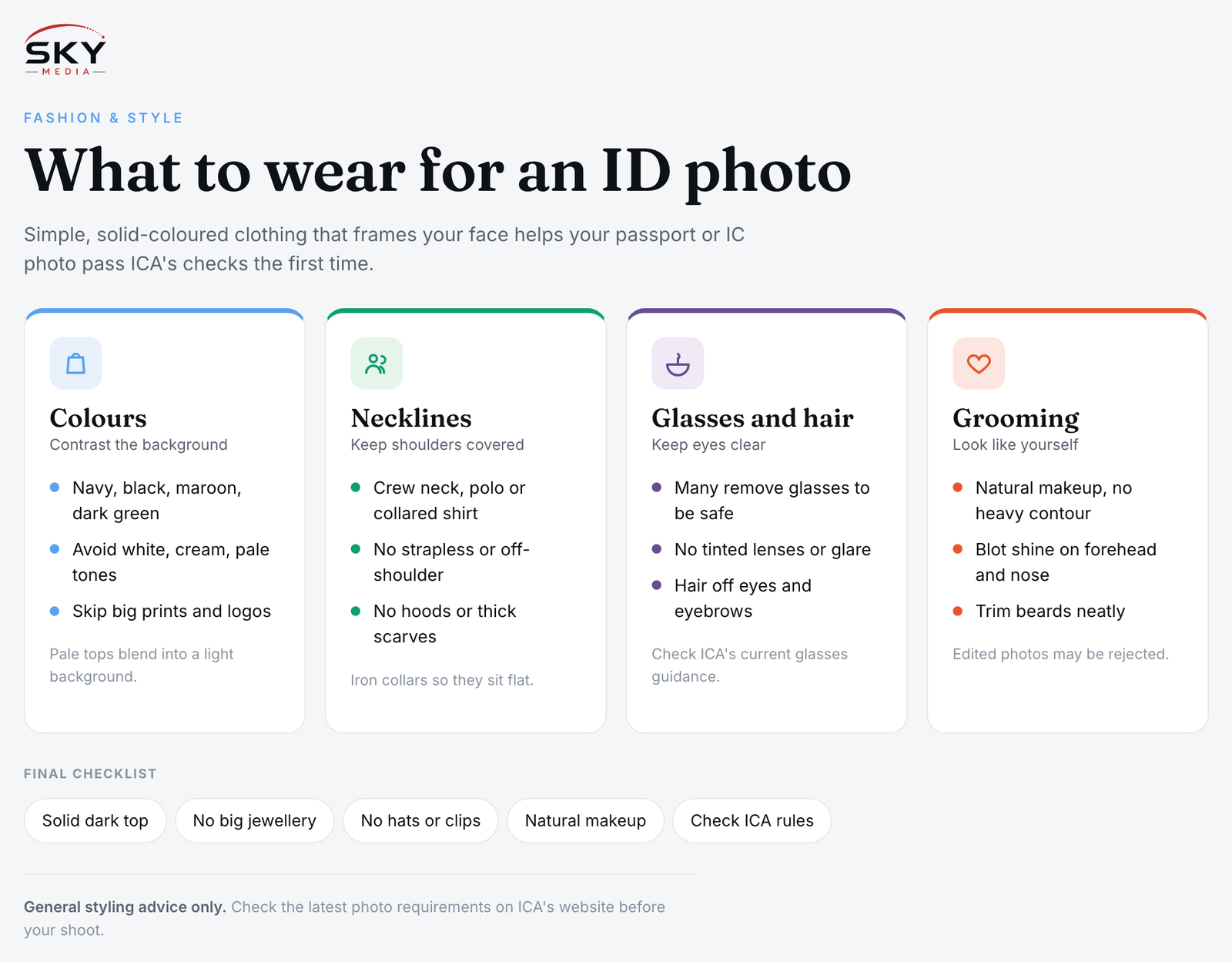
| Top colour | Solid mid to dark tones like navy, black, maroon, grey, dark green | White, cream, very pale colours | Pale tops can blend into a light background |
| Pattern | Plain or very subtle texture | Large prints, stripes, logos, text | Patterns distract and can look noisy when printed small |
| Neckline | Crew neck, collared shirt, modest V-neck | Strapless or off-shoulder tops | Bare shoulders can make it look like you are not wearing a top |
| Accessories | Small stud earrings or none | Large earrings, chunky necklaces, hair clips on top | Can cover features or reflect light |
| Glasses | Clear lenses with thin frames, if allowed | Tinted lenses, heavy frames over the eyes | Eyes must be clearly visible, without glare |
Colours and Necklines That Work
Choose a solid, darker colour. Navy, black, charcoal, deep blue, burgundy and dark green all give a crisp outline against a light background. Medium tones like grey or muted blue also work well. Very bright neon colours can reflect a colour cast onto your face.
Pick a neckline with clear shoulders. A simple crew-neck T-shirt, a polo or a collared shirt photographs well. A modest V-neck is fine. Strapless or off-shoulder tops are best avoided, as the cropped photo can look as though you are bare.
Keep collars tidy. If you wear a collared shirt, iron it so the collar sits flat. Very large or stiff collars and high turtlenecks can hide your jawline and neck.
Skip hoods and heavy layers. Bulky jackets, hoodies with the hood bunched at the neck, and thick scarves add clutter around your face.
If you are taking a photo that might double up for job applications, you might want a slightly smarter look. Our guide on what to wear for a corporate headshot has more styling ideas, but keep in mind that ID photo rules are stricter than headshot conventions.
Glasses, Hair and Head Coverings
Glasses. Rules on spectacles in ID photos vary between countries and can change. Check ICA’s current guidance on whether glasses may be worn. If you do wear them, your eyes must be clearly visible, with no tinted lenses, no glare on the lenses and frames that do not cover your eyes. Many people simply remove their glasses for the photo to avoid problems. Coloured contact lenses that change your eye colour are generally best avoided.
Hair. Your face should be clearly visible, so keep hair away from your eyes and eyebrows, and avoid fringe that covers your brows. Long hair can be tucked behind the shoulders or ears for a clear outline of your face. Avoid large hair accessories, bows or clips on top of the head.
Head coverings. Headwear is generally not allowed unless worn for religious reasons. If you wear a head covering for religious reasons, check ICA’s guidelines on how your face must be visible, and choose a plain covering in a colour that contrasts with the background.
Makeup and Grooming Tips
ID photos are taken with a neutral expression and even lighting, so natural grooming works best.
- Keep makeup natural. The photo should look like you on an ordinary day. Heavy contouring, false lashes or dramatic colours can make you look different from how you appear at the checkpoint.
- Control shine. Blotting paper or a little powder reduces glare on the forehead and nose, especially in Singapore’s humidity.
- Facial hair. You can keep a beard or moustache, but trim it neatly. If you usually have a beard, there is no need to shave it off for the photo.
- Cover visible blemishes lightly if you wish, but avoid heavy retouching. Photos that have been edited to change your appearance may be rejected.
Special Cases: Children and Babies
For a child or baby, dress them in a plain, darker-coloured top with no prints or characters, and remove hair clips, headbands and hats. Babies’ hands and toys should not be in the frame. Expect it to take a few tries to get a neutral expression with eyes open. Check ICA’s guidelines for any specific requirements for infants. Our guide to getting a passport for your newborn walks through the wider application process.
Final Checklist Before Your Shoot
Before you head to the photo studio or set up at home, run through this list:
- A plain, solid, darker-coloured top with shoulders covered.
- No large earrings, necklaces, hair clips or hats.
- Glasses removed, or clear lenses with no glare if you choose to wear them and ICA allows it.
- Hair clear of your eyes, eyebrows and face outline.
- Natural makeup and shine controlled.
- The latest ICA photo requirements checked on the official website.
Choosing the right clothes takes only a moment, and it helps ensure your photo is accepted the first time. If you are submitting the photo for a renewal, our guide to renewing your Singapore passport covers the next steps.
Frequently Asked Questions
Can I smile in my passport or IC photo? Photos are usually taken with a neutral expression, so keep your face relaxed with your mouth closed and eyes open. A big smile can change your face shape and may fail automated checks. Check ICA’s current photo guidelines for the exact expression rules before you go.
What if my passport photo is rejected? You will normally need to retake and resubmit a photo that meets the requirements, which can mean delay and another trip. Ask what caused the rejection, such as a blending background, glare or an obscured face, and fix that before reshooting. ICA’s website lists the current standards.
Can I wear a work uniform for my ID photo? Plain uniforms in a solid, darker colour usually photograph fine. Avoid badges, logos, large collars and anything that blends into a light background or clutters the neckline. If your uniform is pale or busy, change into a plain top just for the photo.
Is it better to take the photo at a studio or at home? A studio usually gives even lighting and a plain background, which makes the photo more likely to meet ICA’s checks. Taking it at home is possible if you control lighting, shadows and background carefully. Check ICA’s website for what it currently accepts and how to submit.
Should I redo my photo if my appearance has changed a lot? Yes, a photo that no longer looks like you can cause trouble at the checkpoint. A major hair change, weight change or growing or removing a beard are common reasons to take a fresh photo. Use a recent picture that shows how you normally look.