

When a loved one passes away, families in Singapore often want to let friends, colleagues and the wider community know quickly. An obituary in a Singapore newspaper is still one of the most common ways to do this, especially for older relatives whose friends read the morning paper. Online notices and social media now sit alongside print, and many families use both.
This guide walks through what to include, gives simple wording templates in English and Chinese, explains what affects the cost of newspaper placement, and covers online alternatives. Take it one step at a time. It is fine to ask a funeral director or a trusted relative to help.
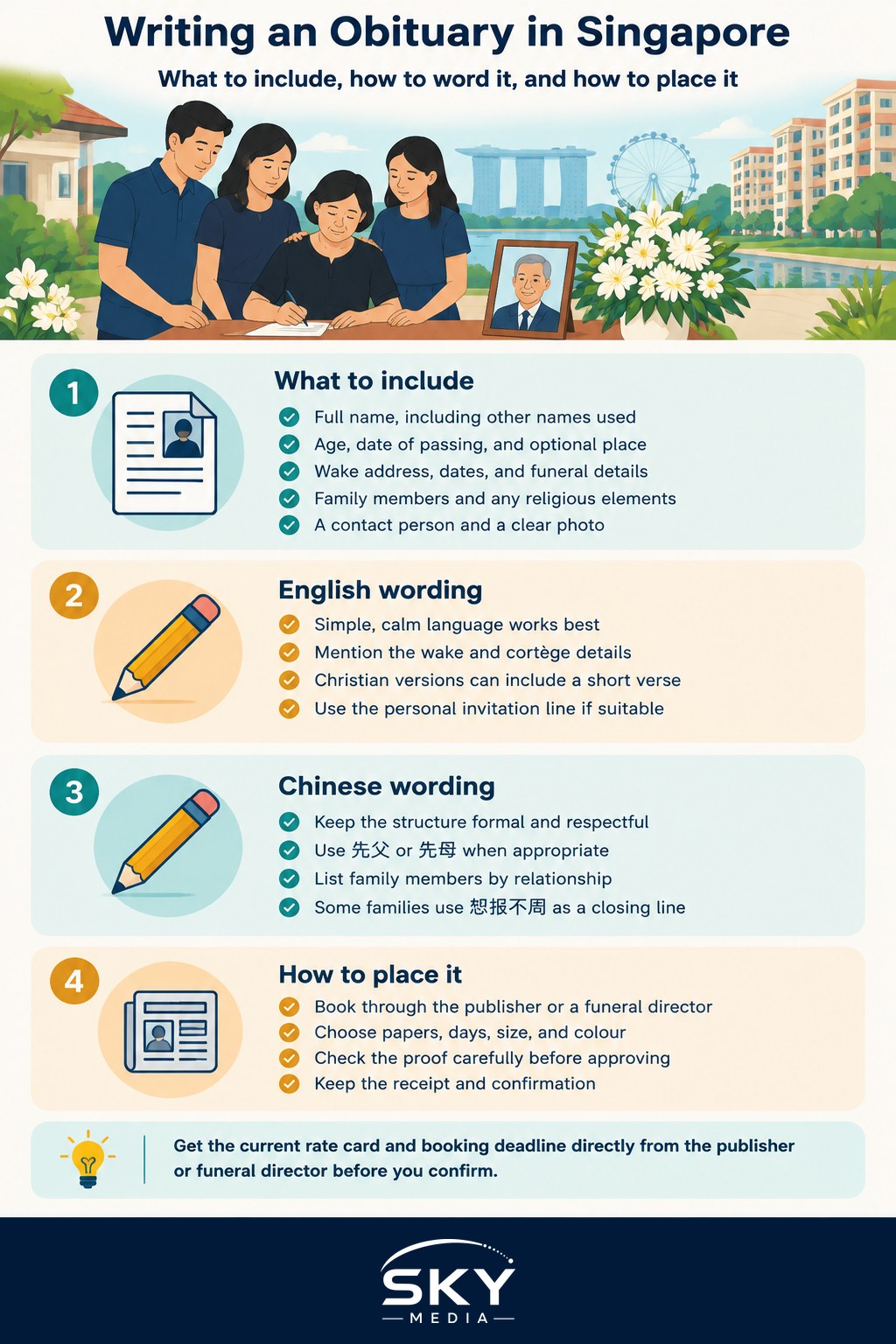
What an Obituary Needs to Say
An obituary or death notice does two jobs: it announces the death respectfully and it tells people where and when they can pay their respects. Before writing, gather these details:
- Full name of the deceased, including any Chinese name, dialect name, Christian name or other names friends know them by.
- Age (some Chinese families use the traditional reckoning, so agree on which to use).
- Date of passing, and optionally the place.
- Wake details: address (for example, a void deck block number or a funeral parlour), and the dates.
- Funeral or cortège details: date, time of departure, and the cremation or burial venue.
- Names of family members, usually listed by relationship.
- Religious elements, if any, such as a verse, prayer or symbol.
- A contact person, optional but helpful for people trying to find the wake.
- A photograph, ideally a clear recent portrait.
Check every date, time and address twice. Mistakes are hard to fix once a notice has printed.
English Wording Templates
Keep the language simple and calm. Here are three common styles you can adapt.
Simple announcement
It is with deep sorrow that we announce the passing of [Full Name], aged [age], on [date]. Beloved husband of [name], loving father of [names], and cherished grandfather of [names]. The wake is held at [address] from [date] to [date]. The cortège will leave on [date] at [time] for [venue]. Please accept this notice as a personal invitation.
Christian or faith based
Called home to be with the Lord on [date], [Full Name], aged [age]. Dearly missed by [family]. Wake at [address]. Funeral service on [date] at [time], followed by [cremation or burial] at [venue]. “[Short verse or prayer]”
Short and modern
In loving memory of [Full Name], [birth year] to [death year], who passed peacefully on [date]. Forever in our hearts. Wake and funeral details: [address, dates, times]. Contact [name and number].
The phrase “Please accept this notice as a personal invitation” is widely used in Singapore so that friends do not feel they need a separate invitation to attend.
Chinese Wording Templates
Chinese obituaries (讣告) often follow a fairly formal structure. Wording varies by family and dialect group, so treat this as a starting point.
Traditional style
讣告
先父/先母 [姓名] 老先生/老夫人,享年[岁数]岁,于[日期]安详辞世。灵柩停放于[地址],定于[日期][时间]出殡,随即移往[火化场或坟场]。
孝男:[姓名] 孝媳:[姓名]
孝女:[姓名] 孝婿:[姓名]
孙:[姓名]
泣告
Simpler version
沉痛哀悼 [姓名],享年[岁数]岁,于[日期]逝世。灵堂设于[地址],[日期][时间]出殡。家属敬告。
A few notes:
- 先父 and 先母 mean “the late father” and “the late mother”, used by the children.
- 孝男, 孝女, 孝媳 and 孝孙 list sons, daughters, daughters-in-law and grandchildren.
- 享年 introduces the age at death.
- Some families add 恕报不周 (“please forgive us for not informing everyone individually”), which serves the same purpose as the English “personal invitation” line.
If the family is bilingual, you can place a Chinese notice in a Chinese paper and an English notice in an English paper, or use one bilingual layout.
Newspaper Versus Online Notices
| Option | Who it reaches | What affects the cost | Things to note |
|---|---|---|---|
| English daily newspaper | Older and professional readers, wide reach | Size, colour or black and white, weekday or weekend, number of days | Booking deadlines apply for the next day’s paper |
| Chinese daily newspaper | Chinese-reading friends, clan and community networks | Similar factors to English papers | Check Chinese characters carefully on the proof |
| Publisher’s online obituary listing | Readers who search online | Often bundled with or added to print notices | Easy to share as a link |
| Social media and messaging groups | Family, friends, colleagues | Free | Fast but informal; avoid sharing home addresses publicly |
| Funeral director’s notice page | People who know the funeral company | Depends on the package | Ask what is included |
How to Place an Obituary in a Singapore Newspaper
The main English and Chinese daily papers accept obituary notices through their publisher’s classified advertising booking channels, which typically include an online booking system and a customer service line. Many funeral directors also handle bookings for families as part of their services.
Steps that usually apply:
- Decide which papers and how many days. Many families run the notice for one to two days, sometimes with a separate thank-you notice after the funeral.
- Choose a size and layout. Prices depend mainly on size and colour. Ask the publisher or funeral director for the current rate card, as rates change and differ by day of the week.
- Prepare the text and photo. Use a clear digital photo. Keep the text concise, since longer notices take up more space.
- Note the booking deadline. There is usually a cut-off time for the next day’s edition. Confirm it when you book.
- Check the proof carefully. Verify names, Chinese characters, dates, times and the address before approving.
- Keep the receipt and confirmation, in case anything needs correcting.
Do not rely on any fee you hear second hand. Obtain the current price directly from the publisher or your funeral director before committing.
Thank-You Notices and Later Memorials
After the funeral, some families place a short thank-you notice (鸣谢) to acknowledge everyone who visited, sent wreaths or helped. Others place anniversary or memorial notices on the first anniversary or on significant dates. These are usually shorter and smaller than the original obituary.
Newspapers have long played a role in community life here, as our piece on the history of Singapore newspapers and media explains, and the obituary pages remain an important space for that.
Looking After Yourself and Your Family
Writing an obituary while grieving is hard. Share the task: one person drafts, another checks facts, and an elder confirms names and titles. Remember that there is no single correct format. What matters is that it is accurate, respectful and helps people come to say goodbye.
If you are supporting an older parent who has lost a spouse, you may also find our guide on ageing in place in Singapore helpful as you plan the months ahead.