

For many families from mainland China, the hardest part of caring for an older parent in Singapore is not finding a service. It is finding one where your mother or father can actually talk to the people looking after them. Chinese speaking elder care in Singapore is more available than many newcomers expect, because Mandarin is widely spoken here and many care staff are bilingual. The challenge is knowing where to look, what to ask, and how to check that “we speak Chinese” means real, everyday communication.
This guide is written for Chinese-speaking families, especially those who have recently moved from China, who need care options that match a parent’s language. It is general information, not medical advice. For health decisions, always speak with a doctor or polyclinic, and for care schemes, check with the official agencies named below.
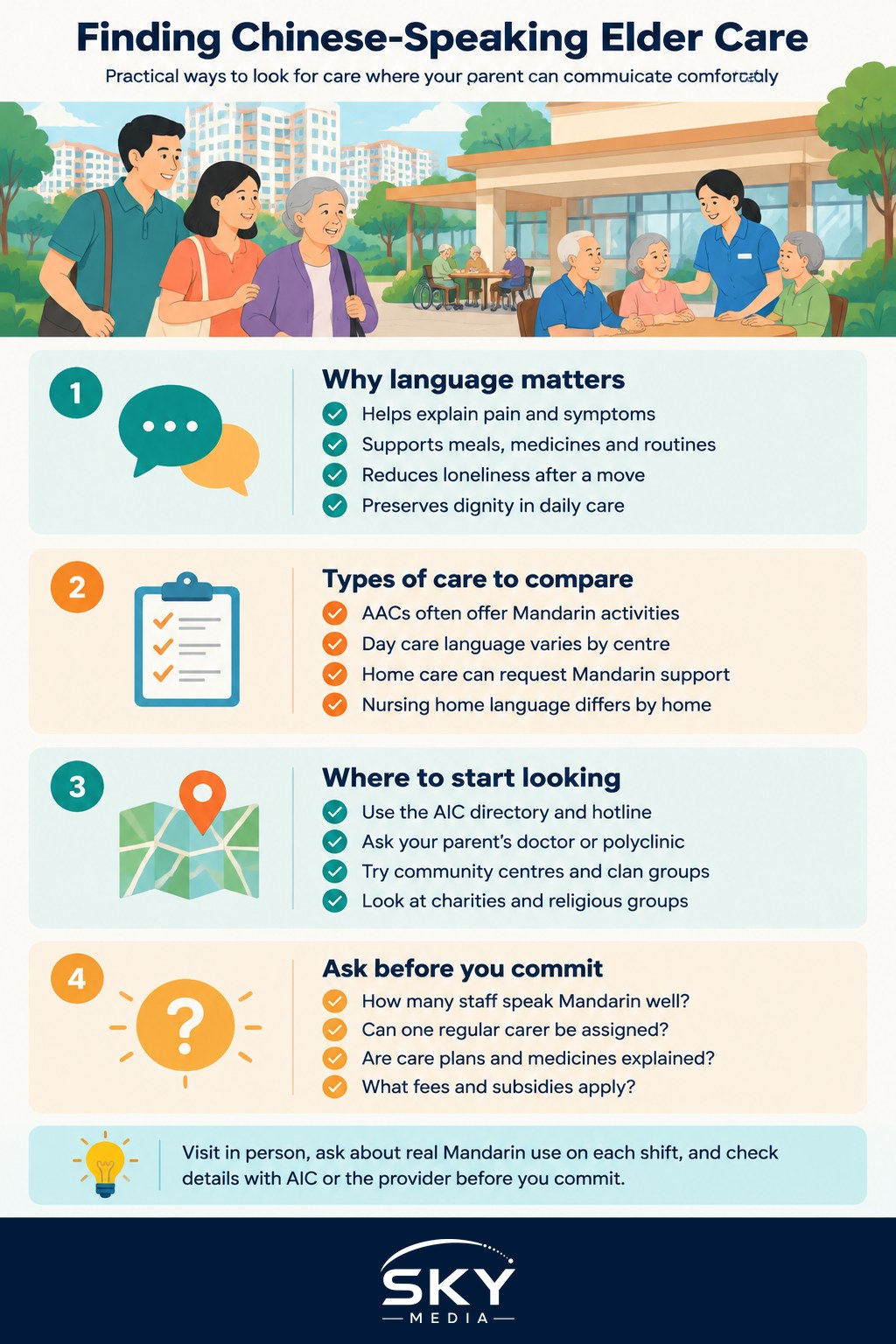
Why Language Matters So Much in Eldercare
Language is not a nice extra in eldercare. It affects safety and wellbeing every day.
- Describing pain and symptoms. An older person who cannot explain discomfort clearly may go unnoticed or be misunderstood.
- Following routines. Instructions about meals, movement and medicines from the doctor need to be understood, not just heard.
- Loneliness. Being surrounded by people you cannot chat with can make an elder withdrawn, especially soon after moving to a new country.
- Dignity. Being able to joke, complain or ask for help in your own language makes care feel like care.
It also helps to know that Singapore’s Chinese community has its own history. Many local seniors grew up speaking dialects such as Hokkien, Teochew or Cantonese, and many care staff learned dialect phrases to serve them. A parent from northern China who speaks only Mandarin, or one who speaks a regional dialect, may find accents and vocabulary a little different at first. This is usually easy to adjust to, but it is worth asking about.
The Main Types of Elder Care and How Language Works in Each
Singapore’s eldercare system works in layers, from light social support to full-time residential care. The Agency for Integrated Care (AIC), a government agency that coordinates eldercare, runs an online directory of services and a hotline. It is the best starting point for any family. If you are used to China, think of AIC as a central coordinator, rather than going hospital by hospital or relying only on word of mouth.
| Type of care | What it is | How easy to find Mandarin support | What to check |
|---|---|---|---|
| Active Ageing Centre (AAC) | Neighbourhood centres with activities, exercise and social contact for seniors | Usually easy; many run activities in Mandarin and dialects | Which activities are in Mandarin, and who can join |
| Senior day care centre | Daytime supervision, meals and therapy while family members work | Often available, varies by centre | Staff languages on each shift, not just the manager’s |
| Home care and home nursing | Caregivers or nurses who visit the home | Can usually be requested | Whether a regular Mandarin-speaking carer can be assigned |
| Live-in caregiver (domestic helper) | A helper employed under MOM rules who lives with the family | Possible; some helpers speak Mandarin | Real conversational level, tested in an interview |
| Nursing home | Residential care for high needs | Commonly available, varies by home | Language of night staff and nurses, and of other residents |
Each of these has its own eligibility rules, and fees and subsidies differ. Government subsidies are generally tied to citizenship or permanent residence and to household means testing. If your parent is in Singapore on a pass such as a Long-Term Visit Pass, do not assume they qualify for subsidised services. Check directly with AIC or the provider before you plan your budget.
Where to Start Looking
1. The AIC eldercare directory and hotline. Search by type of service and area, then call providers to ask about language. AIC staff can also explain which schemes your family might qualify for.
2. Your parent’s doctor or polyclinic. If your parent already sees a doctor here, ask for a referral. Hospital medical social workers can also help when an older person is being discharged and needs follow-up care.
3. Community centres and clan associations. Community centres, run under the People’s Association, and many clan or hometown associations host Mandarin activities for seniors. These are good places to build a social circle before more formal care is needed. Gentle hobbies help too; Chinese calligraphy and cultural hobby groups are a natural fit for many older newcomers.
4. Religious and community organisations. Several temples, churches and charities run day care, home help or befriending services, often in Mandarin. Many welcome people of any faith, but ask.
5. Other Chinese-speaking families. Parent groups, neighbours and WeChat groups can share real experiences. Treat recommendations as a starting list, then check details yourself.
For the bigger picture, including visas, insurance and living arrangements, read our guide on elderly care for Chinese parents in Singapore.
Questions to Ask Before You Commit
When you contact a provider, ask specific questions in Mandarin and listen to how the staff answer. A confident, natural reply tells you a lot.
- How many care staff on each shift speak Mandarin well, including at night and on weekends?
- Can my parent be assigned a regular Mandarin-speaking caregiver, or will it change often?
- Are activities, talks and exercise sessions run in Mandarin, or only in English?
- Can nurses explain care plans and medicine schedules to my parent in Mandarin, and to me in writing?
- Are there other residents or members who speak Mandarin, so my parent can make friends?
- Can meals include familiar dishes, or can family bring food?
- What happens if there is a problem, and who do I contact?
- What are the fees, what is included, and which subsidies apply to my parent’s pass type?
Trial Visits and Watching for Fit
Do not judge by brochures alone. Visit in person with your parent if possible, ideally more than once and at different times of day.
- Watch real interactions. Do staff speak to seniors in Mandarin naturally, or switch to English when busy?
- Let your parent lead. Ask them afterwards how comfortable they felt, and whether they understood people.
- Ask about a trial period. Some day care centres and home care services allow a short trial. Check the terms.
- Check in regularly after starting. Early weeks are when misunderstandings show up. Speak with the staff often and keep notes.
If your parent seems low or anxious after moving to Singapore, emotional support matters as much as physical care. A professional who speaks their language can help; see our guide to booking a Chinese-speaking therapist. If you are worried about mood, memory or health, raise it with a doctor promptly.
Supporting Your Parent as a Family
Even with good services, family remains central. Learn a few key English words with your parent, such as their medicine names and “pain”, so they can communicate in an emergency. Keep a card in their wallet with their name, your phone number, home address and key medical details in both English and Chinese. Save the AIC hotline and your parent’s clinic number on your phone.
Finally, look after yourself. Caring for a parent in a new country is tiring. AIC and many community groups offer caregiver support, training and respite options, and asking for help early makes the whole family stronger.
Official sources: Agency for Integrated Care
Further reading: How to Report Elder Abuse or Neglect in Singapore · How China-Newcomer Families Can Discuss Eldercare in Singapore