

For a small shop, the year-end stocktake is one of the most important jobs on the calendar. Your closing stock figure feeds straight into your cost of sales, your profit and, eventually, your tax. Get it wrong and your accounts are wrong. Get it right and you also learn which products sell, which sit gathering dust and where stock might be going missing.
This guide walks you through a practical year-end stocktake for a small retail business in Singapore, from planning the count to valuing stock, handling write-offs and adjusting your books. It is general information, not accounting or tax advice. Your accountant and IRAS (the Inland Revenue Authority of Singapore) are the final word on how your figures should be treated.
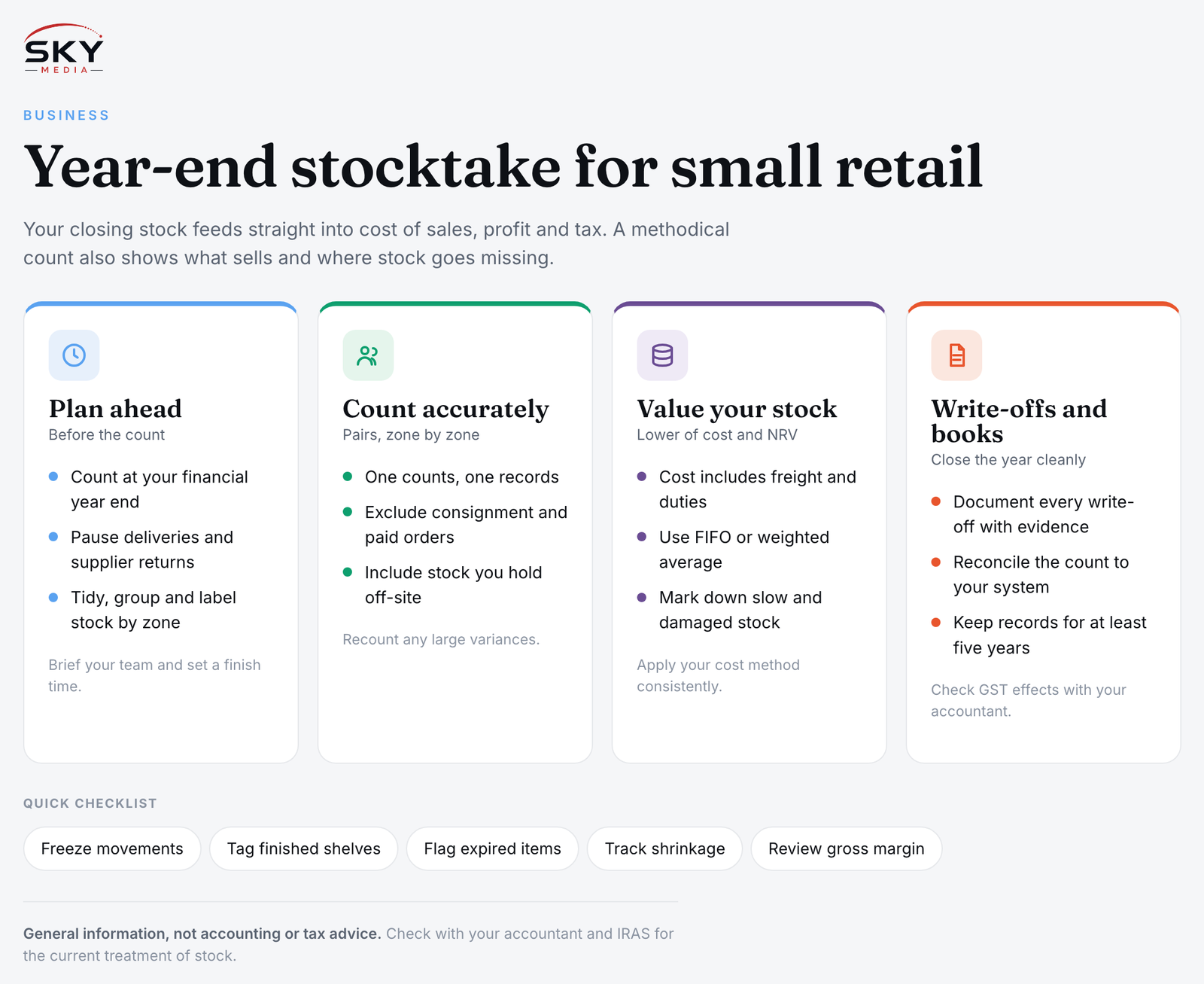
Step 1: Plan the Count Around Your Financial Year End
The stocktake should reflect what you hold at the close of your financial year. That is not always 31 December. If you are unsure of your date, our guide to choosing your company’s financial year end explains how it works.
Plan these points a couple of weeks ahead:
- Pick a count time. Many retailers count after closing on the last day, or before opening on the first day of the new year. If neither works, count as close as possible and adjust for sales and deliveries in between.
- Freeze movements. Ask suppliers not to deliver during the count. Hold back returns to suppliers until after.
- Tidy and group stock. Put like items together, clear the storeroom and label shelves or zones. A messy stockroom doubles the time needed.
- Prepare count sheets or a scanner. Print sheets from your POS or inventory system, or set up handheld scanning if your system supports it.
- Brief your team. Assign pairs to zones, explain the method and set a finish time.
If December is your busiest month, think about timing alongside your peak season. Our guide on preparing for the year-end sales peak can help you avoid clashes.
Step 2: Count Accurately
A good count is methodical. Use these habits:
- Count in pairs. One person counts, the other records. Swap roles for a second check on high-value items.
- Work zone by zone. Count left to right, top to bottom, and tag each shelf or bin once it is done.
- Count only what you own. Exclude goods held on consignment for others, customer orders already paid for and awaiting collection, and items you have returned to suppliers. Include stock you own that is held elsewhere, such as at a warehouse or pop-up.
- Note condition as you go. Mark damaged, expired, shop-soiled or obsolete items separately. You will need this list for valuation.
- Recount big gaps. Compare counts with your system records. Where the difference is large, recount before accepting it.
Step 3: Value Your Stock
Once you know what you hold, you need to put a dollar value on it. The general principle under the accounting standards used in Singapore is that inventory is valued at the lower of cost and net realisable value. Net realisable value is roughly what you expect to sell the item for, less the costs of selling it.
- Cost usually includes the purchase price plus costs of bringing stock to its present location, such as freight and import duties, less trade discounts.
- Cost formula. Small retailers commonly use first-in, first-out (FIFO) or weighted average cost. Pick a method that suits your business and apply it consistently from year to year.
- Slow-moving and damaged stock. If you can only sell an item below cost, value it at the lower expected selling price less selling costs.
This comparison shows how common stock situations are usually treated. Confirm the treatment for your business with your accountant.
| Stock situation | Typical valuation approach | What to record |
|---|---|---|
| Normal saleable stock | At cost, using your chosen formula | Count and cost per item |
| Slow-moving stock that will need clearance pricing | Lower of cost and expected sale price less selling costs | Expected sale price and reason for the markdown |
| Damaged but sellable at a discount | Lower of cost and discounted sale price less selling costs | Photos, damage notes and discount planned |
| Expired, broken or unsellable | Written down to nil, or to scrap value if any | Write-off record with evidence of disposal |
| Stolen or missing (shrinkage) | Removed from stock | Variance report and any police or insurance reference |
Step 4: Handle Write-Offs Properly
Write-offs reduce your closing stock and your profit, so keep good records:
- Document every item written off. Note the product, quantity, cost and reason.
- Keep evidence of disposal. Photos, disposal receipts or a signed note from the staff member who discarded the goods.
- Separate shrinkage from damage. Unexplained losses may point to theft, receiving errors or POS mistakes. Tracking them separately helps you fix the cause.
- Check GST implications. If you are GST-registered, giving away, donating or writing off stock can have GST consequences. Check IRAS guidance or ask your accountant before deciding how to treat these goods.
- Check your insurance. Losses from theft, flood or fire may be claimable. Read your policy wording and contact your insurer promptly.
Step 5: Adjust Your Books
With a final count and valuation, update your accounts:
- Reconcile the count to your system. Post adjustments in your inventory or POS system so it starts the new year with accurate quantities.
- Record closing stock. Your accountant or bookkeeper will use the closing stock value to work out cost of sales for the year.
- Post write-downs and write-offs. Record them with clear descriptions so the figures can be explained later.
- Review gross margin. Compare this year’s margin with last year’s. A sudden drop may signal pricing issues, heavy discounting or shrinkage.
- Keep your records. IRAS generally requires business records to be kept for at least five years. Store count sheets, valuation workings and write-off evidence with your year-end files.
A Quick Stocktake Checklist
Print this and keep it with your count sheets:
- Confirm the financial year-end date and the count time.
- Pause deliveries and supplier returns during the count.
- Tidy, group and label stock by zone.
- Prepare count sheets or scanners and brief the team.
- Count in pairs, zone by zone, and tag finished areas.
- Exclude consignment and paid customer orders; include stock held off-site.
- Flag damaged, expired and slow-moving items.
- Recount large variances.
- Value at the lower of cost and net realisable value.
- Document write-offs with evidence.
- Reconcile the system, post adjustments and pass figures to your accountant.
- File all records for at least five years.
Using Your Stocktake to Plan Ahead
A year-end stocktake is more than a compliance task. The lists of slow movers and write-offs show you what not to reorder, the variance report shows where your controls need tightening, and the final figures give you a clean start for the new year. Many small retailers also fold the stocktake into a wider year-end review of cash flow, staffing and bonuses.
Accounting standards and tax rules can be updated, so check with your accountant and IRAS for the current treatment of stock and write-offs before you finalise your accounts.
Further reading: Keeping a Fixed Asset Register and Depreciating Business Assets