

Singapore’s sun rises early and shines hard, and many homes face the full force of the afternoon heat. That is why blackout curtains in Singapore are popular with shift workers, parents of light sleepers, home office users and anyone whose bedroom turns into an oven by 3pm. But “blackout” on a label does not guarantee a dark, cool room. How the fabric is made, how the curtain is hung and how carefully you measure all decide whether you get real darkness or a glowing frame of light around the window.
This guide focuses on blackout performance, heat reduction and measuring for local homes. For a broader look at styles and window treatments, see our guide to choosing curtains and blinds in Singapore.
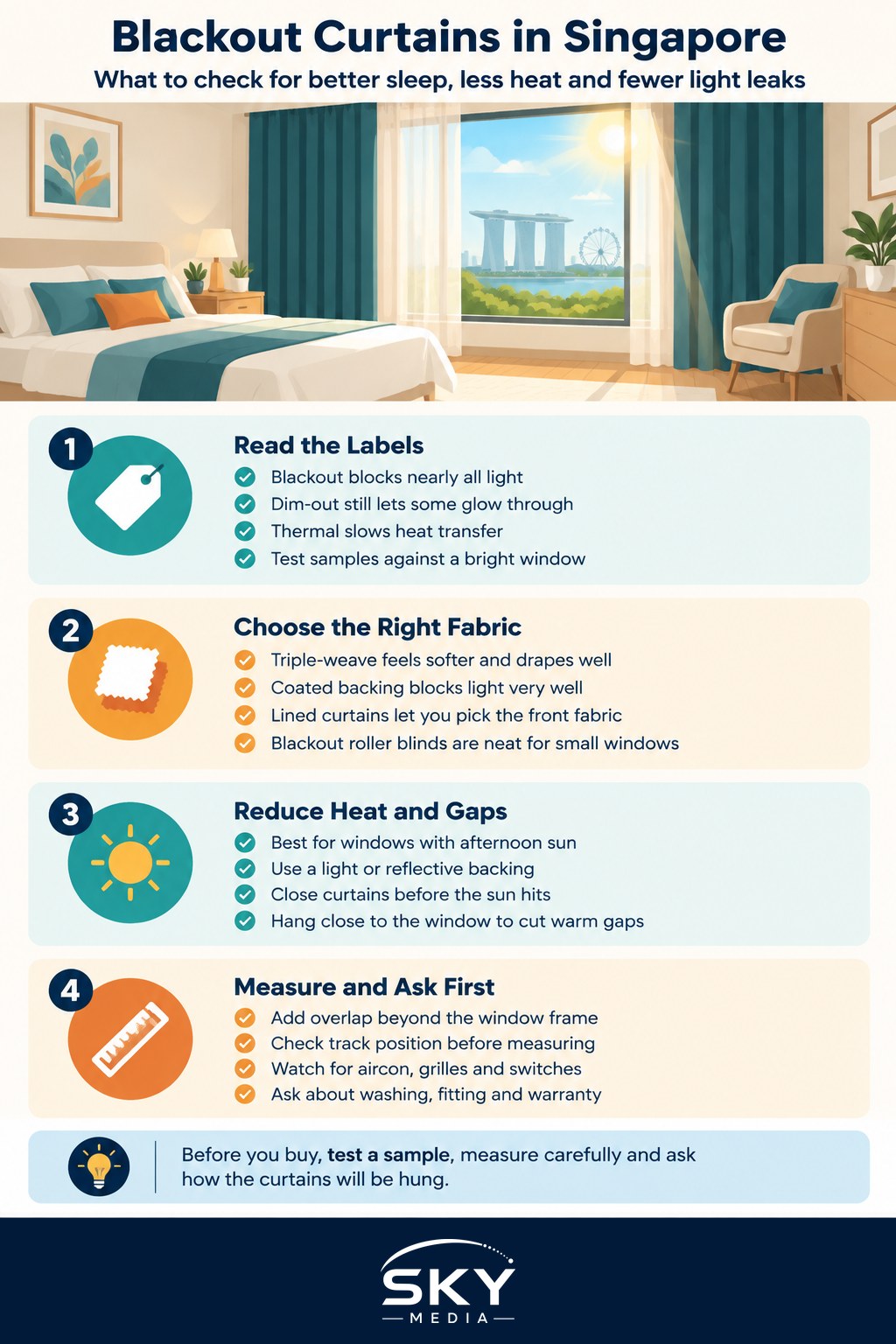
Blackout, Dim-Out and Thermal: Know the Labels
Shops and online sellers use several terms that sound similar but deliver very different results.
- Blackout means the fabric itself is designed to block nearly all light passing through it. Whether the room becomes fully dark also depends on installation.
- Dim-out or room-darkening fabric reduces light significantly but lets some glow through, especially in bright midday sun.
- Thermal or insulating curtains are designed to slow heat transfer. Many blackout curtains have thermal properties, but not every thermal curtain is fully blackout.
Before buying, hold a sample up to a bright window or shine your phone torch through it. If you can see the light source clearly, it is not true blackout.
How Blackout Fabrics Are Made
The construction of the fabric affects darkness, feel, durability and how well it copes with our humidity.
| Fabric type | How it blocks light | Pros | Things to watch |
|---|---|---|---|
| Triple-weave | A dense black yarn woven between two outer layers | Soft drape, looks like normal fabric, washable in many cases | Some lighter colours may let a faint glow through |
| Coated or foam-backed | A rubbery or acrylic coating applied to the back | Very high light blocking, often good thermal effect | Coating can crack or peel over time, may feel stiff |
| Lined curtain | A separate blackout lining sewn or hooked behind a decorative fabric | Lets you choose any front fabric, lining can be replaced | Heavier, needs a stronger track or rod |
| Blackout roller blind | A solid blackout sheet on a roller inside or outside the frame | Neat, compact, good for small windows | Gaps at the sides unless fitted with side channels |
In a humid climate, mould is a real concern. Heavy curtains that touch cold, damp window glass can trap moisture. Choose fabrics that can be cleaned easily, open the curtains to air the room regularly, and check the back of the curtain for spots. Our guide on how to clean curtains, blinds and soft furnishings covers care routines that suit local conditions.
Heat Reduction: What Blackout Curtains Can and Cannot Do
Blackout curtains help with heat mainly by stopping sunlight from entering the room and warming surfaces inside. They are most effective on windows that receive direct afternoon sun, often those facing west.
To get the most heat benefit:
- Choose a light-coloured or reflective backing facing the window. It reflects more sunlight back out.
- Close them before the sun hits. Curtains work better at keeping heat out than at removing heat that has already built up.
- Hang them close to the window. Less gap means less trapped warm air spilling into the room.
- Pair with good aircon habits. A cooler room can help your air-conditioner work less hard, but actual savings depend on your unit, room and usage, so treat any claimed percentage with caution.
What blackout curtains will not do is replace insulation, solar film or shading on the outside of the building. If your home is very hot, consider them as one layer in a wider approach.
Stopping Light Leaks Around the Edges
The most common complaint about blackout curtains is not the fabric. It is the light that sneaks in at the top, sides and bottom.
Ways to reduce light leakage:
- Extend beyond the window. Make the curtain wider than the window frame on each side so the fabric overlaps the wall.
- Mount high. A ceiling-mounted track or one fixed close to the ceiling stops light escaping over the top.
- Use a pelmet or valance. A box or fabric panel over the track blocks the gap above.
- Consider return or wraparound tracks. These curve the curtain back to the wall at the ends, closing the side gaps.
- Add overlap in the middle. For two panels, an overlap arm or a generous centre overlap stops a bright vertical stripe.
- Get the length right. Floor-length curtains that just touch or slightly break on the floor block more light than ones that stop short.
For blinds, side channels or a combination of a blackout blind with a curtain in front can close most gaps.
Measuring for Local Homes
Many HDB flats and condos have similar window types, but no two installations are identical. Measure carefully, or ask the installer to measure for you.
Tips for measuring:
- Measure the width of the window frame, then add extra on each side for overlap. Many people add a generous margin to block light; ask your supplier what they recommend for blackout use.
- Decide on the track position first. Ceiling-mounted, wall-mounted above the frame, or inside a recess all change the measurements.
- Measure the drop from the track to the floor or to just below the sill, depending on the style you want.
- Allow for fullness. Curtains need extra fabric width to form folds. The amount depends on the heading style, such as ripple fold or pinch pleat.
- Check for obstacles. Aircon units, window grilles, switches and furniture can affect where tracks and curtains can go.
- Measure in more than one place. Walls and ceilings are not always perfectly straight.
If you are confident with tools, our guide on installing curtain rails and blinds yourself explains the basics. Remember that blackout curtains are heavier than sheers, so brackets and tracks must be suitable for the weight, and drilling into some walls or ceilings may need care or professional help. Check your building or MCST (Management Corporation Strata Title, the body that manages a condo) rules if you live in a strata development.
Questions to Ask Before You Pay
Whether you buy online, from a furnishing shop or from a contractor, ask:
- Is the fabric true blackout or dim-out, and can I see a sample?
- How should it be washed, and will the coating survive washing?
- Does the quote include tracks, installation and any wraparound or pelmet?
- What are the delivery and installation timelines?
- What happens if the measurements are wrong?
- Is there a warranty on the track or motorised system?
If you want convenience, motorised or smart blackout curtains are worth a look. Our article on smart blinds and curtains explains how they work.
Good blackout curtains can transform how well you sleep and how comfortable your rooms feel. Choose the right fabric, hang it to cover every edge, and measure with care, and the investment will pay off every sunny afternoon.