

Most of us learned to water plants by pouring from the top and hoping for the best. Bottom watering flips that on its head: instead of wetting the soil from above, you let the pot sit in a shallow tray of water and drink it up through the drainage holes. It sounds fussy, but for many houseplants it is neater, more even and surprisingly foolproof. Bottom watering in Singapore suits our indoor gardeners especially well, because it encourages deep roots and keeps foliage dry in a climate where damp leaves invite fungus.
What Bottom Watering Is
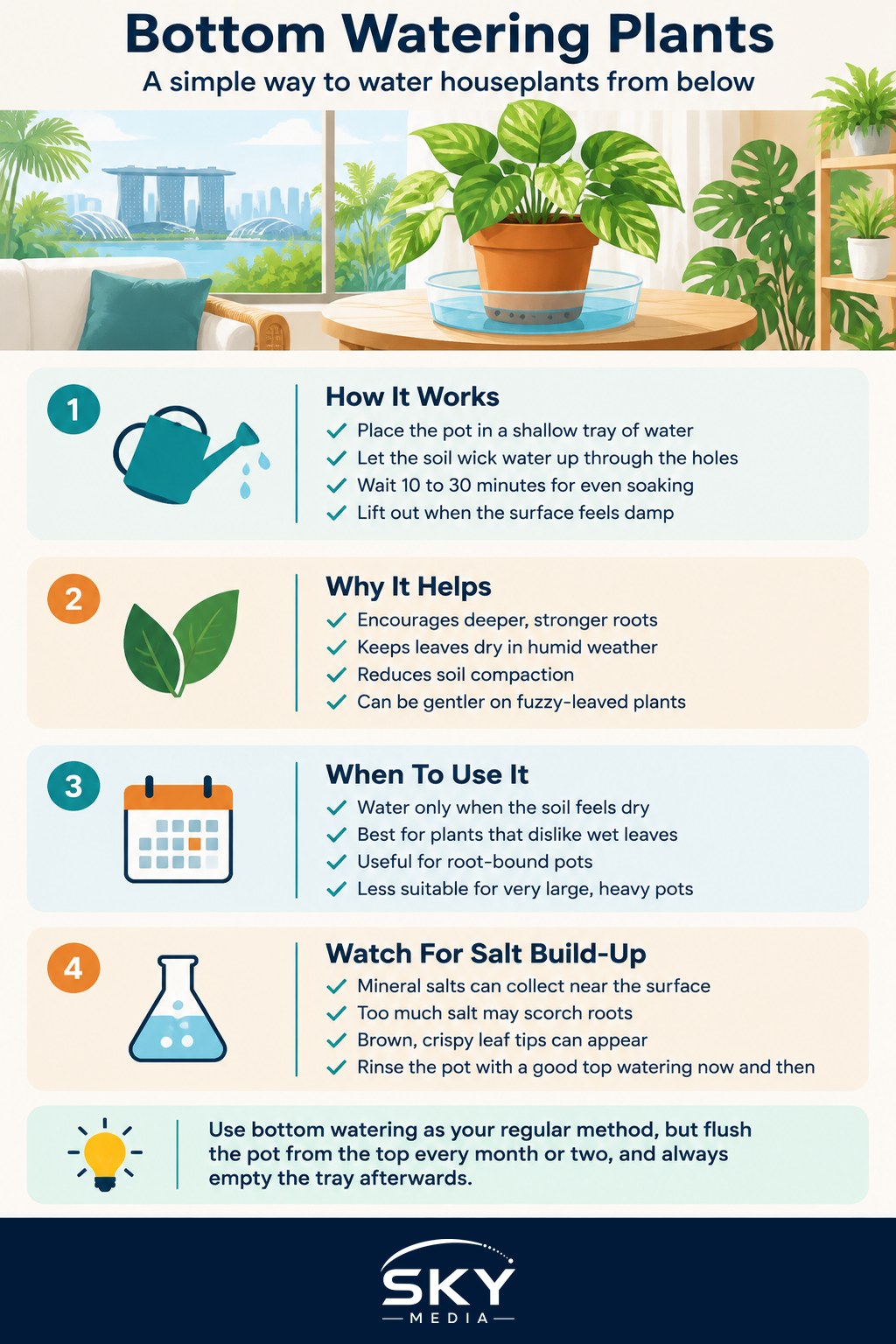
The idea is simple. You place a plant in its plastic nursery pot, the kind with holes in the base, into a tray, saucer or basin holding a few centimetres of water. Over the next 10 to 30 minutes, the dry soil wicks that water upward through the drainage holes, soaking the root ball evenly from the bottom up. Once the surface of the soil feels damp to the touch, the pot has taken up enough, and you lift it out and let it drain.
This works because dry soil naturally draws water upward, the same way a sponge soaks up a spill. The whole root ball gets moistened evenly, with no dry pockets left behind. It is the opposite of a hurried top watering, where water can race down the sides of a compacted or root-bound pot and out of the holes before the middle ever gets wet. For plants that have become root-bound or whose soil has dried out hard, bottom watering can rescue a root ball that top watering barely touches.
Why It Works So Well
Bottom watering has several genuine advantages beyond neatness. Because the moisture is drawn up from below, roots grow downward to follow it, producing a deeper, stronger root system rather than a shallow one clustered near the surface. Even, thorough wetting also means fewer of the dry patches that stress plants and cause uneven growth.
Keeping water off the foliage is a real bonus in our climate.
- Drier leaves, less disease. No water splashes onto the leaves or crown, which reduces the fungal spots and rot that thrive in warm, humid air.
- No soil compaction. Top watering slowly pounds the soil surface down; watering from below leaves the mix light and airy.
- Fewer fungus gnats. A drier soil surface is less inviting to fungus gnats, whose larvae live in constantly damp topsoil.
- Gentle on delicate plants. Fuzzy-leaved plants like African violets, which hate water on their leaves, love being watered from below.
When to Bottom Water
Bottom watering is not something you do on a fixed timetable; you do it when the plant actually needs a drink, just as with top watering. The single most reliable guide is the soil itself. Push a finger a few centimetres into the mix, and if it feels dry at that depth, it is time to water. If it still feels damp, wait and check again in a day or two. In our humidity, soil in an unglazed pot or a breezy spot dries faster than soil in a sealed cover pot or an air-conditioned room, so let the soil, not the calendar, decide.
Certain plants and situations suit bottom watering best. It is ideal for plants that resent wet leaves, for pots that have become root-bound, and for soil that has dried out so completely that water just runs off the top. It is less suitable for very large, heavy pots that are awkward to lift into a tray, and it should be paired with an occasional top watering, as we will see, to keep the soil healthy.
Bottom Watering at a Glance
| Step | What to do |
|---|---|
| Check the soil | Water only when the top few centimetres feel dry |
| Set up the tray | A few centimetres of water in a saucer or basin |
| Soak | Rest the pot in the water for 10 to 30 minutes |
| Test | Stop once the soil surface feels damp |
| Drain | Lift the pot out and let all excess water drip away |
The Salt Build-Up Problem
Bottom watering has one important drawback you must manage. When you water from the top, excess water flushes out through the drainage holes, carrying away the mineral salts that naturally accumulate from tap water and fertiliser. When you only ever water from below, those salts are never flushed out. Instead they get drawn upward with the moisture and concentrate near the soil surface, where you may see a whitish, crusty deposit forming.
Too much salt in the soil can scorch roots and cause brown, crispy leaf tips, the very problems you were trying to avoid. The fix is easy: every month or two, water the plant thoroughly from the top instead, letting plenty of water run right through the pot and out of the holes to rinse the accumulated salts away. Think of bottom watering as your usual routine and the occasional deep top flush as a reset. This simple alternation gives you the benefits of both methods without the salt problem.
Doing It Safely in the Tropics
There is one rule in Singapore you must never break, and it applies especially to bottom watering: never leave a pot standing in water. The whole point is to let the soil drink for a set time and then remove the pot and tip out any water left in the tray. A pot left sitting in a full saucer keeps the roots waterlogged, which quickly leads to root rot in our warm conditions.
Just as importantly, any standing water left in a tray or saucer becomes a breeding ground for Aedes mosquitoes, which spread dengue. Because bottom watering involves trays of water, it is easy to forget one and let it stagnate for days. Make it an unbreakable habit to empty every tray after use and keep saucers dry between waterings, in line with NEA’s guidance on removing stagnant water around the home. Do that, and bottom watering becomes one of the tidiest, healthiest and most reliable ways to keep your plants thriving.
Explore more
To understand watering as a whole, read How to Water Plants in Singapore’s Heat, and for spotting the brown tips that salt build-up can cause, see Common Houseplant Problems and Fixes. Bottom watering suits fresh soil, so it pairs neatly with How to Repot a Houseplant. New to it all? Start with A Beginner’s Guide to Houseplants.
Frequently Asked Questions
Can I bottom water succulents and cacti? You can, as long as you let the mix dry out well first and remove the pot as soon as the surface is lightly damp. Drainage must be excellent, because these plants dislike soggy roots. Keep the soak short and let all excess water drip away afterwards.
Can I bottom water a pot with no drainage holes? No, because the water has no way to travel up through the base. Pots without holes also trap excess water and encourage root rot. Plant in a nursery pot with holes and slip it inside the decorative pot, lifting it out to water.
What if my pot is too heavy to lift into a tray? Water it from the top slowly and in several rounds, letting each pour soak in before the next. A watering can with a narrow spout helps. Alternatively, keep big plants in a lighter nursery pot inside a decorative one so they can still be lifted.
Is bottom watering good for seedlings and newly potted plants? Yes, it is gentle for them. Water from above can wash out seedlings or disturb loose new soil, while bottom watering moistens the mix without that disturbance. Use a shallow tray and take the pot out as soon as the surface feels damp.
Can I reuse the leftover water in the tray for other plants? It is safer not to. Water in a tray can collect salts and disease organisms from the soil. Tip it away, and wash the tray before the next use. This also removes any standing water that mosquitoes could use.