

Vesak is one of the most colourful and welcoming days in Singapore’s religious calendar. Temples fill with flowers, lanterns, chanting and the scent of incense, and many families make a visit part of the day. Spending Vesak Day with kids at a temple can be a lovely experience, but crowds, heat and unfamiliar customs can also make it tiring for little ones.
This guide is written for parents, whether you are Buddhist, from another faith or simply curious. It covers how to plan around the crowds, how to help children behave respectfully, and how to explain what they are seeing in words that make sense for their age.
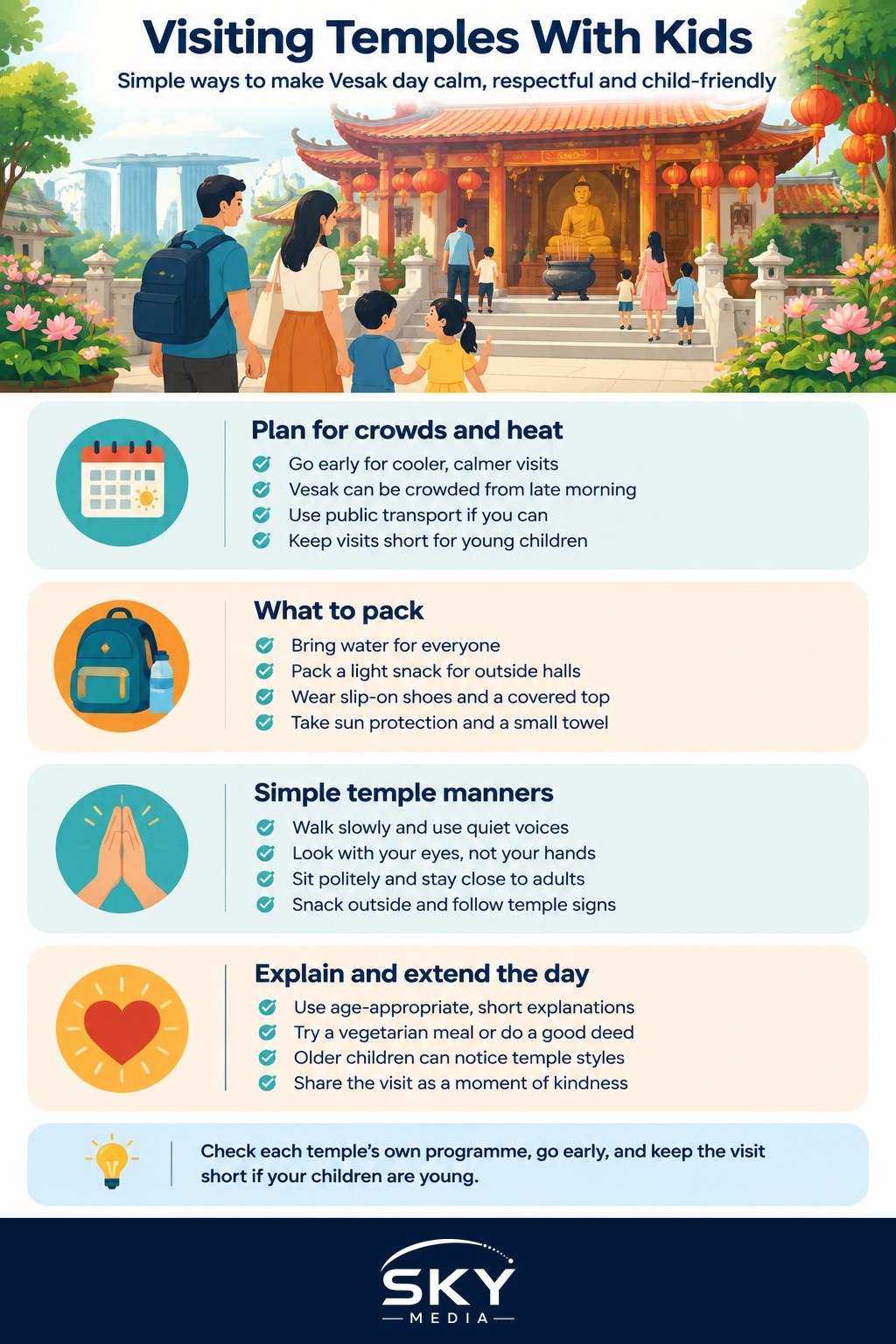
Plan Around Crowds and Heat
Vesak usually falls in May, one of the hottest months of the year in Singapore, and it is a public holiday. Popular temples can be very crowded, especially from late morning onwards and during evening processions.
- Go early. Arriving soon after the temple opens is often the calmest time, with shorter queues and cooler temperatures.
- Consider the days before Vesak. Some temples set up activities such as the bathing the Buddha station a few days ahead. Check each temple’s own website or social media for its programme.
- Use public transport. Car parks near large temples fill up quickly, and there may be temporary traffic arrangements.
- Keep the visit short. For toddlers and young children, 45 minutes to an hour is often plenty. You can always return another year.
- Pick one or two temples. Trying to visit several in a day usually ends in tired, cranky children.
Our guide to Buddhist temples of Singapore can help you choose a temple that suits your family, whether you want a large, busy one or a quieter neighbourhood temple.
What to Pack for a Temple Visit
A small, well-planned bag makes the day much easier:
- Water bottles for everyone, plus a light snack to eat outside the prayer halls
- A foldable umbrella or cap for sun and sudden rain, and sunscreen (see our sun safety for children tips)
- Easy slip-on shoes, since you usually remove footwear before entering prayer halls
- A light layer that covers shoulders, for children and adults
- A small towel or tissues for sticky hands
- A compact carrier for babies; prams may be awkward in crowded halls or on steps
- A quiet activity such as a small picture book, for waiting in queues
Temple Etiquette for Children, Made Simple
Children do not need to learn a long list of rules. A few simple ideas, explained before you arrive, go a long way. Customs vary by temple and family, so follow signs and what others around you are doing.
| Instead of this | Try this | How to explain it |
|---|---|---|
| Running and shouting in halls | Walking slowly, using a quiet voice | “This is a calm place where people come to think and pray.” |
| Touching statues or offerings | Looking with hands behind your back | “These are special, so we look with our eyes.” |
| Pointing feet at the altar when sitting | Sitting cross-legged or kneeling | “We sit politely, like when we visit someone’s home.” |
| Climbing on steps or railings | Holding a grown-up’s hand | “There are lots of people, so we stay close together.” |
| Taking food into prayer halls | Snacking outside in the courtyard | “We keep the prayer hall clean for everyone.” |
A useful tip is to agree on a simple hand signal, such as a finger to the lips, that means “time for quiet voices”. It saves you repeating yourself in a busy hall.
Covering shoulders and knees, removing shoes where signs ask you to, and not using flash photography inside halls apply to the whole family. If your family usually visits Chinese temples during other festivals, many of the same habits apply. Our guide to Chinese temple etiquette covers these in more detail.
Explaining Vesak to Children by Age
Children usually enjoy a temple visit more when they understand what is happening. Keep explanations short and concrete, and let their questions guide you.
Toddlers and preschoolers (about 2 to 5)
- “Today is a special day for Buddhists. It is like a birthday for the Buddha.”
- Point out colours, flowers, lanterns and the sound of bells or chanting.
- Let them help carry flowers or hold your hand while you light a candle, if your family does this.
Lower primary (about 6 to 9)
- Explain that the Buddha was a prince who gave up his palace to find a way for people to be less unhappy.
- Talk about kindness. Many people on Vesak try to do good deeds, eat vegetarian food and help others.
- The bathing the Buddha ritual is a great hands-on moment. Help them hold the ladle and pour gently, and suggest they make a kind wish.
Upper primary and older (about 10 and up)
- Explain that Vesak marks the Buddha’s birth, enlightenment and passing.
- Discuss ideas such as compassion, mindfulness and generosity, and how people of many backgrounds share these values.
- Older children might enjoy noticing differences between temples, for example Chinese, Thai or Burmese styles.
If your family is not Buddhist, it is perfectly fine to say so: “Our family has different beliefs, but we are visiting to learn and to be respectful guests.” This models curiosity and respect, which children carry into Singapore’s multi-religious life.
Turning the Visit Into a Day of Kindness
Many parents find that Vesak is a natural moment to talk about values. Some ideas to extend the day:
- Try a vegetarian meal together. Many temples serve vegetarian food on Vesak, often for a donation, or you can cook one at home.
- Do a family good deed. Pack donations for a food bank, write cards for grandparents, or help a neighbour.
- Give together. Let children choose a charity and contribute a small amount from their own savings. It also links nicely with lessons about money and sharing.
- Look at the lanterns in the evening. If your children can manage a later night, the lights and processions are memorable. Keep a close eye on children in crowds.
Safety Tips for Busy Temple Grounds
- Dress younger children in a bright top so they are easy to spot.
- Agree on a meeting point in case you get separated, and teach older children to approach a temple volunteer or staff member if lost.
- Write your phone number on a wristband or card in your child’s pocket.
- Watch out around candles, incense burners and oil lamps, which are often at a child’s eye level.
- Take breaks in the shade and offer water regularly.
For broader background on the festival, see Vesak Day in Singapore, Explained.
Key Points to Remember
- Go early or on the days before Vesak, keep visits short, and plan for heat.
- Teach a few simple manners: quiet voices, looking not touching, shoes off where asked.
- Explain Vesak in age-appropriate terms, focusing on kindness and celebration.
- Make the day about shared values, whatever your family’s own beliefs.
Frequently Asked Questions
Is a baby or toddler too young for a Vesak temple visit? There is no age limit, but very young children tire quickly in heat and crowds. A short visit at a quiet time, a carrier instead of a pram and plenty of water make it manageable. If your little one is unwell or fussy that day, it is fine to skip it and go another year.
What should I do if my child has a meltdown inside the prayer hall? Step outside calmly to a courtyard or shaded corner, since nobody will mind. Offer water, a snack and a few quiet minutes before deciding whether to go back in. Forcing a tired child to stay usually makes things worse for everyone, including other worshippers.
Is incense smoke a problem for children with asthma or sensitive airways? It can be, because temple halls often hold a lot of incense smoke, especially when crowded. If your child has asthma or breathing problems, ask your doctor beforehand, bring any prescribed medication and stay in open courtyards or near doorways where the air is fresher.
Do children from non-Buddhist families need to bow or make offerings? No. Visitors are welcome to simply observe respectfully, and nobody expects a child to join in a religious act that does not match your family’s beliefs. Standing quietly, keeping hands to themselves and following the adults is a perfectly good way to show respect.
Further reading: Joining a Meditation Retreat at a Singapore Buddhist Temple · Why Releasing Animals on Vesak Day Is Discouraged in Singapore · Observing the Eight Precepts on Vesak Day in Singapore