

A good second-hand instrument can save you a large share of the new price, and many instruments, from pianos to guitars, can last for decades with proper care. The local resale market for used musical instruments Singapore buyers can tap into is busy, with listings on online marketplaces, community groups and music shops that take trade-ins. The catch is that a worn instrument can hide expensive problems, and a bargain that sounds too good often is.
This guide is for buyers who already know roughly what they want to play. It focuses on how to inspect a used instrument, how to judge a fair price and how to avoid scams. If you are still deciding which instrument to learn, start with our guide on how to choose your first instrument.
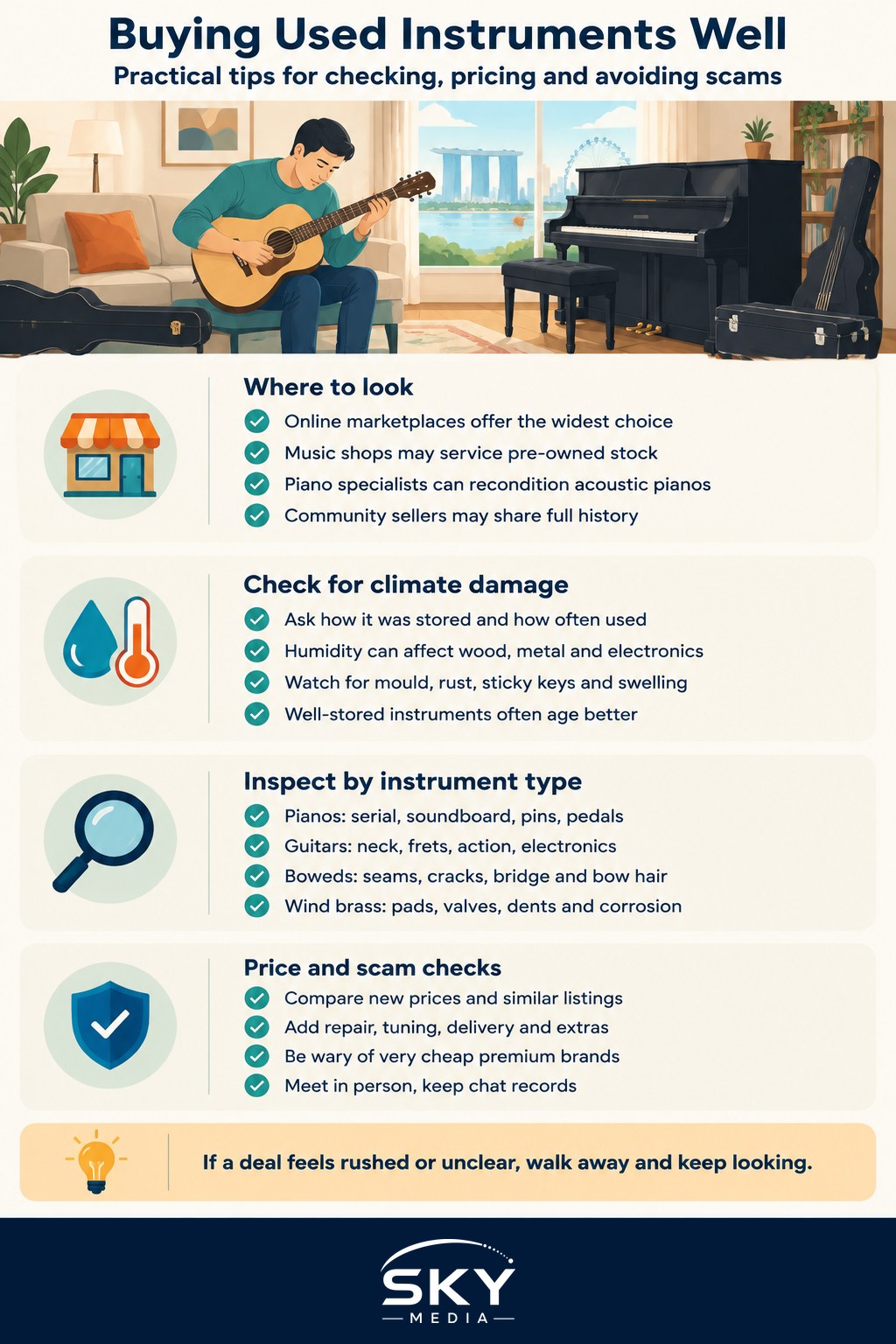
Where to Find Used Instruments
Each source has its own trade-offs:
- Online marketplaces and classifieds. The widest choice and often the lowest prices, but no guarantee, and you need to inspect carefully.
- Music shops that sell pre-owned stock. Usually higher prices than private sellers, but instruments are often serviced, and some shops offer a short warranty. Ask what work has been done.
- Piano dealers and reconditioners. For acoustic pianos, a reconditioned instrument from a specialist can be safer than a private sale, as it may come with tuning and servicing included.
- Community groups, schools and orchestras. Players upgrading their instrument often sell to other musicians and can tell you the full history.
Whichever source you use, the same inspection principles apply.
Singapore’s Climate and What It Does to Instruments
Humidity is the biggest local factor when buying second-hand. Constant moisture in the air affects wood, metal, felt and electronics. Before inspecting any instrument, ask the seller:
- Was it kept in an air-conditioned room, with a dehumidifier, or in a dry cabinet?
- Has it been stored in a storeroom, near a window or in a car boot?
- How often was it played and serviced?
Signs of humidity damage include mould spots or a musty smell inside cases, rust on strings and metal parts, sticky keys or valves, swollen wood and lifting veneer or glue joints. An instrument stored well for ten years can be in better shape than one left in a humid storeroom for two.
Inspection Checklist by Instrument Type
The table below summarises what to check for common instruments. Bring a torch, and if you are not confident, bring a friend who plays.
| Instrument | Key things to check | Red flags |
|---|---|---|
| Acoustic piano | Serial number and age, tuning pins, hammers and felts, soundboard, pedal action, every key | Cracked soundboard, loose tuning pins, rust on strings, many sticking keys |
| Digital piano or keyboard | Every key and its velocity response, pedal and power supply, all buttons, headphone jack | Dead or uneven keys, crackling output, missing adapter |
| Acoustic or electric guitar | Neck straightness, fret wear, action height, tuners, electronics and output jack | Neck warp, cracks near the bridge or heel, crackly pots, lifted bridge |
| Violin, viola or cello | Body and neck for cracks, bridge position, soundpost, bow hair and stick | Open seams, cracks on the top, warped or broken bow |
| Flute, clarinet, saxophone or trumpet | Pads and corks, valve or key action, dents, corrosion, case condition | Leaking pads, stuck valves, heavy dents near joints, green corrosion |
Acoustic pianos
A piano is the costliest common instrument to buy used, and the hardest to inspect. Note the serial number and ask the seller for the brand and model, then look up the approximate manufacture year through the maker’s official resources or a technician. Open the lid and look for rust on the strings and tuning pins, moth damage to felts and cracks in the soundboard. Play every key softly and loudly, and test each pedal.
Given the cost, it is often worth paying a qualified piano technician to inspect before you commit. Also factor in moving costs, which depend on access, floor level and whether the lift is large enough, and the need for a tuning after the move.
Guitars
Look down the neck from the headstock to check it is straight. Press strings at different frets to listen for buzzing. Check fret wear, which shows as grooves under the strings. For electric guitars, plug in, turn each knob and flick each switch while listening for crackle. Look closely at areas around the bridge, neck joint and headstock for cracks or past repairs.
Bowed strings
Hold the instrument up to light and check seams around the edges for gaps. Look at the top near the f-holes and bridge for cracks. Make sure the bridge stands straight and the bow hair is intact, and play a few notes to listen for buzzing. A string teacher or luthier can confirm whether the size and setup suit the player, which matters greatly for children.
Wind and brass
Ask to play the instrument, or bring someone who can. Leaking pads on woodwinds make notes hard to produce, while stiff valves or slides on brass instruments point to poor maintenance. Check for dents around joints and the bell. For hygiene, plan to have mouthpieces cleaned or replaced before use.
How to Judge a Fair Price
Prices vary widely with brand, model, age and condition, so there is no single right number. To estimate a fair price:
- Find the current new price of the same or equivalent model from authorised retailers.
- Compare several similar listings, looking at age and condition rather than just the asking price.
- Subtract the cost of any work needed, such as new strings, a setup, pad replacement, tuning or a missing case.
- Consider what is included, for example a hard case, stand, bench or accessories.
- Factor in delivery, especially for pianos and large items.
Very cheap listings for premium brands deserve extra suspicion. Well-maintained instruments from respected makers tend to hold their value, so a price far below other listings may signal a problem, a counterfeit or a scam.
Avoiding Common Scams
Most sellers are genuine, but scams do appear in instrument listings. Common warning signs include:
- Pressure to pay a deposit or full price before viewing, often with a story about other buyers waiting
- Requests to pay through unusual methods or to move the chat off the platform
- Sellers who refuse a viewing or video call with the instrument playing
- Stock photos or photos that do not match the description
- Counterfeit branded instruments, particularly guitars, sold as genuine
To protect yourself, inspect in person where possible, pay only when you are satisfied, and use the platform’s recommended payment and safety features. Keep chat records. The Singapore Police Force and the National Crime Prevention Council publish scam advisories, and the ScamShield resources are worth checking if a deal feels off. For branded instruments, ask for the original receipt or warranty card, and check serial numbers with the manufacturer if you have doubts.
After You Buy
Budget for a little care right away. Restring a guitar or violin, get a setup if the action is high, have a piano tuned once it has settled after the move, and have wind instruments serviced. Store the instrument in an air-conditioned room or with humidity control, and keep cases clean and dry.
A well-chosen used instrument can serve you for years. If you are returning to music later in life, our guide to learning a musical instrument as an adult has tips for building a practice habit around your new purchase.
Further reading: Buying a Used Acoustic Piano in Singapore: What to Check · Learning the Tin Whistle: An Easy First Instrument · Where to Donate Old Musical Instruments in Singapore