

You have passed your driving test, maybe found a used car or been offered the family car, and then the insurance quote arrives. For many people under 26, it is a shock. Car insurance young drivers Singapore quotes tend to come with higher premiums, an extra excess and stricter conditions than a parent would see for the same car.
This guide explains why that happens and what you can realistically do about it. It is general information, not financial advice. Terms differ between insurers and change over time, so always read the policy wording and ask the insurer to explain anything unclear before you pay.
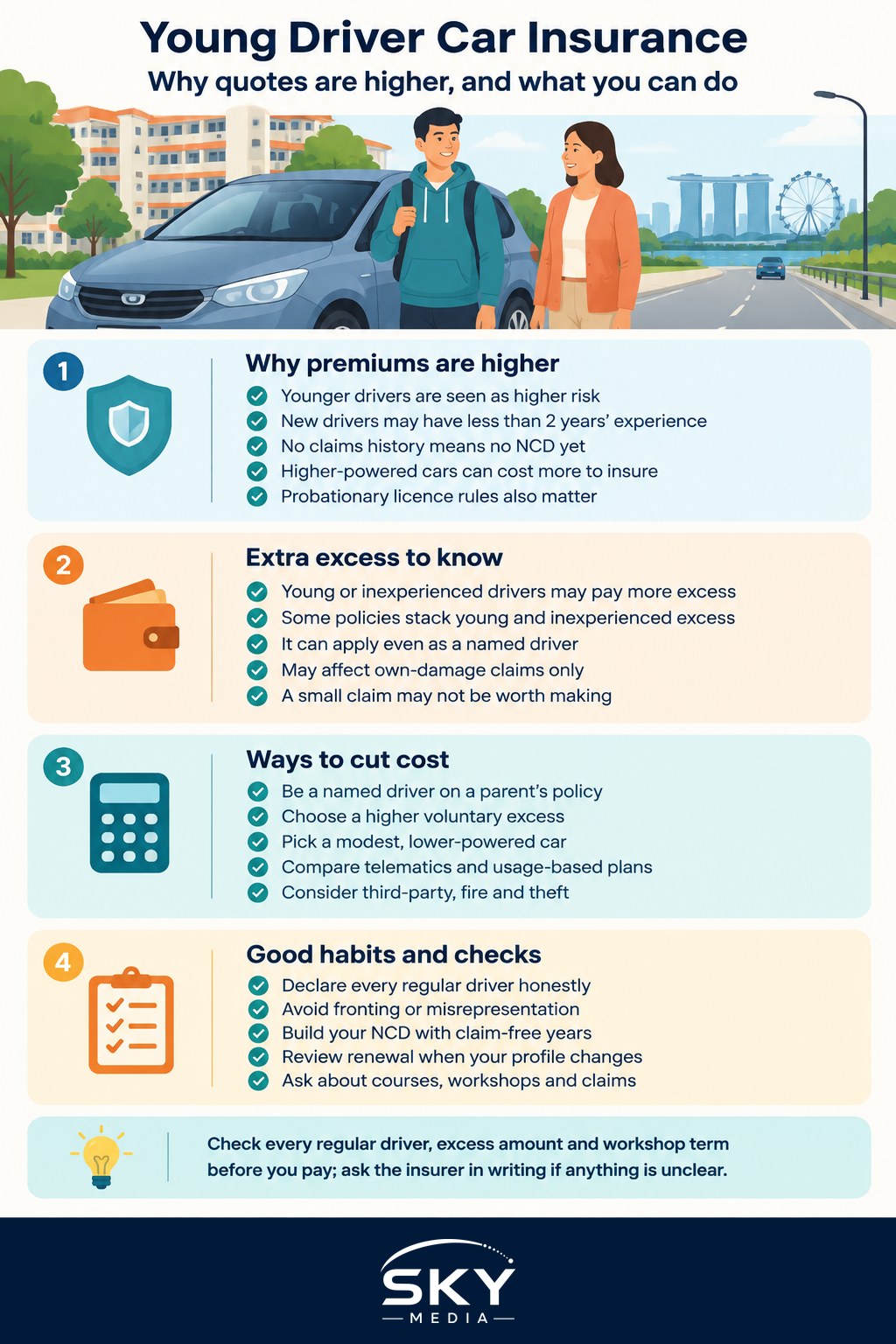
Why Young and New Drivers Pay More
Insurers price risk using claims data. Across many markets, younger drivers and drivers who have only recently qualified are statistically more likely to be involved in accidents, and those accidents tend to be more costly. In Singapore, insurers usually look at two separate things:
- Age. Many policies treat drivers below a certain age, commonly 26, as “young drivers”.
- Driving experience. Separately, drivers who have held their licence for less than a set number of years, often around two, may be treated as “inexperienced drivers”, whatever their age.
You can fall into one, both or neither. A 24-year-old who has driven for five years is young but experienced. A 35-year-old who just passed is older but inexperienced. A 21-year-old new driver ticks both boxes, and pays the most.
Other factors also push the price up for many young drivers: having no claims history to earn a No Claim Discount (NCD), driving a higher-powered car, and being on probation after passing the test. Under the Traffic Police’s rules, new drivers hold a probationary licence for their first year, and accumulating too many demerit points during that period can lead to revocation. Check the current rules on the Singapore Police Force website.
The Extra Excess Explained
The excess is the amount you pay yourself toward an own-damage claim before the insurer pays the rest. For young or inexperienced drivers, many policies add an additional excess on top of the standard one. In some policies, the extra amounts stack if the driver is both young and inexperienced.
What this means in practice:
- A modest scrape that would be worth claiming for an experienced driver may not be worth claiming for you, because the combined excess eats most of the payout.
- The extra excess can apply even if you are a named driver on someone else’s policy, as long as you are the one driving at the time of the accident.
- Some policies apply it only to own-damage claims, others more widely. Read the schedule.
Our explainer on understanding your insurance excess goes deeper into how excess works across claim types.
Common Ways to Reduce Your Premium and Excess
None of these is a guaranteed saving for every person, but each is worth checking when you compare quotes.
| Lever | How it can help | What to watch for |
|---|---|---|
| Being a named driver on a parent’s policy | The main driver’s NCD and profile set much of the premium | You must be declared honestly, and young driver excess still applies to you |
| Choosing a higher voluntary excess | Lowers the premium | You pay more out of pocket if you claim |
| Picking a modest, lower-powered car | Cheaper to insure and repair | Popular models may still carry theft or repair cost loadings |
| Restricting who can drive | Fewer drivers means less risk to the insurer | Unnamed drivers may not be covered, or face a large excess |
| Usage-based or telematics policies | Rewards low mileage or safe driving habits | Check data collection terms and how scores affect the price |
| Third-party, fire and theft instead of comprehensive | Lower premium on an older, lower-value car | You bear the cost of repairing your own car |
A few more points:
- Compare widely. Get quotes directly from insurers and through comparison platforms, and compare the same coverage level, excess and workshop terms side by side.
- Look at workshop choice. Policies that restrict you to authorised workshops are often cheaper than those allowing any workshop.
- Ask about driving courses. Some insurers may look favourably on defensive or advanced driving courses. Ask whether this affects your quote rather than assuming it does.
- Build your NCD. Every claim-free year typically increases your NCD, up to the insurer’s maximum. Protecting it early pays off for years.
If you are weighing cover types, our comparison of comprehensive vs third-party car insurance sets out the trade-offs.
Named Driver Arrangements: Do It Properly
Driving the family car is the most common route for young Singaporeans, and adding a young driver to a parent’s policy is often much cheaper than taking out a separate policy. But it only works if it is done honestly.
- Declare every regular driver. If you drive the car regularly and are not declared, the insurer may reduce or reject a claim, or apply a large unnamed driver excess.
- Do not “front”. Fronting means naming an older, experienced person as the main driver when the young driver actually uses the car most. Insurers treat this as misrepresentation, and it can void the policy when you most need it.
- Understand the effect on the parent’s NCD. If you have an accident and a claim is made, it is usually the policyholder’s NCD that drops.
Our guide to named driver insurance in Singapore explains how these arrangements work in more detail.
Habits That Keep Future Premiums Down
The single biggest factor you control is your claims record. Premiums for young drivers usually ease as you pass the age threshold, gain experience and build NCD.
- Drive defensively in your first years. Leave a bigger following distance, take extra care in car parks and at junctions, and avoid driving tired.
- Think before claiming small damage. For minor bumps, compare the repair cost with your total excess and the NCD you would lose. Get advice from the insurer before deciding, and always report an accident within the time the policy requires, even if you do not claim.
- Keep dashcam footage. A front and rear dashcam can help establish who was at fault and protect your record in a third-party claim.
- Review every renewal. Do not auto-renew without checking. Once you pass 26 or two years of experience, your profile changes and other insurers may offer better terms.
- Keep your details accurate. Tell the insurer about changes such as a new address, a modification to the car or a new regular driver.
For practical road tips during your first months behind the wheel, see driving tips for new drivers in Singapore.
Before You Sign: A Final Checklist
- Is every regular driver named, with the correct age and licence date?
- What is the total excess for a young or inexperienced driver, including any extra amounts?
- Which workshops can you use, and how do you make a claim?
- Is there NCD protection, and what does it cost?
- What happens if an unnamed driver uses the car?
If anything in the policy is unclear, ask the insurer in writing before you pay. For disputes with an insurer, the Financial Industry Disputes Resolution Centre (FIDReC) handles complaints that cannot be resolved directly, and the General Insurance Association of Singapore (GIA) publishes consumer guides on motor claims.