

A Catholic wedding in Singapore is both a sacrament in the eyes of the Church and, if done correctly, a legally recognised marriage. That double meaning is why the process asks more of couples than simply booking a venue. There is preparation to attend, paperwork to gather, conversations with a priest, and the civil side of the marriage to sort out as well.
This guide walks through what a Catholic wedding in Singapore usually involves. Practices are guided by the Archdiocese of Singapore, but individual parishes set their own timelines and checklists, so treat this as an overview and confirm the details with the parish where you hope to marry.
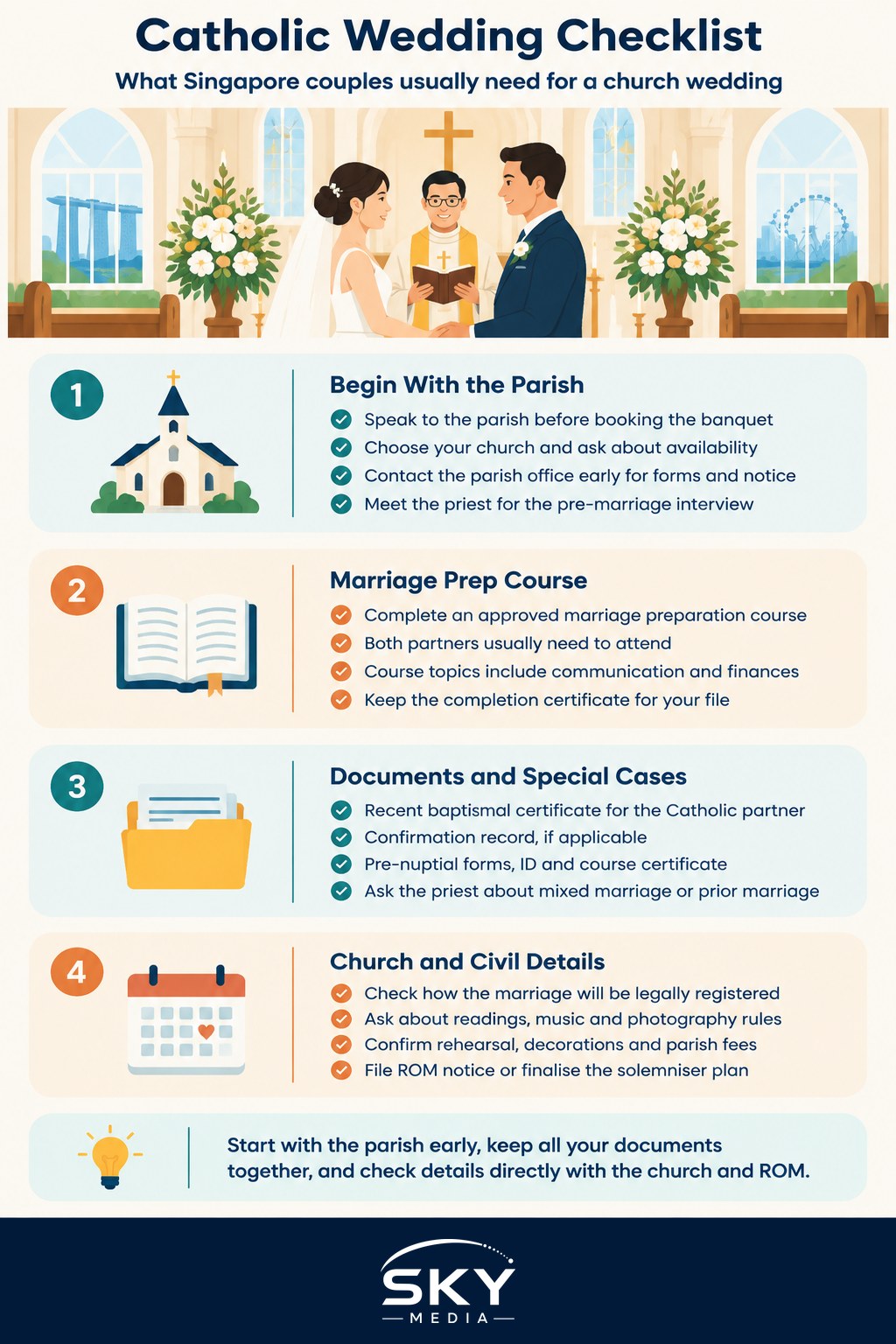
Start With the Parish, Not the Banquet
The single most common mistake couples make is confirming a banquet date before speaking to a church. Popular parishes and dates fill up, and the Church needs time to complete its preparation with you.
Typical first steps look like this:
- Choose a parish. Many couples marry in the bride’s or groom’s home parish. If you want a different church, ask whether they accept couples from outside the parish and what extra steps apply.
- Contact the parish office early. Ask how much notice they need, which dates are available, and what forms to fill in. Many parishes ask for several months’ notice, but the exact lead time varies.
- Arrange a meeting with the priest. The priest who will officiate usually meets the couple, sometimes more than once, to get to know you and to complete a pre-marriage interview.
- Only then lock in the reception. Once the church date is confirmed, you can plan the wedding banquet around it.
If you are drawn to a historic setting, note that some heritage buildings that were once chapels, such as the one described in our story on CHIJMES Chapel, are now event venues rather than consecrated churches. Ask the parish whether a wedding there would be recognised as a Catholic sacramental wedding before you commit.
The Marriage Preparation Course
Couples marrying in the Catholic Church in Singapore are generally expected to complete an approved marriage preparation course before the wedding. These courses are run by Church-related ministries and usually cover communication, conflict, finances, intimacy, family planning from a Catholic perspective, and the meaning of marriage as a sacrament.
Practical points to keep in mind:
- Book early. Courses run on a schedule and can fill up. Many parishes want the course completed well before the wedding date.
- Both partners attend. This applies even if one partner is not Catholic.
- Keep the certificate. The parish will usually ask for proof of completion as part of your file.
Many couples find the course genuinely useful, even the practical sessions on money and in-laws, regardless of how long they have been together.
Documents a Parish Will Usually Ask For
Each parish publishes its own list, but these documents come up again and again:
- A recent baptismal certificate for the Catholic partner, issued by the church where you were baptised. Parishes often want a freshly issued copy rather than an old one, because it carries notes about any previous marriage. Ask how recent it must be.
- Confirmation record, if applicable. Some parishes encourage Catholics who have not been confirmed to consider it before marriage.
- Pre-nuptial enquiry or interview forms, completed with the priest, confirming you are free to marry and understand what Catholic marriage involves.
- Identity documents such as NRIC or passport.
- Marriage preparation course certificate.
- Details of witnesses, usually two.
- Documents relating to any previous marriage, if either partner was married before.
If you were baptised overseas, request your certificate early, as postage and church office response times can stretch for weeks.
Mixed Marriages and Special Situations
Not every couple consists of two Catholics, and the Church has established ways to accommodate that. The table below summarises common situations. Your priest will explain exactly what applies to you.
| Situation | What it generally involves | Who to speak to |
|---|---|---|
| Both partners Catholic | Standard preparation, documents and interview | Your parish priest |
| Catholic marrying a baptised Christian of another church | Permission for a mixed marriage, requested through the priest | Parish priest, who handles the request |
| Catholic marrying someone not baptised | A dispensation, requested through the priest, before the wedding | Parish priest, who handles the request |
| One or both previously married | The Church will need to establish freedom to marry, which may involve a Church tribunal process | Parish priest first, who can guide you |
For mixed couples, the ceremony is often held as a celebration of the Word rather than a full nuptial Mass, so that guests of other faiths feel included. Couples from different cultural backgrounds may also find ideas in our guide to intercultural weddings in Singapore.
Making the Marriage Legal: The Civil Side
In Singapore, a marriage is legally valid when it is solemnised under the Women’s Charter and registered with the Registry of Marriages (ROM), or for Muslim marriages, the Registry of Muslim Marriages (ROMM). A church ceremony on its own is not automatically a civil registration.
Couples usually handle this in one of two ways:
- Civil solemnisation through ROM before or around the church wedding, then the sacramental ceremony in church.
- Solemnisation by a licensed solemniser at the church, where the officiating priest or another person holds a valid solemnisation licence and the legal steps are combined with the church rite.
Ask your parish which approach they follow, then check ROM’s official website for the current notice period, documents and procedures for filing your notice of marriage. Rules can change, so confirm them directly rather than relying on a friend’s experience from a few years ago.
Planning the Liturgy, Music and Details
Once the paperwork is moving, the fun part begins. A Catholic wedding liturgy has a set structure, but couples usually choose readings, music and some elements within it.
- Readings. You will normally pick from approved Scripture readings. Family members or friends can be invited to read.
- Music. Many parishes expect sacred or liturgical music during the ceremony and may not allow secular pop songs in church. Save those for the reception or your first dance.
- Photography and videography. Parishes often set rules on where photographers can stand and whether flash is allowed. Brief your photographer early.
- Decorations. Ask what is permitted, how early your florist may enter, and whether other weddings are scheduled the same day.
- Rehearsal. Many parishes hold a short rehearsal shortly before the day. Our explainer on the wedding rehearsal covers what usually happens.
- Offerings and fees. Some parishes ask for a fee or suggest a donation for use of the church, the organist or choir. Ask the parish office directly rather than guessing.
A Simple Timeline to Work Back From
Every parish differs, but a sensible order of tasks is:
- Talk to the parish and secure a date.
- Register for the marriage preparation course.
- Request baptismal certificates and gather documents.
- Complete interviews with the priest and any permissions or dispensations.
- File your notice of marriage with ROM, or confirm the solemniser arrangements.
- Plan the liturgy, music, readers and photography rules.
- Attend the rehearsal and confirm timings with the parish office.
A Catholic wedding in Singapore asks for patience and paperwork, but it also gives couples time to reflect on what they are promising. Start early, keep a folder of documents, ask the parish office whenever you are unsure, and you will reach the altar with far less stress.
Frequently Asked Questions
Can a non-Catholic partner join the marriage preparation course? Yes, both partners generally attend the approved marriage preparation course, even if one is not Catholic. Book early since courses run on a schedule and can fill up, and keep the certificate because the parish usually asks for proof.
Can we have a Catholic wedding in a church outside our home parish? Possibly. Many couples marry in the bride’s or groom’s home parish, but you can ask another church whether it accepts couples from outside and what extra steps apply. Individual parishes set their own timelines and checklists.
Is a church ceremony enough to make the marriage legal in Singapore? No. A marriage is legally valid when solemnised under the Women’s Charter and registered with the Registry of Marriages. Some couples solemnise civilly through ROM, while others use a licensed solemniser at the church. Ask your parish which approach applies.
What if one of us has been married before and wants a Catholic wedding? The Church needs to establish that you are free to marry, which may involve a Church tribunal process. Speak to your parish priest first, as early as possible, and gather any documents relating to the previous marriage.
Can we play pop songs and use our own photographer during a church wedding? Parishes often expect sacred or liturgical music, so save pop songs for the reception. They may also limit where photographers stand and whether flash is allowed. Check the rules with the parish office and brief your photographer early.
Official sources: Ministry of Social and Family Development (MSF)