
Furnishing a compact flat is already a puzzle. Add a toddler who climbs everything or a primary schooler who needs a study corner, and every purchase starts to feel high stakes. Good child friendly furniture in a small Singapore home does three jobs at once: it stays stable when a child pulls or climbs on it, it survives years of spills and rough use, and it earns its floor space.
This guide focuses on how to judge individual pieces before you buy, not on general childproofing like socket covers and cabinet locks. Use it when you are standing in a showroom or scrolling an online store, trying to decide between two options.
Start With Stability: The Non-Negotiable
In small homes, furniture tends to be taller and narrower so it fits against walls. That shape is exactly what makes tip-overs more likely when a child opens several drawers and uses them as steps, or hangs off a door.
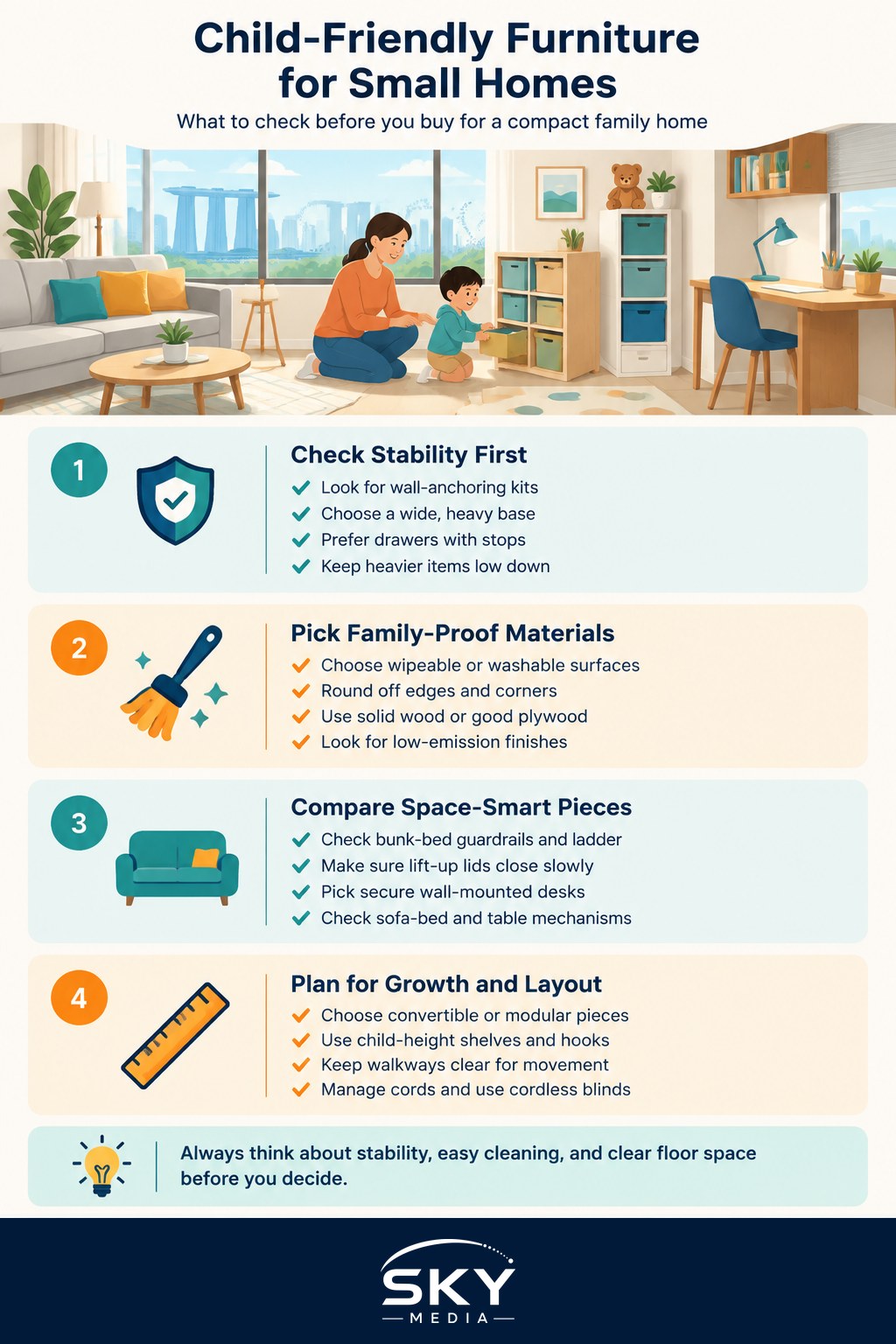
When you assess any tall or heavy piece, check for:
- A wall-anchoring kit in the box. Reputable wardrobes, bookshelves and chests of drawers include straps or brackets. If a tall piece does not come with one, ask why, and plan to buy a suitable kit.
- A wide, heavy base. Press on the top corner gently. If it rocks, it will rock more when a child climbs it.
- Drawer stops. Drawers that cannot be pulled all the way out are less likely to fall on small feet.
- Weight low down. Store heavier items in the lowest drawers and on the bottom shelves.
Before drilling into walls, check what is behind them. In HDB flats, some walls carry concealed wiring or pipes, and certain structural walls have restrictions. If you are unsure, consult your contractor or check HDB’s guidance before installing brackets. Condo residents may also need to follow MCST (the management corporation that runs the estate) rules on works.
Also think about placement. Keep anything a child could climb, such as a low bookshelf, bench or toy chest, away from windows, even when window grilles are fitted.
Choose Materials That Survive Real Family Life
Small homes mean the living room is also the play area and the dining table doubles as the homework desk. Furniture gets far more wear than in a larger house.
Points to look for:
- Washable or wipeable surfaces. Removable sofa covers that can go in a washing machine, or performance fabrics described as stain resistant, save a lot of stress. Leather and good-quality faux leather wipe clean but can scratch.
- Rounded edges and corners. Coffee tables and side tables sit at a toddler’s head height. Rounded or softened corners are better than adding bumpers later, which children often peel off.
- Solid construction. Solid wood or good-quality plywood generally handles knocks and moisture better than thin particleboard, which can swell if wet. Singapore’s humidity makes this more noticeable over time.
- Low-emission finishes. Look for products that state low formaldehyde or low VOC (volatile organic compounds) emissions, and air out new furniture with windows open for a few days.
- Hardware quality. Soft-close hinges and drawer runners reduce pinched fingers and last longer than basic ones.
Compare Space-Smart Options Before You Commit
Multifunctional furniture is the obvious answer in a small flat, but not every clever design suits young children. A table that folds down from a wall or a sofa bed with a heavy mechanism can introduce pinch points and instability.
The table below compares common space-saving choices from a family safety and durability point of view.
| Furniture type | Why families like it | What to check first |
|---|---|---|
| Bunk beds and loft beds | Frees floor space in a shared kids’ room | Guardrails on all sides of the top bunk, a sturdy ladder, and the manufacturer’s minimum age for the top bunk |
| Storage beds (lift-up or drawers) | Hides bedding and out-of-season items | Gas-lift lids that close slowly; drawers a child cannot get inside and close |
| Wall-mounted fold-down desks | Saves space in tiny study corners | Secure mounting into a suitable wall; hinges that do not trap fingers |
| Extendable dining tables | Seats guests during festive visits | Locking mechanism so the leaf does not drop when a child leans on it |
| Ottomans with storage | Extra seat plus toy storage | Lid supports so it cannot slam shut; ventilation if a child could climb in |
| Sofa beds | Guest bed for visiting grandparents | Mechanism that cannot close on hands; whether children can operate it |
If you are still deciding which multifunctional pieces suit your layout, our guide to space-saving and multifunctional furniture for small homes covers the broader range of options.
Plan for How Your Child Will Grow
Children change fast. A cot is outgrown in a couple of years, a toddler table in a few more. In a small home, there is rarely space to store outgrown pieces, so buying for longevity matters.
- Convertible pieces. Cots that convert into toddler beds, and desks with adjustable height, stretch your budget further.
- Neutral designs. A plain wardrobe or bookshelf with themed accessories is easier to keep than a cartoon-shaped bed a ten-year-old will refuse to sleep in.
- Modular storage. Cube units and stackable boxes can be reconfigured from toy storage to book and school supply storage.
- Child-height access. Low open shelves and hooks let younger children put away their own things, which helps keep a small home tidy. Raise the hooks as they grow.
For kids’ clothing, a wardrobe with adjustable rails and shelves adapts better than fixed compartments. Our tips on how to organise a small wardrobe help you make the most of limited hanging space.
Get the Layout Right for Movement and Supervision
Even safe furniture becomes a hazard if it crowds the room. In a compact living room, children run, ride scooters and play on the floor, so clear pathways matter as much as the pieces themselves.
Practical layout tips:
- Keep a clear walkway between the main door, kitchen and bedrooms.
- Position the play area where you can see it from the kitchen or dining table.
- Avoid glass-topped tables in high-traffic areas; if you already own one, place it out of the main running path.
- Push the sofa against a wall rather than floating it, which leaves a larger open floor area for play.
- Manage cords from TVs, lamps and blinds so they are out of reach. Looped blind cords are a known strangulation risk for young children, so choose cordless blinds where possible.
For more ideas on arranging pieces in a tight space, see our guide on how to arrange furniture in a small living room.
A Quick Checklist Before You Pay
Run through these questions in the store or before you check out online:
- Will this piece be stable, or can I anchor it to a suitable wall?
- Are the edges rounded and are there any pinch points?
- Can the surface be cleaned easily, and will it handle humidity?
- Does it state safety or emission standards, and does the seller provide assembly instructions with anchoring guidance?
- Will it still be useful in three to five years?
- Does it leave enough clear floor space for play and movement?
Also check the return and warranty terms, and whether delivery includes assembly. Poorly assembled furniture can be as unstable as a badly designed piece.
Choosing carefully at the start means fewer replacements, fewer worries and a home that works for every member of the family.
Frequently Asked Questions
What age is safe for a child to sleep on a top bunk? Follow the manufacturer’s stated minimum age for the top bunk, as it varies by product. Make sure guardrails run along all sides, the ladder is sturdy and the mattress is the recommended thickness. Younger children are usually safer on the lower bunk.
Is second-hand furniture safe for children? It can be, if you inspect it carefully. Check that it is stable, has no loose screws, splinters or missing parts, and that drawers have stops. Be cautious with old cots and painted pieces of unknown age, and look up any safety recalls for the model.
How do I secure tall furniture in a rented flat? Ask your landlord first, since anchoring usually means drilling. If drilling is allowed, check what is behind the wall and use the kit supplied. If not, choose lower, wider pieces with heavy bases, and keep the heaviest items low.
How do I pick a study desk that suits a growing child? Choose one with adjustable height so it grows with them, and a chair that lets their feet rest flat on the floor. A stable surface with rounded edges and enough room for books suits most school-age children. It also saves you from replacing it too soon.
Further reading: How to Build a Homework Station in a Small Home