

If you learnt photography in mainland China, you probably think in words like 光圈, 快门 and 感光度. Then you move to Singapore, buy a camera locally or join a photography group, and suddenly the menus, YouTube tutorials and conversations are all in English. The concepts are the same, but the labels are not, and some English terms are abbreviated in ways that are hard to guess.
This guide matches common Chinese camera terms to the English words you will see on camera menus and hear from Singapore photographers. It focuses on the settings you use every day: exposure, focus, shooting modes and video. Exact menu names differ between brands, so use this as a map and check your camera manual for the precise wording.
Exposure Basics: The Exposure Triangle
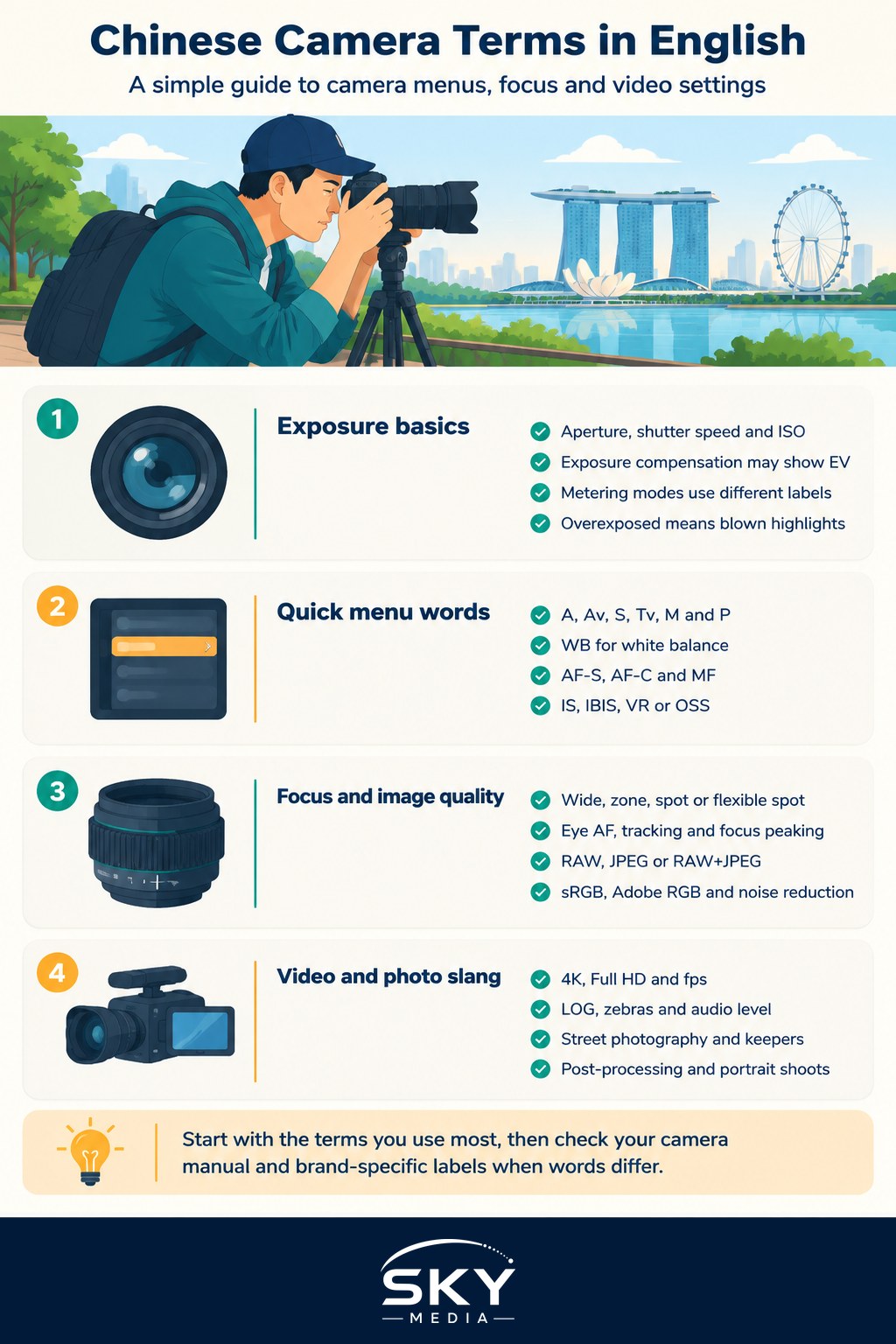
In English, aperture, shutter speed and ISO together are usually called the “exposure triangle”. These are the first terms worth learning.
- 光圈 (aperture). Shown as an f-number, such as f/1.8 or f/8. People say “f-stop” or “stop down” (缩小光圈) and “open up” or “shoot wide open” (开大光圈, 最大光圈).
- 快门速度 (shutter speed). Shown as fractions like 1/250 or whole seconds like 2″. A “slow shutter” is 慢门, and “long exposure” is 长曝光.
- 感光度 (ISO). Usually written simply as ISO. “High ISO noise” is 高感噪点.
- 曝光补偿 (exposure compensation). Often shown with a +/- symbol and the word “EV”.
- 测光 (metering). English menus use “metering mode”. 评价测光 may appear as “evaluative” or “matrix” depending on brand, 中央重点测光 as “centre-weighted”, and 点测光 as “spot”.
- 过曝 and 欠曝. “Overexposed” and “underexposed”. 高光溢出 is often described as “blown highlights” or “clipped highlights”.
Quick Reference Table: Common Terms
This table covers the terms newcomers ask about most. English menu labels can be abbreviated, so the third column shows what you may actually see on screen.
| Chinese term | English term | What you may see on the menu |
|---|---|---|
| 光圈优先 | Aperture priority | A or Av |
| 快门优先 | Shutter priority | S or Tv |
| 手动模式 | Manual mode | M |
| 程序自动 | Program auto | P |
| 白平衡 | White balance | WB, AWB for auto |
| 单次自动对焦 | Single autofocus | AF-S or One Shot |
| 连续自动对焦 | Continuous autofocus | AF-C or AI Servo |
| 手动对焦 | Manual focus | MF |
| 防抖 | Image stabilisation | IS, IBIS, VR or OSS depending on brand |
| 连拍 | Continuous shooting, burst | Drive mode, continuous high or low |
| 包围曝光 | Bracketing | AEB or BKT |
| 直方图 | Histogram | Histogram, often in the display (DISP or INFO) settings |
If a term on your camera does not match any of these, search the brand’s English manual online. Most manufacturers publish manuals in both Chinese and English, which makes side-by-side comparison easy.
Focus, Lenses and Image Quality
Focus and lens vocabulary is where newcomers most often get stuck, because English uses a lot of shorthand.
Focus terms
- 对焦区域 (focus area). Options may be called “wide”, “zone”, “spot” or “flexible spot”.
- 眼部对焦 (eye AF or eye detection). Some brands also have “animal eye AF”.
- 追焦 or 跟踪对焦 (tracking). Often labelled “tracking” or “subject detection”.
- 峰值对焦 (focus peaking). A manual focus aid that highlights sharp edges.
- 跑焦 (missed focus). Photographers simply say “the focus is off” or “front-focused” and “back-focused”.
Lens and sensor terms
- 焦距 (focal length), measured in mm.
- 定焦 (prime lens) and 变焦 (zoom lens).
- 广角 (wide-angle) and 长焦 (telephoto).
- 全画幅 (full frame) and 半画幅 or APS-C (crop sensor).
- 等效焦距 (equivalent focal length or full-frame equivalent).
- 景深 (depth of field). “Shallow depth of field” means a blurry background.
- 焦外 or 虚化 (bokeh). English speakers usually just say “bokeh” or “background blur”.
File and quality terms
- 画质 (image quality), where you choose RAW, JPEG or RAW+JPEG.
- 降噪 (noise reduction), sometimes split into “long exposure NR” and “high ISO NR”.
- 色彩空间 (colour space), usually sRGB or Adobe RGB.
Video Settings in English
Many newcomers shoot video for work or social media, and video menus are dense with abbreviations.
- 分辨率 (resolution), such as 4K or Full HD (1080p).
- 帧率 (frame rate), shown as fps, for example 24p, 30p or 60p. “Slow motion” is 慢动作, often shown as S&Q or high frame rate.
- 码率 (bit rate), in Mbps.
- 对数曲线 or LOG (log profile). English speakers say “shooting log” and “colour grading” for 调色.
- 斑马纹 (zebras), a warning for bright areas.
- 录音电平 (audio level or recording level).
If you mainly shoot on a phone, many of the same terms appear in “Pro” or manual camera modes. Our guide to mastering your phone camera settings explains how those controls work in practice.
Talking Photography With Singapore Photographers
Knowing the menu words is one thing. Joining a photo walk or chatting at a camera shop needs everyday photography slang too. Some useful equivalents:
- 扫街 is “street photography”.
- 出片 is roughly “getting keepers” or “getting good shots”.
- 糊片 is “a blurry shot” or “motion blur”.
- 约拍 is usually “a portrait shoot” or “a TFP shoot” (time for prints) when no money changes hands.
- 后期 is “post-processing” or “editing”.
- 大光圈人像 is “shooting portraits wide open”.
Singlish also slips in. You might hear “the light very nice today” or “this lens quite heavy leh”. It is friendly and casual, and nobody expects you to copy it.
Practical Tips for Switching to English Menus
- Change the language deliberately. Most cameras let you choose the menu language. Some newcomers keep Chinese at first, then switch to English once they know the key terms. Others switch straight away to learn faster.
- Make a cheat sheet. Write down the ten settings you use most in both languages and keep a photo of it on your phone.
- Learn the abbreviations by brand. The same idea can have a different label on different cameras, so focus on the brand you own.
- Watch English tutorials with subtitles. Seeing the menus on screen while hearing the words helps them stick.
- Ask without embarrassment. Singapore photography groups are used to members from many countries. Saying “In Chinese we call this 包围曝光, what do you call it?” is a good way to start a conversation.
If you want to build broader confidence in English beyond photography, see our guide on improving your English in Singapore. With a few key terms and a little practice, English menus quickly stop feeling foreign, and you can get back to what matters: taking good pictures.
Explore more: Phone photography basics explains the menus in more depth if you want to keep practising the terms above.