

Tucked inside the leafy campus of Nanyang Technological University (NTU) in the west of Singapore, the Chinese Heritage Centre NTU is one of the quieter cultural stops on the island. It sits in the handsome former administration building of Nanyang University, known affectionately as Nantah, and focuses on a big subject: the story of the Chinese overseas, the millions of people of Chinese descent who settled across Southeast Asia and the wider world.
This guide explains what the centre is, what you can expect to see, how it differs from similarly named places, and how to plan a comfortable visit.
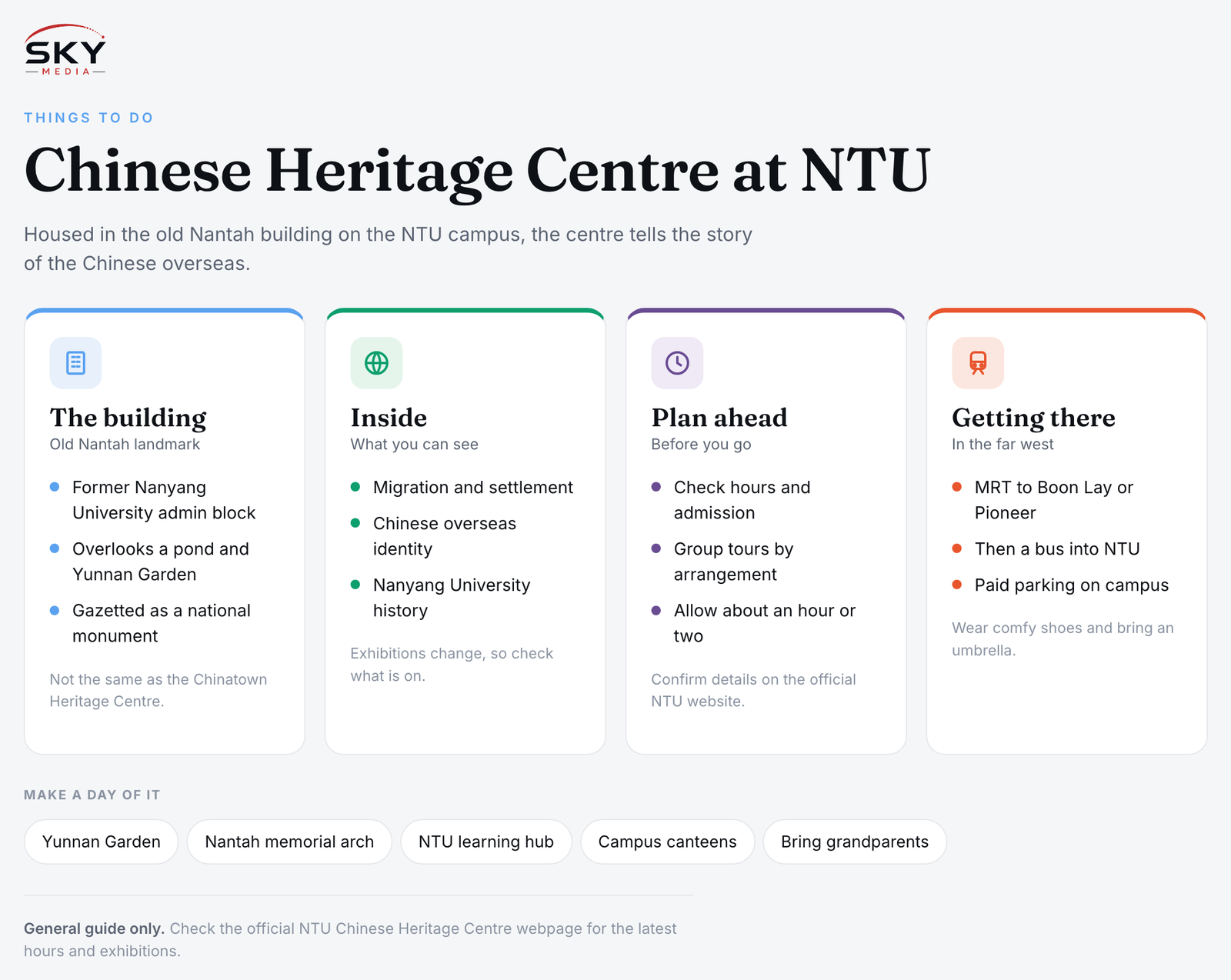
Not the Same as the Chinatown Heritage Centre
The names cause frequent mix-ups, so it is worth clearing this up first.
The Chinese Heritage Centre is part of NTU and is housed in the old Nantah building in Jurong West. Its focus is research, publications and exhibitions about the ethnic Chinese outside China, including their migration, identity and contributions.
The Chinatown Heritage Centre is a separate museum in a row of shophouses in Chinatown. It recreates the cramped living conditions of early immigrants in the district. If that is what you are after, see our Chinatown Heritage Centre guide.
There is also the Singapore Chinese Cultural Centre near Tanjong Pagar, which runs performances, talks and exhibitions about Chinese Singaporean culture today. Our Singapore Chinese Cultural Centre visitor guide covers that one.
| Place | Location | Main focus | Best for |
|---|---|---|---|
| Chinese Heritage Centre (NTU) | Old Nantah building, NTU campus, Jurong West | The Chinese overseas and the history of Nanyang University | History lovers, researchers, alumni families |
| Chinatown Heritage Centre | Shophouses in Chinatown | Daily life of early Chinatown immigrants | First-time visitors and families exploring Chinatown |
| Singapore Chinese Cultural Centre | Near Tanjong Pagar | Contemporary Chinese Singaporean culture and arts | Performances, workshops and modern exhibitions |
The Old Nantah Building and Its Story
Part of the appeal is the building itself. Nanyang University was founded in the 1950s as the first Chinese-medium university outside China, funded in large part by donations from the Chinese community across the region. Contributions came from wealthy merchants as well as from ordinary workers such as trishaw riders, hawkers and labourers, which is why the university holds such emotional weight for many older Chinese Singaporeans and Malaysians.
The administration building, with its traditional Chinese roof and green tiles, overlooks a pond and the landscaped Yunnan Garden. It was later gazetted as a national monument together with other Nantah landmarks. Nanyang University merged with the University of Singapore in 1980, and the campus later became the home of NTU. The Chinese Heritage Centre now occupies the old building, keeping its legacy alive.
Nearby, outside the main campus off Jurong West, you can also find the original Nantah memorial arch, another surviving landmark from the university’s early years. If you enjoy heritage architecture, it makes a natural add-on to your walk.
What You Can See Inside
The centre’s exhibitions centre on the Chinese overseas, with a strong focus on Southeast Asia. Exhibition themes have included:
- Migration and settlement: why people left southern China, the journeys they made, and how they built communities in places such as Singapore, Malaysia, Indonesia, Thailand and the Philippines.
- Identity: how people of Chinese descent see themselves in different countries, how language, religion and customs changed over generations, and how ideas of being “Chinese” vary widely.
- Nanyang University history: photographs and materials on how the university was founded, its student life and its place in Singapore’s history.
The centre is also known for scholarship. It has been associated with major reference works on the Chinese overseas and hosts a library and resource collection used by researchers. Some areas may be intended mainly for research use, so check what is open to casual visitors before you go.
Exhibitions are updated from time to time, so treat the list above as a guide to the kind of content you will see rather than a fixed programme. The official NTU Chinese Heritage Centre webpage is the best place to confirm what is currently on display.
Planning Your Visit
Because the centre sits on a working university campus, a little planning helps.
- Check opening days and hours first. The centre’s hours can differ on weekends, public holidays and during university events. Confirm on the official NTU website before setting off, and check whether admission is free or ticketed.
- Guided tours. Group tours may be available by arrangement, which is useful for schools, clan associations or community groups. Ask the centre directly about availability and booking.
- Language. Many visitors find bilingual panels helpful, but the level of English and Chinese text varies by exhibit. A parent or grandparent who reads Chinese can add a lot to the experience for younger family members.
- Time needed. Allow roughly an hour or two for the exhibitions, plus extra time if you want to walk around Yunnan Garden and photograph the building.
Getting There and Getting Around
NTU is in the far west of Singapore, so the journey is part of the outing.
- By public transport: take the East-West MRT line to Boon Lay or Pioneer, then a bus that runs into the NTU campus. NTU also runs internal campus shuttle services, which may be open to visitors. Use a journey planner app to check current routes before you go.
- By car: paid parking is available on campus. Follow signs for the Yunnan Garden area and check parking charges and rules on arrival.
- On campus: the campus is large and hilly in places. Wear comfortable shoes, carry water and an umbrella, and plan around the afternoon heat.
Making a Day of It in the West
The Chinese Heritage Centre pairs well with other stops if you are travelling across the island. Several NTU buildings, including a striking learning hub with its stacked, rounded towers, are worth a look from outside. Food options on campus include student canteens, which are a cheap and lively place for lunch on weekdays, though some stalls may close during university vacations.
If you are building a broader heritage itinerary, you can compare the centre with Singapore’s other community museums in our overview of history museums and heritage centres in Singapore, then plan days around the Malay, Indian and Eurasian heritage spaces as well.
Tips for Families and Older Visitors
- For grandparents: many seniors who grew up in the 1950s and 1960s remember the Nantah fundraising campaigns. A visit can spark wonderful stories, so bring them along and give them time to talk.
- For children: set a simple challenge, such as finding where their own family’s dialect group came from, or spotting how the building’s roof differs from modern ones.
- For newcomers from China: the exhibitions show how Chinese communities developed their own distinct identities in Southeast Asia over generations, which helps explain why Chinese Singaporean culture feels both familiar and different.
- Be respectful of campus life: classes and exams continue around you, so keep noise down near teaching buildings.
The Chinese Heritage Centre at NTU rewards visitors who are curious about where Chinese communities in this region came from and how they changed. Check the latest hours and exhibitions on the official NTU website, pick a cooler part of the day, and give yourself time to enjoy both the stories inside and the graceful building that holds them.
Further reading: Sun Yat Sen Memorial Hall Singapore: A Full Visitor Guide · A China-Connected Heritage Trail in Singapore