

For an island so often described as young and fast-changing, Singapore keeps an unusually rich set of places to slow down and look back. The heritage museums in Singapore range from grand national institutions to small, deeply personal community galleries tucked inside old shophouses and temples. Together they tell a layered story of migration, trade, war, independence and daily life. This guide describes the main kinds of history and heritage museums and centres you will find, and how to explore them so a visit becomes more than a walk past glass cases.
Rather than a checklist of names, think of it as a map of categories. Once you know the types, you can build a route that matches your interest, whether that is national history, a particular community, or the story of a single street.
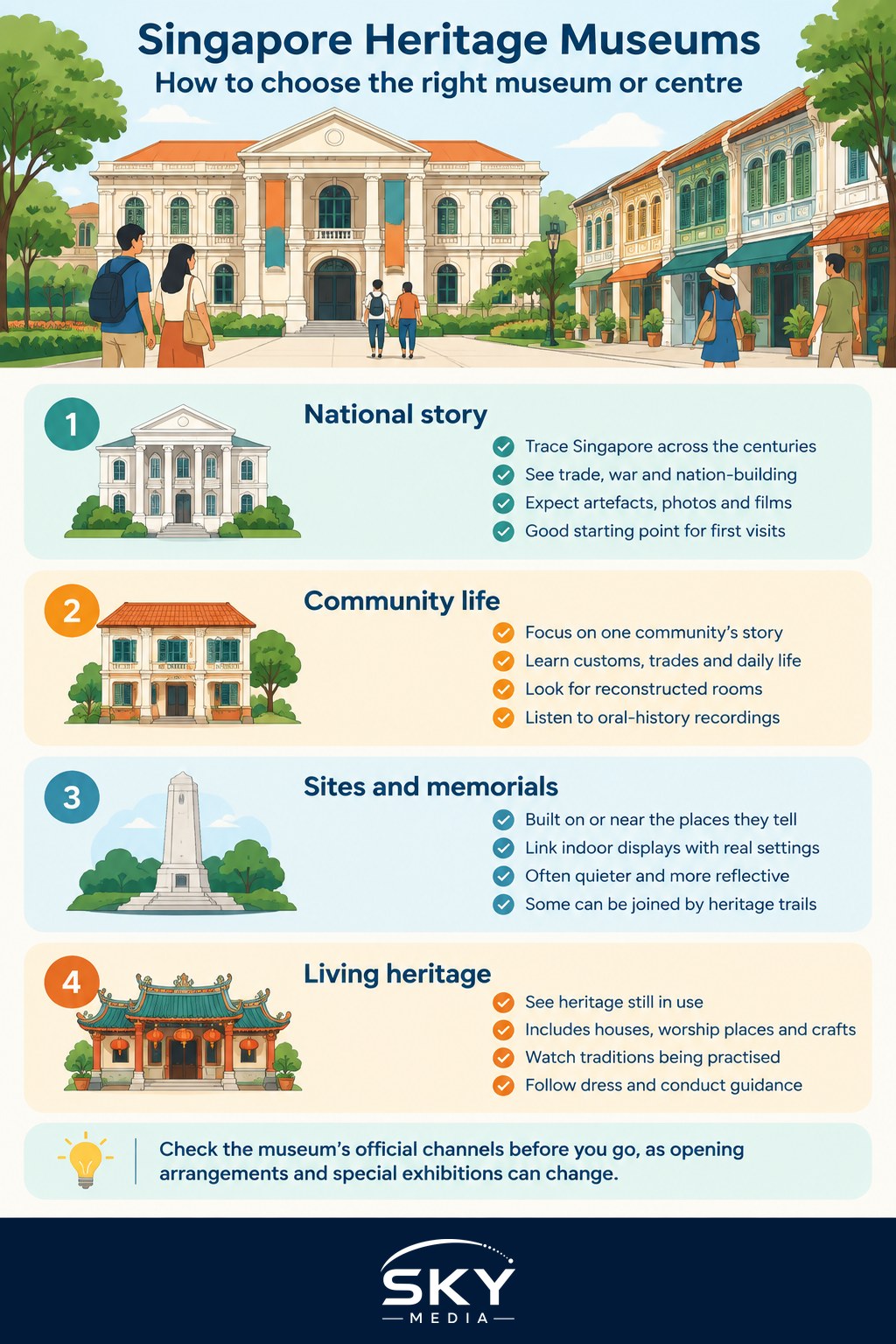
National and City History Museums
At the top of the scale are the national history institutions. These are large, purpose-built or heritage-housed museums that trace Singapore’s story across centuries, from its early days as a trading port through colonial rule, the Japanese Occupation, the road to self-government and the nation-building decades that followed.
Expect galleries arranged broadly by chronology, with a mix of artefacts, documents, photographs, film and immersive rooms. These museums are the natural starting point if you want the big picture before diving into a specific era or community. They usually offer guided tours, family trails and rotating special exhibitions, so the same museum rewards repeat visits. Because programmes and admission arrangements change, check the current details on the museum’s own channels before you go.
Give yourself at least a couple of hours here. The temptation is to read every panel; a better approach is to walk the whole timeline once at a steady pace, then double back to the two or three galleries that spoke to you most.
Community and Ethnic Heritage Centres
Alongside the national museums sit smaller heritage centres devoted to specific communities. These focus on the customs, migration stories, trades and everyday lives of particular groups, and they are often set within the historic districts most associated with those communities. They tend to be more intimate than the big museums, built around reconstructed interiors, oral-history recordings, family photographs and donated objects.
What makes these centres valuable is their point of view. Where a national museum takes the wide angle, a community centre zooms in on how a festival is actually kept, how a kitchen was run, or how a trade was learned. Practices differ between families and generations, and good centres are careful to present traditions as lived rather than fixed, so treat what you see as one honest account among many.
- Look for reconstructed rooms and shopfronts that show daily life rather than only grand events.
- Listen to the oral-history stations; a recorded voice often lingers longer than a label.
- Notice how the surrounding streets echo the exhibits, and plan to wander the district afterwards.
Site, Memorial and Wartime Museums
A third kind of museum is anchored to a place or an event. These include memorials and galleries built on or near the sites they interpret, such as former wartime locations, old barracks, colonial buildings and civic landmarks. Because the building is part of the story, these visits combine indoor displays with the atmosphere of standing where events happened.
Wartime and memorial sites in particular ask for a quieter, more reflective frame of mind. They often deal with loss and hardship, and are best approached with respect and without rushing. Many are connected by heritage trails that let you link several sites into a single themed walk. As with all these places, opening arrangements and any need to book ahead can change, so verify the specifics close to your visit.
Specialist and Living Museums
Beyond history proper, Singapore has a spread of specialist museums covering art, science, civilisations, faith, food, transport and design, plus “living” heritage spaces such as conserved houses, places of worship that welcome visitors, and traditional trade demonstrations. These sit at the border of museum and experience, where you might watch a craft being practised rather than only read about it.
Living heritage is best treated as an encounter, not just a display. If a temple, mosque or church opens part of its grounds to visitors, observe any dress and conduct guidelines, keep your voice low, and ask before photographing people at prayer. The reward is a sense of heritage as something still in use, not sealed behind glass.
Choosing Where to Go and How to Explore
With so many options, the trick is to match the museum type to your mood and time. The table below is a rough guide to help you plan rather than a strict ruling.
| If you want | Look for | How long to allow |
|---|---|---|
| The big national story | A national history museum | Half a day |
| One community up close | A community heritage centre | One to two hours |
| Place-based history | A site or memorial museum | One to two hours, plus a trail |
| A hands-on encounter | A living or specialist museum | Varies with the activity |
| A themed walk | Linked heritage trails | An afternoon on foot |
A few habits make any museum visit richer:
- Go early or late. The quieter hours give you room to linger without crowds.
- Read selectively. Choose a couple of galleries to study closely rather than skimming everything.
- Join a guided tour when offered; a good guide surfaces stories the panels leave out.
- Pair a museum with its neighbourhood. Many sit inside historic districts, so a visit naturally extends into the surrounding streets, monuments and food.
- Check before you travel. Admission arrangements, tour times, opening days and special exhibitions change, so confirm current details on each museum’s official channels.
Approached this way, a museum stops being a box to tick and becomes a doorway. You leave not just with facts but with a feel for how the many communities of this island have lived, worked, worshipped and remembered, and with a longer list of streets and stories you now want to explore in person.
Explore more
To place what you see in a wider frame, walk through our Singapore history timeline and read about the national monuments that anchor so many of these stories. For the art side of the picture, our guide to art galleries and the National Gallery is a natural next stop, and architecture lovers can continue with the black and white houses that survive from the colonial era.
Further reading: Chinese Heritage Centre at NTU: A Visitor Guide · Tampines Heritage: From Sand Quarries to Regional Centre · Lee Kong Chian Natural History Museum: A Visitor Guide