

Set within three restored shophouses on Pagoda Street, the Chinatown Heritage Centre tells the story of the early Chinese immigrants who shaped this corner of Singapore. It is one of the few places in the city where you can step inside a recreated shophouse interior and sense how families, coolies, samsui women and shopkeepers actually lived. This guide explains what the centre is, what you can expect to see, how to plan a respectful visit, and why it matters to Singapore’s shared history.
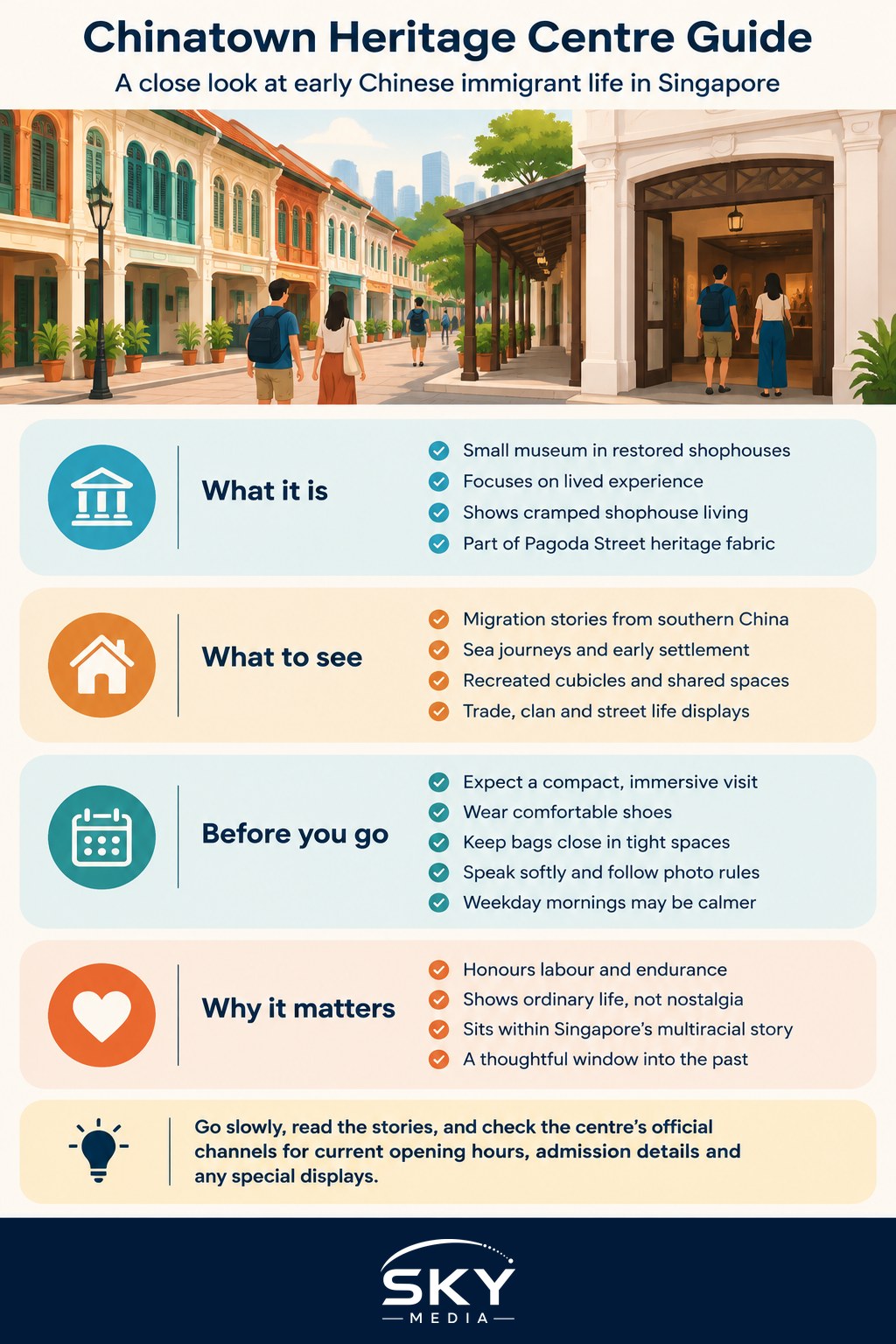
What the Chinatown Heritage Centre Is
The Chinatown Heritage Centre is a small but immersive museum that focuses on the lived experience of Singapore’s early Chinese community. Rather than displaying grand artefacts behind glass, it reconstructs the cramped, subdivided living quarters that were common in Chinatown’s shophouses through much of the twentieth century, when many arrivals from southern China rented a single cubicle or a shared bunk.
The building itself is part of the story. Pagoda Street sits within a conservation area, and the shophouse form, with its narrow frontage, deep interior and five-foot way, is a distinctive part of Singapore’s architectural heritage. The centre works within this real fabric, so the walls, staircases and airwells you move through are part of the history you are learning about.
Because exhibitions and operating arrangements can change over time, treat this guide as an overview. For current opening hours, admission details and any special displays, check the centre’s official channels or the National Heritage Board before you go.
What You Can Expect to See
A visit generally moves from the broad story of migration into the intimate detail of daily life. Displays trace why people left southern China, the sea journeys they made, and the tightly packed districts they settled into once they arrived. Personal accounts, photographs and everyday objects help turn statistics into human stories.
The recreated interiors are usually the most memorable part. Visitors often describe walking through:
- Reconstructed cubicles that show how several people shared a single rented space
- A tailor’s or trade workspace that doubled as a home
- Kitchen and communal areas that many families shared along a corridor
- Displays on the trades, clan associations and street life that held the community together
Look out for the quieter details, such as the way light falls through an airwell or the worn timber of a staircase. These features say a great deal about comfort, privacy and resilience in a crowded quarter. Because specific exhibits are refreshed from time to time, do not assume any single room or object is permanent; enjoy what is on show during your visit.
Planning a Respectful and Comfortable Visit
The centre is compact, so it rewards a slower, attentive pace rather than a quick walk-through. Reading the personal stories and captions is where the experience comes alive. Many visitors find that setting aside an unhurried hour or more allows the space to make its impression.
A few practical notes that tend to hold true:
- Wear comfortable shoes, as there are stairs and narrow passages between floors.
- Keep bags close in the tighter cubicle spaces so you can move without knocking displays.
- Follow any photography guidance shown on site, as some areas may have restrictions.
- Speak softly, since the recreated interiors invite a reflective mood.
- Consider visiting on a weekday morning if you prefer a calmer atmosphere.
Getting there is straightforward, as the centre sits in the heart of Chinatown near the MRT and within easy walking distance of temples, markets and food streets. This makes it easy to pair your visit with a wider afternoon in the district. For the freshest details on tickets, accessibility and any guided experiences, rely on the centre’s own current information rather than older listings.
How It Compares With Other Heritage Museums
Singapore has a family of community and specialist heritage museums, and each offers a different lens. The table below gives a general sense of how the Chinatown Heritage Centre sits alongside a few others, so you can plan a route that suits your interests. Details and displays evolve, so confirm specifics before visiting.
| Museum | Main focus | Typical experience |
|---|---|---|
| Chinatown Heritage Centre | Early Chinese immigrant daily life | Recreated shophouse interiors and personal stories |
| Peranakan Museum | Peranakan culture and identity | Objects, heritage and cross-cultural history |
| Malay Heritage Centre | Malay community history and arts | Community galleries in a historic setting |
| Indian Heritage Centre | Indian and South Asian heritage | Themed galleries on migration and culture |
Reading these together, the Chinatown Heritage Centre stands out for its emphasis on domestic, ground-level experience. Where some museums foreground craft, objects or grand narratives, this one asks you to imagine the texture of ordinary days in a shared shophouse.
Why the Chinatown Heritage Centre Matters
The centre matters because it preserves a chapter of Singapore’s story that is easy to romanticise from the outside. The colourful streets and heritage shopfronts of today grew out of hard, crowded and often precarious lives. By recreating the cubicles and communal spaces, the centre honours the labour and endurance of the people who built the district, and it invites reflection rather than nostalgia.
It also plays a wider role in Singapore’s multiracial heritage. The Chinese immigrant experience is one thread in a larger fabric that includes Malay, Indian, Eurasian, Peranakan and many other communities. Understanding one community’s journey with care makes it easier to appreciate the others with the same respect. Institutions supported by the National Heritage Board help keep these varied stories accessible to residents and newcomers alike.
For newcomers to Singapore, a visit is a gentle and human introduction to the country’s past. For long-time residents, it can be a moving reconnection with family memory, since many can recognise something of a grandparent’s or great-grandparent’s world in the recreated rooms. Either way, it encourages a habit of looking closely at the shophouses, streets and everyday spaces that are still all around us.
If your visit leaves you curious to follow other threads of Singapore’s heritage, the district and nearby institutions offer plenty. You might continue with the Peranakan Museum, explore the Malay Heritage Centre, learn South Asian stories at the Indian Heritage Centre, or step into a preserved family home at NUS Baba House.
Explore more: Peranakan Museum, Malay Heritage Centre, Indian Heritage Centre, NUS Baba House.
The Chinatown Heritage Centre is modest in size but generous in feeling. Approach it slowly, read the stories, and let the shophouse walls do their quiet work. It is one of the most human windows into how modern Singapore came to be, and a thoughtful first stop for anyone wanting to understand the city beyond its skyline.
Frequently Asked Questions
Do I need to book Chinatown Heritage Centre tickets in advance? Booking requirements can change, so check the centre’s official website or the National Heritage Board for current ticketing and any timed entry. If you plan to visit on a weekend or public holiday, or in a group, booking ahead is wise to avoid disappointment.
Is the Chinatown Heritage Centre suitable for young children and seniors? It can be, with preparation. The centre is housed in restored shophouses with stairs and narrow passages, so check accessibility details with the centre before you go. Wear comfortable shoes, move at a slow pace and plan rest breaks, especially with very young or elderly visitors.
What else can I do nearby after visiting? The centre sits in the heart of Chinatown, within easy walking distance of temples, markets and food streets, so it pairs well with an afternoon exploring the district. Pick one or two stops rather than rushing through everything, and check each place’s opening hours.
How is a visit different from just walking around Chinatown? Walking shows you the streets, while the centre explains the lives behind them, with recreated cubicles, personal stories and everyday objects. It adds context to the shophouses and trades you see outside. Visiting first can make the neighbourhood much easier to read afterwards.
Are there discounts for residents, students or seniors? Admission schemes can change, so check the centre’s official channels or the National Heritage Board for current rates and eligibility. Bring proof of identity or status if a concession applies, and ask about group or school visit arrangements when you book.
Further reading: Chinese Heritage Centre at NTU: A Visitor Guide · The Old Kreta Ayer and Chinatown Market