
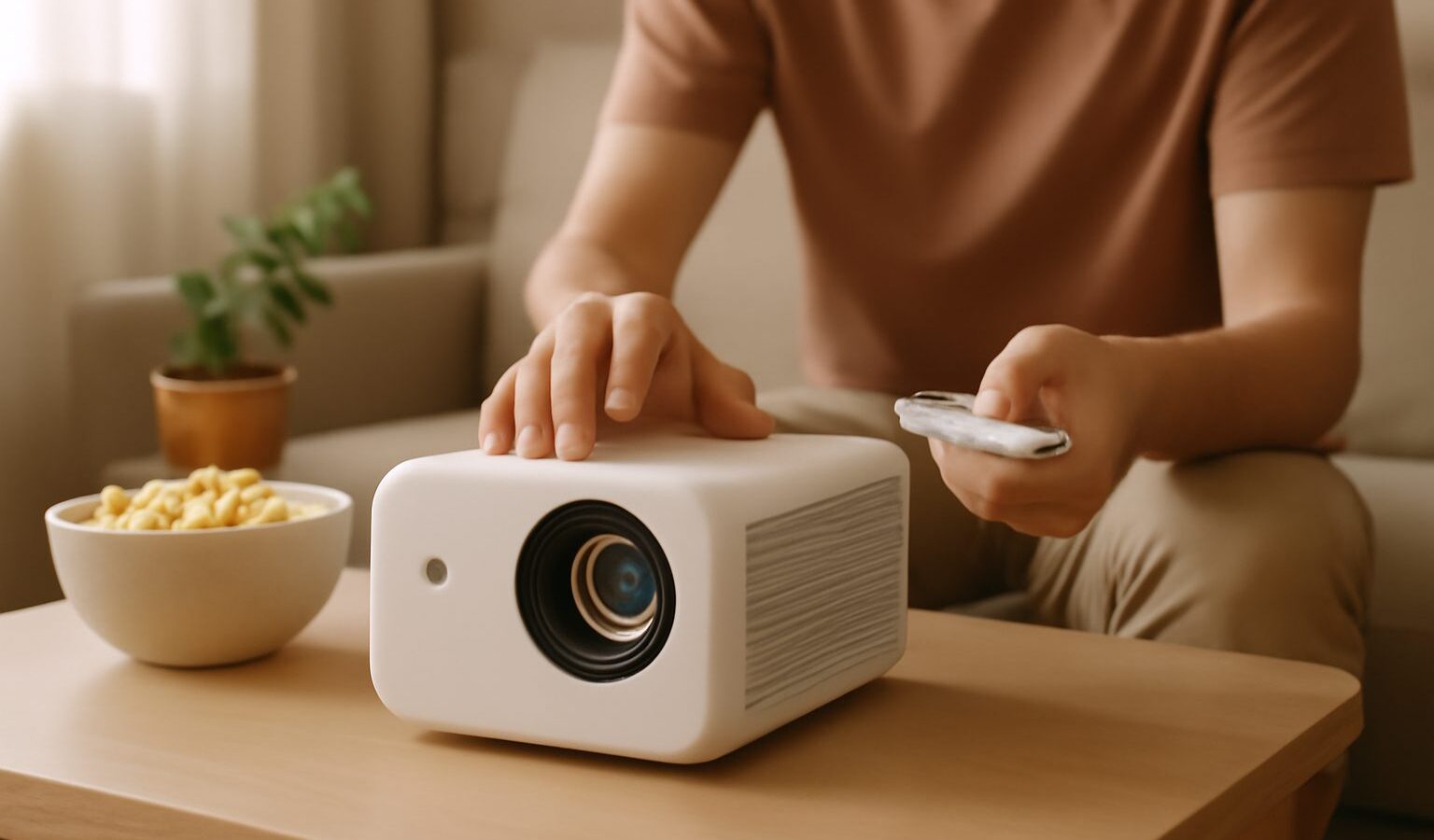
Buying a home projector in Singapore is tempting once you have seen a 100 inch picture fill a wall for less than the price of a giant television. Done well, a projector turns an ordinary HDB living room into a cinema on movie nights and packs away when you are done. Done badly, you end up with a dim, washed-out image you can only enjoy with every light off and every blind drawn. The difference comes down to a handful of decisions: how far the projector sits from the wall, how bright it needs to be for our well-lit rooms, the native resolution, and whether you project onto a proper screen or bare paint. This guide walks through each choice in the context of local flats and the way people here actually watch.
Projector or a Big TV for Your Flat
Before spending anything, be honest about how you watch. A large television is brighter, simpler, and better for daytime viewing, casual news, and bright rooms, which describes most Singapore homes with big windows and strong afternoon light. A projector wins on sheer scale and that immersive cinema feel, and it hides away when not in use, which suits smaller flats where a permanent 100 inch screen would dominate the room.
Think about your typical viewing. If most of your screen time is daytime television, sport with the lights on, or background viewing while you cook, a TV is the more practical pick, and our guide to buying a TV in Singapore covers that path. If you dream of dark-room movie nights, gaming on a huge canvas, or a setup you can roll out only when guests come over, a projector earns its place. Many households end up with both: a modest TV for everyday use and a projector for occasion viewing.
Throw Distance and Small Rooms
The single biggest projector mistake in a flat is ignoring throw distance, which is how far the projector must sit from the wall to produce a given image size. A standard, long-throw projector often needs roughly three metres or more of distance to fill a large screen, which is more depth than many HDB living rooms comfortably offer once you account for the sofa and walkway.
Every projector has a throw ratio in its specifications, and manufacturers publish a distance-to-size chart or an online calculator. Before you buy, measure the actual gap between where the unit would sit and the wall you plan to use, then check that the model can produce the size you want at that distance. Ceiling mounting a long-throw projector at the back of the room is one classic solution, but it means cabling and a more permanent install. In tighter rooms, the answer is usually a short-throw or ultra-short-throw design instead.
Short-Throw and Ultra-Short-Throw Explained
Short-throw and ultra-short-throw (UST) projectors are built for exactly the space problem above. A short-throw model produces a big image from a metre or two away. An ultra-short-throw sits on a low console right against the wall, just centimetres from it, and beams the picture upward to fill the surface, so nobody walks through the beam and casts a shadow.
UST projectors, often sold as laser TV systems, are the closest thing to a genuine big-TV replacement for a small flat, and many are bright enough for use with some ambient light. They cost more than standard projectors and demand a very flat, straight wall or a special screen to look their best, since any bumps or bowing show up at that steep angle. If your room is short on depth, a short-throw or UST design is usually the realistic choice; just budget accordingly and compare current models at the retailer, since prices and specifications change often.
Brightness for Bright Singapore Living Rooms
Brightness is where many home projectors disappoint here, because our living rooms are rarely dark. Projector brightness is measured in lumens, and more lumens means a picture that holds up better against ambient light. A dim projector can look stunning in a blacked-out room and almost invisible once you open the curtains.
For a room you can darken well, a modest brightness rating is fine. For a typical bright flat where you want to watch with some light on, look for a higher lumen rating and be sceptical of vague marketing brightness numbers that are not stated in standard lumens. Two honest fixes help enormously: control the light with blackout curtains or blinds, and pair the projector with a proper screen rather than a wall. If daytime, lights-on viewing is your main use, this is another point in favour of a TV, since even a bright projector struggles against direct sunlight.
Native Resolution, Screens and Portable Options
Two more details separate a satisfying picture from a soft one. First, check native resolution, not just the highest signal the projector will accept. Some cheaper units accept a 4K signal but display it at a lower native resolution, so the image is not truly sharp. Match the native resolution to your use: higher resolution rewards you more on a very large image viewed up close.
Second, decide between a screen and a bare wall. A dedicated projector screen gives a flatter surface, more even colour, and better contrast than painted plaster, and screens come in fixed-frame, manual pull-down, and motorised versions to suit different rooms. A smooth, matte, light-coloured wall can work for casual viewing on a budget, but a screen is the single biggest easy upgrade to picture quality.
Finally, portable projectors are a distinct category worth knowing. Compact, often battery-powered units are great for spontaneous viewing, a movie on the ceiling, or a gathering in the garden, but they are dimmer and lower in resolution than a home model, so treat them as fun extras rather than a main-screen replacement.
Projector Types Compared for Different Rooms
Use this table to match a projector type to your space and how you watch. Always confirm the exact throw distance and brightness on the current model at the store, since figures vary widely.
| Projector type | Best room for it | Ambient light tolerance | Notes |
|---|---|---|---|
| Standard long-throw | Larger living room with depth to spare | Better with lights dimmed | Often ceiling mounted at the back; needs the most distance |
| Short-throw | Typical HDB living room | Moderate | Big image from a metre or two; less shadow trouble |
| Ultra-short-throw (laser TV) | Small flat, sits against the wall | Good on many models | Closest to a big-TV replacement; needs a flat wall or special screen |
| Portable | Anywhere temporary, indoor or outdoor | Poor, best in the dark | Convenient and fun, not a main-screen replacement |
Where to buy: the big electronics retailers such as Courts, Harvey Norman, Best Denki and Challenger stock mainstream projectors and let you see brightness in person, the Sim Lim area and specialist audio-visual shops carry a wider range including UST and screens, and official brand stores plus Shopee and Lazada cover the rest. For a used bargain, Carousell has plenty, but test the lamp or laser hours and image quality before you commit.
Explore More
A projector is one piece of a bigger setup, so plan the whole room together. If you are still weighing your main screen, compare the projector route against buying a TV in Singapore, and once you have chosen, tie in sound, sources and streaming with our guide to setting up a home entertainment system in Singapore. Both help you spend on the parts that matter and skip the ones that do not.